
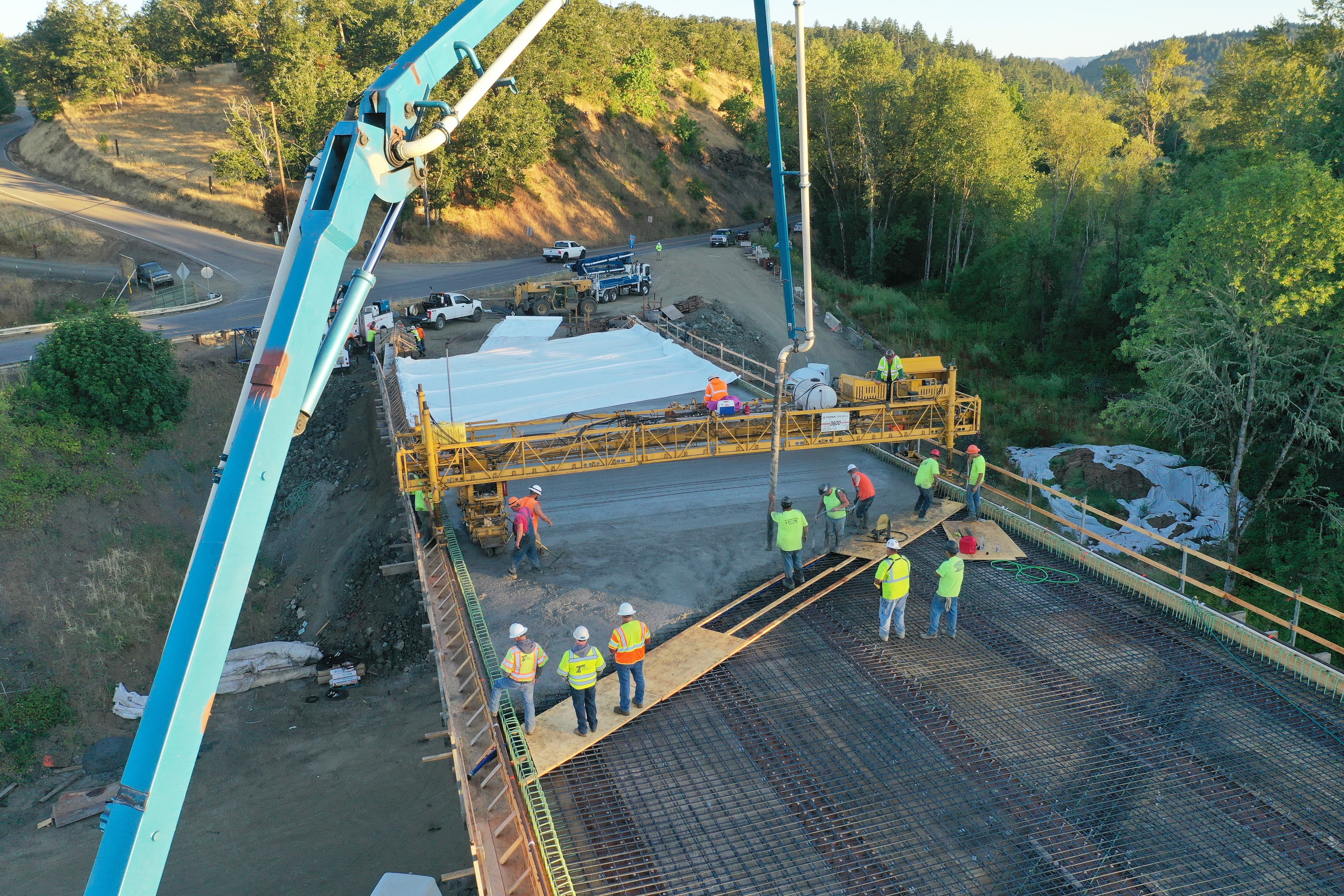
Vogtle had too many people in the same place
In July 2023, Tom Newsome, director of utility finance at the Georgia Public Service Commission, testified during one of the commission's semi-annual progress updates on Plant Vogtle Units 3 and 4. According to Georgia Public Broadcasting, he tied part of the overruns to labor productivity, with workers essentially getting in each other's way. He did not blame the craft. "The people out there trying to get the work done were doing the best they could," he said. "[But] they just had too many people out there."
Newsome was talking about crew size.
Three years earlier Southern Company had already tried cutting the workforce. In April 2020, as COVID-19 spread, it announced a cut of about 20 percent to a Vogtle construction workforce of roughly 9,000, with the reductions expected to run late into the summer. Its SEC filing, as quoted by Utility Dive, said the cut was "expected to provide operational efficiencies by increasing productivity of the remaining workforce and reducing workforce fatigue and absenteeism." Liz Coyle, executive director of the consumer group Georgia Watch, told the publication that commission staff had flagged the crew size as an issue in earlier proceedings, and that "there were so many people on site that it might have been counterproductive."
The same question comes up on a data hall when the three-week lookahead slips and somebody asks for six more electricians. Find out what the six would install on their first Monday.
Electricians ranked materials and information ahead of manpower
Electricians answered this themselves. In his 1994 paper "The Last Planner," Glenn Ballard reported a NECA survey of union electricians in the Alameda County local about what stopped planned work. "Materials, craft coordination (prerequisite work), and information were the three most frequent causes," Ballard wrote, "suggesting that the most bang for the buck could be had from improving plan quality." Those electricians, working mostly on smaller and simpler projects, estimated that 4.2% of paid labor time was lost to material delays. On one project, foremen whose share of planned work completed ran above 50 percent were 25 points more productive (a performance factor of 1.25 against 1.00) than foremen below it.
Thirty-two years later the list looks familiar. The 2026 AGC and NCCER Workforce Survey, released September 3, 2026, drew 1,830 responses. Shortages of a firm's own or its subcontractors' workers were the most cited cause of delay, at 42 percent. Longer lead times or shortages for electrical equipment came in at 29 percent, and governmental delays like missing approvals or inspectors at 26 percent.
Electrical contractors report the same split. In EC&M's 2026 Top 50 report, 83% of firms named labor shortages as an issue, and the biggest need was electricians. Revenue came in stronger than expected at Gaylor Electric in Indianapolis, but Jim Crews, the company's president, says receipts "could have been larger if we had had sufficient supplies of materials." A lineup still waiting on switchgear gives six new electricians nothing to terminate.
Crowding has a measured limit
Awad S. Hanna of the University of Wisconsin-Madison put numbers on crowding in a 2004 Electrical Contractor column, using data gathered from several electrical contractors. He found "0 percent lost efficiency at a worker density of 191 square feet per worker and a 50 percent loss of efficiency at a worker density of 90 square feet per worker." The model covers only projects of 2,000 to 150,000 man-hours. He also wrote that University of Wisconsin research put the minimum at "200 to 250 square feet" per construction worker for full productivity, depending on how complex the work is.
Timing makes it worse. In a University of Wisconsin survey of NECA members, contractors placed "nearly half" of trade stacking in the final quartile of construction and almost one-third in the third quartile. On a well-run job, Hanna wrote, that last quartile is the "run-down" period, when the contractor can reduce its work force.
Take the net working area (floor space minus shafts, production lines and permanent fixtures), divide it by 200 to 250 (Hanna's data shows losses starting below 191), and count every trade standing in it, yours included, before you add a name to the roster.
Loss-of-productivity claims often price crowding with the factors the Mechanical Contractors Association of America first published in 1971. William Ibbs and Xiaodan Sun at UC Berkeley reviewed them in 2016 and found the loss percentages are not supported by real project data, so read the numbers below as pricing estimates. Boards do award them. In the Appeal of Stroh Corporation (1996), a contractor forced to use a four-man crew in place of its planned two-man crew was awarded 10% for crew-size inefficiency.
| Factor | Minor | Average | Severe |
|---|---|---|---|
| Crew size inefficiency | 10% | 20% | 30% |
| Concurrent operations (stacking of the contractor's own force) | 5% | 15% | 25% |
| Learning curve | 5% | 15% | 30% |
| Dilution of supervision | 10% | 15% | 25% |
Count ready work positions before you count people
A work position is a place where one electrician or a small team can install today, with the drawings and material in hand and a lead close enough to answer questions. Greg Padalecki, president and CEO of Alterman Inc. in San Antonio, describes the prefab version of it in a 2023 Electrical Contractor story. "We would have a bin of prefab materials developed to space, materials, directions and tools needed for one day," he says. Planning that used to happen at the work site moved to the office, "leaving foremen to manage people."
Collins Electric did the job-site version on Kaiser Medical Center in Modesto, Calif., according to a 2006 Electrical Contractor article. Expecting a large crew, the company had one or two Graybar employees on site every day, stocking pipe, wire, fittings and boxes "at levels set by our foreman who anticipates our needs for a week or two weeks, depending on the phase of construction," says Brian Gini, then the Modesto branch manager for Collins. The foreman also laid out how he wanted material packaged for each floor, and an apprentice moved the pallets to the installation area. "When we get materials in front of the installers, it adds to our productivity," Gini says.
Stan Shook, the magazine's estimating columnist, wrote in 2008 that "you'll be lucky to get six fully productive labor hours per day, per electrician," while you still pay for eight. Adding electricians also adds costs for drug testing, badging and security, training "and other required nonproductive time," he wrote. Count ready positions first, and budget about six productive hours out of each eight-hour day for whoever fills them.
Foremen are hard to hire too
AGC's 2026 survey found electricians are the hardest craft to fill, with 81 percent of firms that had electrician openings reporting difficulty. Field leadership is nearly as hard to hire. Superintendent openings were hard to fill for 75 percent of firms, and project managers and supervisors for 74 percent.
A ramp that puts eight new people under a foreman already running two areas adds work to the one person nobody can easily hire. The Construction Industry Institute's research team 330 on frontline supervision found, from self-reports by hundreds of foremen and general foremen, that many spend more or less time than the target on their daily tasks. We covered the warning signs in when the crew needs a foreman.
Rules can set the ratio for you. Under California Labor Code section 108.4(a)(3), an uncertified electrician trainee may do certified work only if the employer attests the trainee will be "under the direct supervision of an electrician certified pursuant to Section 108 who is responsible for supervising no more than one uncertified person." The trainee also has to be registered with the Labor Commissioner and enrolled in an approved curriculum, per section 108.4(a)(1) and (2). Four more trainees on that kind of California work means four certified electricians to pair them with, one for one.
Decide the bigger crew four weeks out, and write down when it leaves
Jennifer Daneshgari, VP of financial services at MCA Inc., and Hannah Durant, a business operations analyst there, wrote in EC&M in August 2026 that a labor plan works as an early warning system. "If a project needs a larger crew in four weeks, that information is much more useful today than it is three days before the need arrives," they wrote. They suggest re-evaluating the plan at 25, 50 and 75 percent complete at a minimum. Wait too long and "the conversation becomes a postmortem."
Set a base crew for the work that is open now. Tie an upper crew to a release the field can verify, like a second area released with current drawings, staged material and a named foreman, and give that release an owner and a decision date before anyone books travel. Write the exit condition the same day, as an accepted quantity or a system released to testing. Rob Smith, CEO of Sargent Electric in Pittsburgh, told EC&M that labor decides which jobs his company chases at all. "Can we get the people, predict their productivity, and what's the impact of where the job is?" he says.
OSHA's coordination guidance asks host employers and staffing agencies to work together on unexpected staffing needs, either by having enough trained and equipped workers available or by allowing "adequate lead time" to train and equip them. AGC found 83 percent of firms report at least some turnover among new field employees in their first 90 days, and 42 percent say new hires fail to show up or quit shortly after starting. A planned first-day orientation is part of the ramp.
One IBEW local asked for the same patience on data centers. At the Quantum Frederick campus in Frederick, Md., Baltimore Local 24, with 2,400 members, conservatively expected to need 1,000 members on site by August 2025, and the peak "could be double that. Or triple," according to the union's Electrical Worker in May 2025. "Our hope is that they ramp up slowly and it isn't 'We need 1,000 in six weeks, then another 1,000,'" says Carmen Voso, the local's business agent.
Sources
- PSC expert: Plant Vogtle expansion bad deal for Georgia Power customers, Georgia Public Broadcasting, July 28, 2023.
- Southern cuts 20% of Vogtle expansion staff for labor efficiency, worker safety as coronavirus spreads, Utility Dive, April 17, 2020.
- The Last Planner, Glenn Ballard, Northern California Construction Institute, Monterey, Calif., April 22 to 24, 1994.
- 2026 Workforce Survey Analysis, Associated General Contractors of America and NCCER, September 3, 2026.
- Data Center Buildout Fuels Revenue Blowout: EC&M's 2026 Top 50 Electrical Contractors Special Report, Tom Zind, EC&M, September 15, 2026.
- The Stacking of Trades, Awad S. Hanna, Electrical Contractor, August 15, 2004.
- Proposed Improvements to the MCAA Method for Quantifying Construction Loss of Productivity, William Ibbs and Xiaodan Sun, University of California, Berkeley, May 2016.
- Ready-Made for Productivity: Prefabrication reduces work hazards, yields more efficient job sites, Susan DeGrane, Electrical Contractor, May 15, 2023.
- Distribution and Productivity, Susan Casey, Electrical Contractor, February 15, 2006.
- Calculating Manpower, Stan Shook, Electrical Contractor, May 15, 2008.
- Improving Frontline Supervision in Industrial Construction (RT-330), Construction Industry Institute, December 1, 2018.
- California Labor Code section 108.4, California Legislative Information, added by Stats. 2012, Ch. 46, Sec. 79 (SB 1038).
- Staying Ahead of Electrical Job-Site Changes, Jennifer Daneshgari and Hannah Durant, EC&M, August 17, 2026.
- Communication and Coordination for Host Employers, Contractors, and Staffing Agencies, Occupational Safety and Health Administration, accessed September 29, 2026.
- The Data Center Surge: A New Generation of IBEW Jobs, The Electrical Worker, IBEW, May 1, 2025.
Featured image: Oregon Department of Transportation (public domain).