
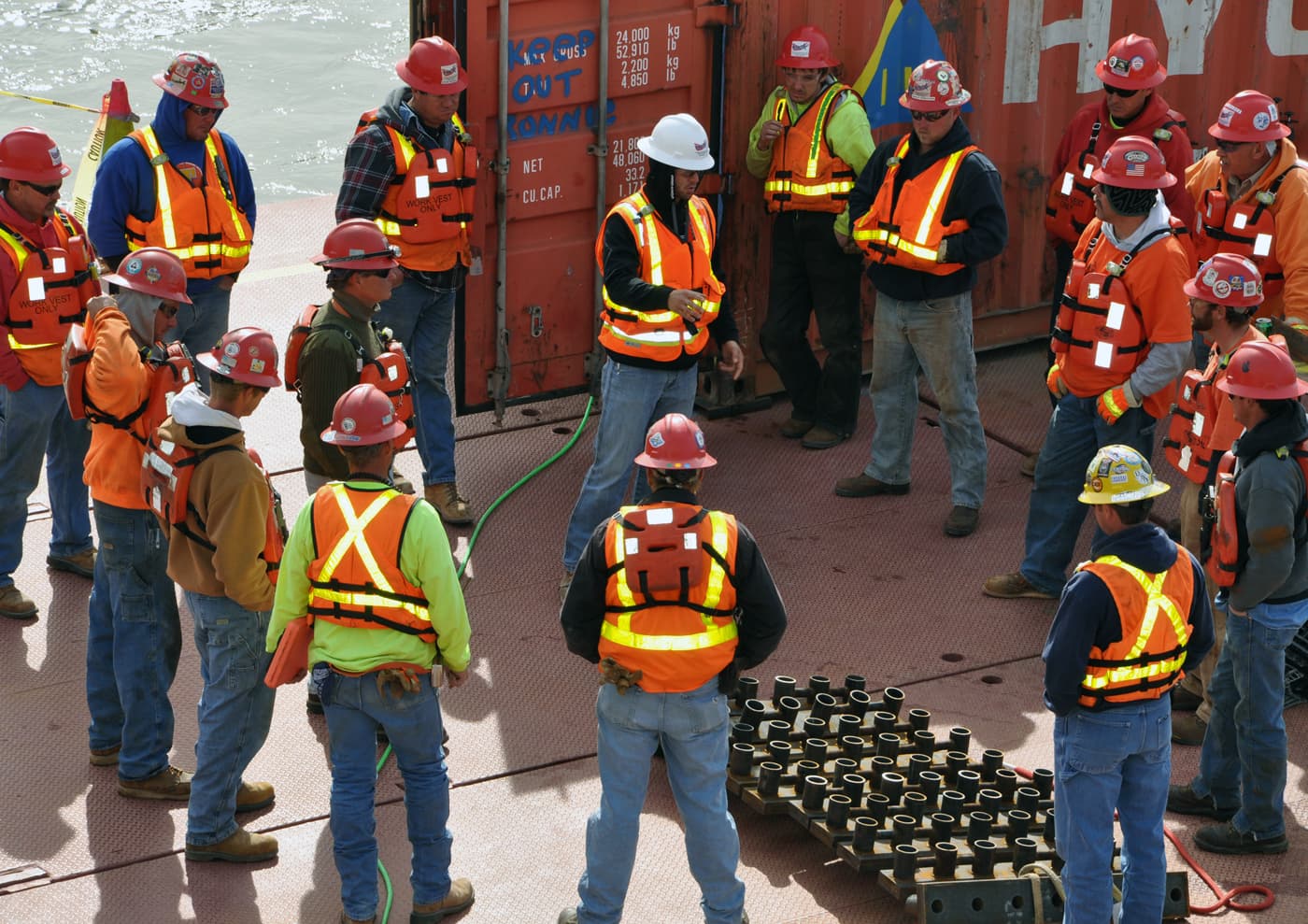
The badges work and the roster is signed. A supplemental crew of electricians finishes the orientation video, walks out of the trailer and stands around, because nobody has told them which foreman they report to or where the first workfront is.
The sign-in sheet says they were oriented.
Standing around is the smaller cost. Travelers' 2026 Injury Impact Report, built on more than 1.2 million workers' comp claims the insurer received from 2021 to 2025, found that first-year employees accounted for 44% of injuries in construction. Construction also had the highest average lost time of the industries Travelers listed, at 114 days. The claims in the study were indemnity claims only, meaning the injured worker could not go straight back to work.
A journeyman new to the site is still a new worker
The Institute for Work & Health in Ontario looked at lost-time claims from 1999 to 2008 and found that workers in their first month on a job had more than three times the lost-time injury risk of workers with over a year in the job. The first-month risk was highest for workers over 45. New-worker risk also ran higher in the goods sector, which includes construction. "The key risk factor is newness, not youth," says Curtis Breslin, the IWH scientist who led the research. The data comes from Ontario's Workplace Safety and Insurance Board, and the newest year in it is 2008.
OSHA made the same point about staffed labor in a July 15, 2014 policy memo on its Temporary Worker Initiative. Thomas Galassi, then director of the Directorate of Enforcement Programs, wrote that "most temporary workers will be 'new' workers multiple times a year." A traveling electrician who moves from one data hall to the next fits that description.
The AGC and NCCER 2026 Workforce Survey drew 1,830 respondents in July and August. Eighty-three percent of firms reported at least some turnover among new field employees in their first 90 days, and the reason given most often was a mismatch between what workers expected and what construction work turned out to be. Physical demands came second. At Ace Electric, the Valdosta, Georgia, electrical contractor, the turnover runs highest on the traveling data center teams. "The travel team data center work does have the highest turnover particularly in the field and the electricians and helpers level," says Mindy Bates, the company's human resources director. She spoke at an AGC webinar covered by Construction Dive. Ace puts new hires through a weeklong orientation at its Ace University building before they go to a project.
Boyd Worsham, president and CEO of NCCER, has spent 45 years in construction and has been visiting large data center projects around the country. "Those jobs are overwhelming to somebody like me who's been in the industry for 45 years," he says in ACHR News. "And we take young people who have never walked on a construction job in their life, and we put them on the biggest projects in our country. Of course, they're going to be overwhelmed."
Settle who trains what before anyone travels
OSHA treats the staffing firm and the host contractor as having shared responsibilities. Its Protecting Temporary Workers page gives the usual split as an example, with the staffing agency providing general safety and health training and the host providing "specific training tailored to the particular workplace equipment/hazards." Temporary Worker Initiative Bulletin No. 15, the 2025 bulletin on construction, says the host should give the staffing agency "all task assignments, written job descriptions, job hazard analysis, and a list of equipment and/or machinery on the worksite." Send it before anyone is dispatched.
Bulletin No. 4, from 2016, covers timing and language. Training "must be completed before the worker begins work on a project," it says, and it has to be in "a language and vocabulary the worker understands." As a recommended practice, the two employers should settle which of them covers each part of the training and tell each other when it is done. Neither one can use a contract to get out of its own duties under the OSH Act.
Scope changes are where this tends to go wrong. If the job moves from cable tray to equipment terminations after the order was placed, tell the staffing firm before the crew gets in the truck. NIOSH publication 2022-126, whose listed authors include the American Staffing Association, says site- and task-specific training should spell out the tasks a worker is approved for, "including any hazardous tasks they will NOT perform." Supervisors should not ask staffed workers to take on new tasks without first getting written approval from the staffing company, the document says. The seven-day readiness check is a good place to catch that kind of mismatch.
T&D World reports that contractors who come in to help ComEd must be onboarded to its safety rules and learn the language used to talk to dispatchers at the operations control center. "That's what keeps us safe, and that's our best practice because safety comes first," says Michael Daddio, an underground lead crew leader at ComEd with 35 years in the industry. "We want to turn everybody's lights on as fast as possible, but if we don't do it safely, then it's for nothing."
Marc Hutson, senior vice president and director of construction operations at JE Dunn, says his company does $60 million to $70 million of work in place a month on a hyperscale data center, against about $15 million on a big $200 million hospital. He told ENR in July that he plans to roll out Caterpillar Safety Services' approach on all of JE Dunn's data center work in 2026. Craft workers will not be allowed to work until they complete a day-long course, and superintendents not until they finish a three-day one.
OPPD's bird dogs show what a named handoff looks like
The Omaha Public Power District has a name for the person who meets outside crews. After a July 2023 storm left more than 188,000 customers without power, OPPD put 13 bird dogs with 142 outside workers. The formal title is external crew coordinator. Gary Wohlman, a line maintenance technician who started as a bird dog 15 years ago, worked 15- and 16-hour days that week.
Crews usually meet at an OPPD center and huddle while OPPD officials brief them on safety procedures and take down names, safety equipment and the number of people working (the count also helps with hotel rooms and meals). In the field, Wohlman talks with dispatchers so he knows "without a doubt" which lines are de-energized and where crews can safely work. He asks crews to leave one member behind at an OPPD shop to grab parts. "You have a lot of equipment that's going to be necessary, but you usually won't have everything," he says.
"I'm basically a guide to answer whatever questions they have going forward," says Mark Gorseth, another OPPD line maintenance technician, who took his first bird dog assignment in 2013. "The biggest thing is communication. I let them know that I'm their go-to guy."
Eli Schiessler, OPPD's Construction Management Team storm duty manager, says bird dogs give "one point of contact for our mutual aid crews so that they can effectively do their work." Eversource's safety guidelines for outside storm crews use the same word, telling crews to ask "your owners representative and/or bird dog" for circuit voltages and arc flash potential.
Danny Raines, who retired from Georgia Power after 40 years, wrote in Incident Prevention that making arriving crews wait in staging areas "for their marching orders due to a lack of planning is not ideal." He recommends an advance team that meets the host for the safety briefing before the crew shows up. He also wants local employees guiding the out-of-town crews. On a data hall the same job belongs to one named person who meets the crew at the badging office and walks them to the receiving foreman.
Site rules and the task briefing are two separate talks
Site orientation covers what is true everywhere on the project: alarms, evacuation routes, the assembly area, restricted zones and how to report an injury. That last item is a recordkeeping duty. Under 29 CFR 1904.35(b)(1)(i) an employer must set up "a reasonable procedure" for reporting injuries, and (b)(1)(ii) requires telling each employee what it is. Under 1904.31(b)(2), a host that supervises staffed workers on a day-to-day basis records their injuries.
The task briefing changes with the assignment. For power line work, 29 CFR 1926.952 requires the employee in charge to give a job briefing before each job, and (c)(1) sets a floor of at least one before each day or shift. Under (c)(2), another briefing is due "if significant changes, which might affect the safety of the employees, occur during the course of the work." Eversource's guidelines call for documented job briefings before each job and "when the scope of the job changes." In California, 8 CCR 1510(a) requires hazard instruction when workers are first employed, and 8 CCR 3203(a)(7)(C) requires training for any new job assignment the worker has not been trained on before.
One talk happens once per project. The other repeats.
A knowledge check tells you more than a signature sheet
NIOSH 2022-126 recommends a knowledge assessment after training and before the assignment starts, in a language the worker understands, with the training repeated if the answers show gaps. For power line crews, Note 2 to 29 CFR 1926.950(b)(7) lets an employer accept a worker's earlier training by confirming it, using "an examination or interview" to check the worker understands the safety-related work practices, and supervising closely until the worker shows proficiency. A July 26, 2010 OSHA interpretation says there is no OSHA requirement that a construction site's communication system be based on English, as long as the communication can reliably occur.
Ask where the assembly point is, who directs the work today and how to report a hazard. When someone gets one wrong, go over that part again and ask again.
The same NIOSH document suggests pairing each new worker with an experienced peer, because people "may feel more comfortable speaking up to their peers (as opposed to supervisors)" about safety. ABC found in its 2025 Health and Safety Performance Report that firms with an in-depth orientation based on a documented process (one listed element is a safety mentor for each new hire until orientation is complete) posted a TRIR of 1.09 against 2.28 for firms that limit orientation to basic compliance topics, and a DART of 0.61 against 1.4. There is more on keeping that pairing going in mentorship that survives a busy schedule.
The first shift ends with tomorrow's handoff
Before the crew leaves, confirm tomorrow's reporting point, shift start and supervisor. Ask the foreman what confused people. Fix the site map or the task description that night. On power line jobs, 29 CFR 1926.950(c)(2)(iii) requires the contract employer to tell the host about any unanticipated hazardous condition "within 2 working days after discovering the hazardous condition."
Sources
- Travelers Injury Impact Report Highlights Longer Recovery Times Amid Declining Injury Rates, The Travelers Companies, May 4, 2026.
- Study finds persistence of higher injury risk for new workers, Institute for Work & Health, July 26, 2012.
- Policy Background on the Temporary Worker Initiative, memorandum from Thomas Galassi, Occupational Safety and Health Administration, July 15, 2014.
- 2026 Workforce Survey Analysis, Associated General Contractors of America and NCCER, September 2026.
- Labor squeeze prompts revised construction workforce strategies, Construction Dive, September 14, 2026.
- Megaprojects and Data Centers are Reshaping the Labor Market, ACHR News, September 10, 2026.
- Protecting Temporary Workers, Occupational Safety and Health Administration, accessed September 29, 2026.
- TWI Bulletin No. 15, Construction Industry Employment (OSHA 4482), Occupational Safety and Health Administration, 2025.
- TWI Bulletin No. 4, Safety and Health Training (OSHA 3859), Occupational Safety and Health Administration, 2016.
- Protecting Temporary Workers: Best Practices for Host Employers, DHHS (NIOSH) Publication No. 2022-126, NIOSH, July 2022.
- 'Bird dogs' play key role during major outages, Grant Schulte, OPPD The Wire, July 18, 2023.
- Planning for Storm Work, Danny Raines, Incident Prevention, April 17, 2023.
- 29 CFR 1904.35, Employee involvement, Occupational Safety and Health Administration, accessed September 29, 2026.
- 29 CFR 1904.31, Covered employees, Occupational Safety and Health Administration, accessed September 29, 2026.
- 29 CFR 1926.952, Job briefing, Occupational Safety and Health Administration, accessed September 29, 2026.
- Outside Crew Storm Restoration Safety Guidelines (for work crews), Eversource, undated, accessed September 29, 2026.
- 8 CCR 1510, Safety Instructions for Employees, California Department of Industrial Relations, accessed September 29, 2026.
- 8 CCR 3203, Injury and Illness Prevention Program, California Department of Industrial Relations, accessed September 29, 2026.
- 29 CFR 1926.950, General, Occupational Safety and Health Administration, accessed September 29, 2026.
- English language proficiency at construction sites, standard interpretation letter, Occupational Safety and Health Administration, July 26, 2010.
- 2025 Health and Safety Performance Report, Associated Builders and Contractors, 2025.
- Storm Response Strategies: Insights from Utility Industry Leaders, T&D World, August 28, 2026.
- Data Center Building Boom Brings New Spotlight to Safety, ENR, July 24, 2026.
Featured image: U.S. Army Corps of Engineers, Louisville District, via Flickr (CC BY 2.0).