
Five electricians waiting on one answer do not move faster when two more show up. Now seven people are waiting.
A crew can look short-handed when what it lacks is somebody with the authority to reset the work. The superintendent who is assigning tasks, chasing material and answering layout questions on three or four workfronts at once is usually the last person with time to notice, because every question routes back to them and each answer costs a walk to the far end of the site.
The Construction Industry Institute's research team RT-330 calls foremen and general foremen "the managers who translate construction execution plans into productive action." In its December 2018 report on frontline supervision, self-reports from hundreds of them showed many spending time above or below the target for each task, and as a group they reported little training in basic construction management skills (scheduling and estimating, for example).
Local contracts set when a foreman is required
Some electrical agreements write the trigger points into the contract. Under Sec. 3.08(a) of the IBEW Local 48 and NECA Oregon-Columbia inside agreement, a foreman may work with the tools while supervising five workers; once six workers are on the job, not counting the foreman, the foreman supervises only, and a job with a foreman and twelve workers requires a general foreman or superintendent. The IBEW Local 569 agreement in San Diego designates a foreman once five electricians are on a job and caps a foreman at twelve (Sec. 3.09). Those are minimums for two locals.
For May 2025, the Bureau of Labor Statistics counted 79,660 first-line supervisors at electrical contractors against 541,390 electricians and 52,870 electrician helpers, which works out (our arithmetic) to roughly 7.5 field workers per supervisor. Supervisors there earned a median $93,500 a year. In the AGC and NCCER 2026 Workforce Survey, 81 percent of firms with electrician openings and 74 percent with project manager or supervisor openings reported trouble filling them.
Sign one is a morning plan that goes stale by first break
Priorities shift by 9 a.m. and nobody turns the change into new assignments. The crew hears that Area A is blocked, but no one says who moves, where they go, which drawing controls or what done looks like.
Maximo Fuentes, a retired SMUD line supervisor, wrote in T&D World in 2020 that the foreman "might have to re-evaluate his or her goals and objectives and change the original tailboard" when conditions change. OSHA makes it a rule for power transmission and distribution construction. Its standard at 29 CFR 1926.952(c)(2) requires additional job briefings "if significant changes, which might affect the safety of the employees, occur during the course of the work," and 1926.952(a)(2) puts the briefing on the employee in charge. That covers Subpart V work only.
If every other area is blocked too, look at what the open workfront is costing before adding a supervisor.
Sign two is a line of people waiting on one decision maker
Count the waits. In a 2017 University of Wisconsin-Madison thesis that surveyed 182 electrical workers, most of them foremen, 17 percent said they often lost time waiting on a supervisor for information. Among those who put a number on the wait, 77 percent said 1 to 2 hours a week, 15 percent 3 to 4 hours and 8 percent five or more. The response rate was 6 percent.
The sign worth tracking is a repeating line of ordinary assignment and layout questions that a prepared foreman could answer on the spot. Design and engineering questions still go to engineering. Write each one down with the time it was asked and the time it was answered.
Sign three is a crew that finds the material problem after it opens the area
Tom Ross coordinates the IBEW 7th District Foreman Development Series. "An estimate may have down that a pallet of materials moves one time on the job, but in reality it will move eight times," he says in Electrical Contractor. "That's not profitable. It's up to the foreman to figure out how to avoid needless work and make people more successful." A series handout sets the goal at 8 hours of material no more than 10 feet from the installer.
Glenn Ballard's 2000 Last Planner dissertation found that "only about half of the assignments" given to crews at the start of a week were finished when planned. His readiness test asks whether materials are on hand, design is complete and prerequisite work is done, and it names the foreman's make-ready work, from coordinating with trades in the same area to moving material to the point of installation. An ELECTRI International study from February 2013 recommends a weekly work plan that includes only work packages "made fully ready and committed to by the foreman."
A second foreman cannot make late switchgear arrive.
Sign four is quality checked after the package is done
The first unit installed is usually the cheapest place to catch a bad pattern. Alterman Inc. in San Antonio moved tool planning upstream to its project designers and project management team, and it sends each crew of 6 to 10 no more than a week's worth of material kits at a time. Eric Walker, now its installation and planning manager, was a general foreman there from 2012 to 2020. "Foremen are overseeing quality checks as projects proceed," he says in Electrical Contractor. "Before, we had it backward, with the foreman coming up with the assembly process at the job site." Acceptance still rests with the quality plan and designated inspectors.
Sign five is a lead stretched between crowded workfronts
A lead walking between two areas tends to arrive just after the decision was needed. More hands in a crowded area make it worse. In 54 mechanical and sheet-metal projects, Hanna and colleagues found in 2007 that overmanning cut labor productivity by 0 to 41 percent, depending on the level of overmanning (peak crew size over the project average) and the peak manpower.
Plant Vogtle Units 3 and 4 in Georgia got crowded late in construction. In June 2020, Don Grace, vice president of engineering for the Vogtle Monitoring Group, which the Georgia PSC engaged to watch the project, testified that weekly cost-performance indices from June 2019 to mid-March 2020 averaged 1.51 on Unit 3 and 1.41 on Unit 4. That meant the work cost 40 to 50 percent more than planned. He expected worse as work areas filled with craft, testing crews and subcontractors, and his group called that end-of-job condition "the stacking of crafts." Tom Newsome, the PSC's director of utility finance, blamed the overruns on poor management. "The people out there trying to get the work done were doing the best they could," he says in Georgia Public Broadcasting. "[But] they just had too many people out there."
Map the work by area and shift before anyone is added.
Sign six is a field change that reaches the wrong person first
An RFI answer that reaches one electrician and misses the rest of the crew means old and new instructions run side by side until somebody catches it. A foreman can own the readback. A title will not fix a broken document-control process.
Sign seven is a handoff that reports headcount
"Eight people in Area C" tells the next shift almost nothing. A useful handoff names installed and accepted quantity, open constraints, the current drawing revision, staged material and the next safe task, and somebody has to own it.
Open paperwork counts too. At Vogtle, a work package could not close until its QC and engineering issues were resolved. PSC staff testified in November 2020 that Southern Nuclear reported 9,741 open Unit 3 work packages as of October 16, 2020. The weekly closure rate, roughly 200, had to more than double, to 450 or more, in order to support two milestones.
Three shifts of observation separate a leadership gap from a workfront gap
Watch one bounded work package for three shifts. Record whether there was executable work, every decision wait with its start and answer time, when the first quality check happened and what the handoff said. If the crew had ready work and ordinary decisions kept waiting on one overloaded person, the case for another foreman is strong. If the work was not ready, the fix is material, design or access.
Choose the person with care. Rex Ferry, NECA president from 2009 to 2011, wrote in Electrical Contractor in 2010 that "the best craftsman is not necessarily the best at managing job site productivity, quality, and safety outcomes and delivering customer satisfaction." "It can be challenging to one day be working among your peers and then the next, having to guide them in what they need to do," Marty Riesberg, director of the Electrical Training Alliance, told Electrical Contractor in 2023.
When supplied workers are on the crew, write down who owns what. OSHA's Protecting Temporary Workers page says host employers and staffing agencies "share responsibility for ensuring worker safety and health." Its communication and coordination guidance has the host employer tell contractors, staffing agencies and their workers about nonroutine hazards before on-site work starts and, as needed, "if conditions change."
"I think a lot of contractors would bid on a lot more jobs if they had properly trained foremen," Ross told Electrical Contractor.
Sources
- Improving Frontline Supervision in Industrial Construction (FR-330), Construction Industry Institute, December 2018.
- Inside Agreement 2024-2026, IBEW Local 48 and NECA Oregon-Columbia Chapter, January 1, 2024.
- Inside Agreement 2024-2028, IBEW Local 569 and San Diego County Chapter NECA, June 1, 2024.
- Occupational Employment and Wage Statistics, Electrical Contractors (NAICS 238210), U.S. Bureau of Labor Statistics, May 2025 estimates, published May 15, 2026.
- 2026 Workforce Survey Analysis, Associated General Contractors of America and NCCER, 2026.
- Leadership for Lineworkers, Part 7: Tailboards, T&D World (Maximo Fuentes), March 5, 2020.
- 29 CFR 1926.952, Job briefing, Occupational Safety and Health Administration, accessed September 29, 2026.
- Qualitative Analysis of Lost Labor Productivity in Electrical Construction from the Perspective of Field Personnel, Godwin Ashley Dilibe Offiah, MS thesis, University of Wisconsin-Madison, Fall 2017.
- Training Programs for Foremen: A variety of topics, role-playing and more engage learners, Electrical Contractor (Susan DeGrane), August 14, 2023.
- Foreman Development Series, Food for Thought handout, IBEW, posted March 2025.
- The Last Planner System of Production Control, H. Glenn Ballard, University of Birmingham, May 2000.
- Effective Look-Ahead Scheduling for Electrical Contractors, ELECTRI International, February 2013.
- The Right Tools, Right on Time: Having necessary tools close by makes better use of electricians' time, Electrical Contractor (Susan DeGrane), November 15, 2024.
- Impact of Overmanning on Mechanical and Sheet Metal Labor Productivity, Awad S. Hanna and others, Journal of Construction Engineering and Management 133(1), 2007.
- Direct Testimony of Donald N. Grace, 22nd VCM, Docket 29849, filed on behalf of Georgia Public Service Commission Public Interest Advocacy Staff (hosted by POWER), June 5, 2020.
- PSC expert: Plant Vogtle expansion bad deal for Georgia Power customers, Georgia Public Broadcasting, July 28, 2023.
- Direct Testimony of Steven D. Roetger and William R. Jacobs Jr., 23rd VCM, filed on behalf of Georgia Public Service Commission Public Interest Advocacy Staff, November 24, 2020.
- Leadership: Foremost Feature of Effective Foremen, Rex A. Ferry, Electrical Contractor, March 15, 2010.
- Protecting Temporary Workers, Occupational Safety and Health Administration, accessed September 29, 2026.
- Communication and Coordination for Host Employers, Contractors and Staffing Agencies, Occupational Safety and Health Administration, accessed September 29, 2026.
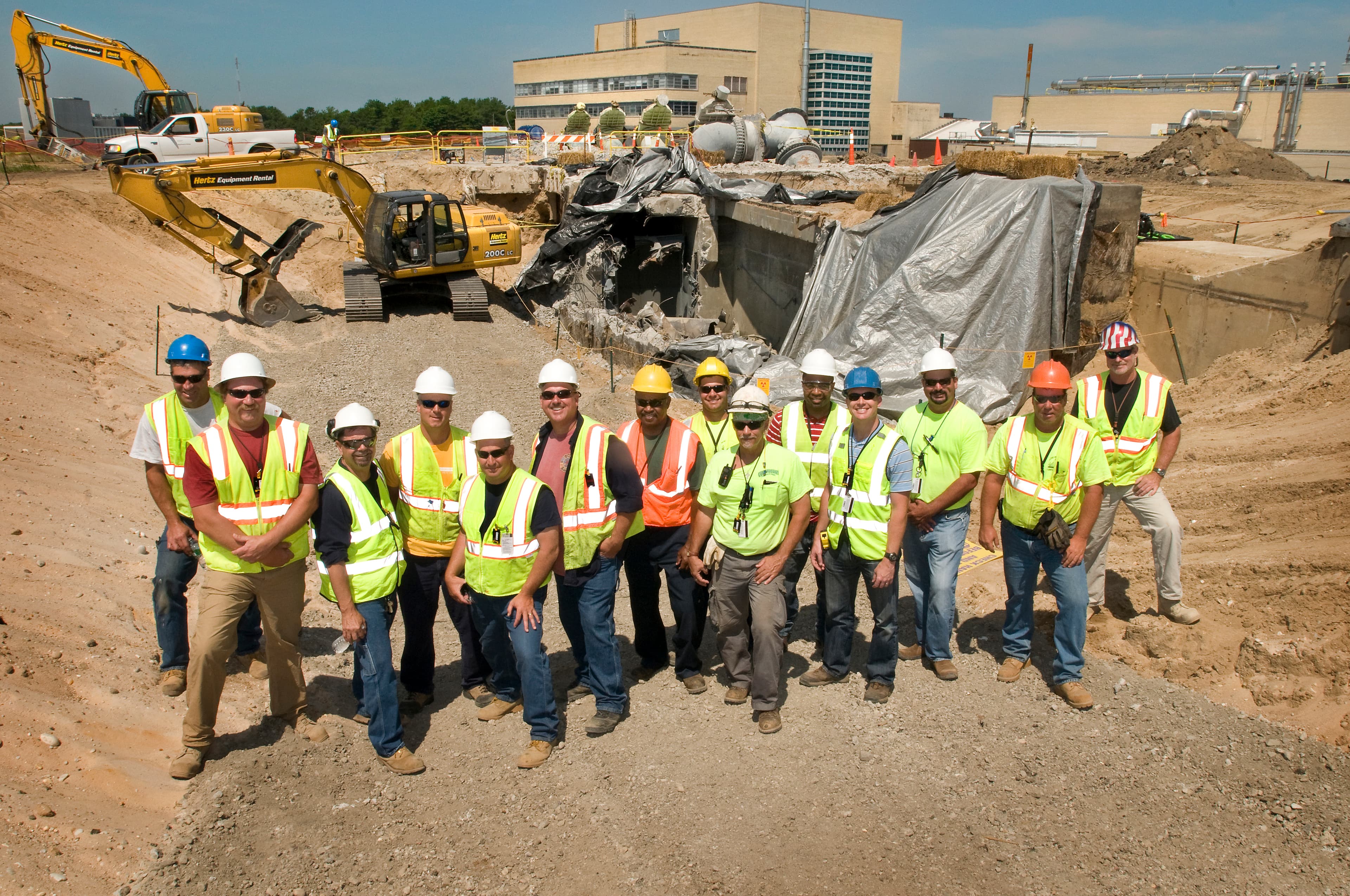
Featured image: U.S. Department of Energy (public domain).