
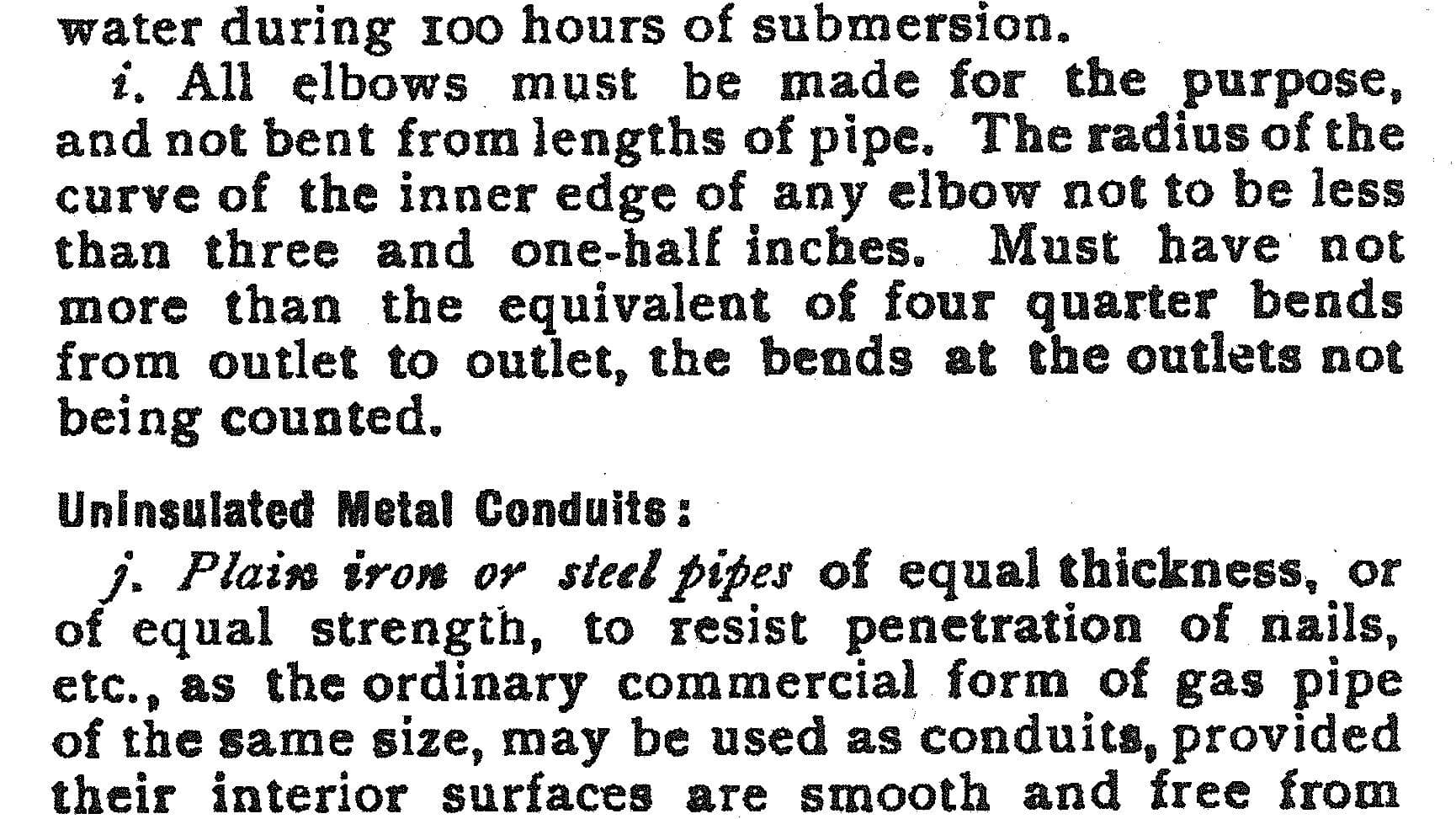
Page 35 of the first National Electrical Code, the edition of 1897, limits a conduit run to "the equivalent of four quarter bends from outlet to outlet." The same rule, Rule 41 i, says every elbow "must be made for the purpose, and not bent from lengths of pipe."
Now pipe gets bent on the job.
The National Board of Fire Underwriters published that code in 1897. It runs 56 numbered pages and 72 rules, and the whole book is free online in a public-domain scan. Some of its rules are still in the code book on the truck, 2023 or 2026 edition, under new section numbers.
When was the NEC first published?
In 1897. The National Fire Protection Association (NFPA) says on its NFPA 70 page that a March 1896 meeting in New York City started the work.
Mark Earley, an electrical engineer retired from NFPA, was secretary of the National Electrical Code Committee for 30 years. He says that by 1896 five electrical codes had emerged in the United States, all "incompatible with one another." His history in Electrical Contractor (March 15, 2021) puts 23 people at the first meeting, held March 18 and 19, 1896, at the American Society of Mechanical Engineers in New York.
Earley says the minutes of that meeting noted that, with no standard, electrical workers had "to create their own rules as they worked, and rarely did two electricians think alike."
Voting members came from nine national associations, architects and street railways among them. The group took the Underwriters' National Electric Association's rules as its base (Electrical Review, New York, August 25, 1897), and Earley says the draft went to 1,200 people in the United States and Europe. The committee also used requirements developed in Germany and England, he says. "We are often accused of not looking at the rest of the world," he says, but "we have done so since the first edition of the NEC."
NFPA says the 1897 book was also designated National Board of Fire Underwriters Pamphlet 70, the first time the code was tied to the number 70. In 1911 the work passed to NFPA, which has managed the NEC ever since, and NFPA says the code kept the number 70.
The fire problem behind the 1897 rules
The New York Times of October 25, 1881, says the New York Board of Fire Underwriters adopted a standard for electric light wires after several recent fires were blamed on electric light, "the new element of fire hazard."
"We have thus far on record accounts of nearly one thousand such electrical fires," says a September 1895 paper by William H. Merrill Jr., electrician of the National Board of Fire Underwriters. Of 815 fires in the underwriters' first eight reports, about one in seven came from telephone, telegraph and similar wires crossing trolley or electric-light wires, for a loss of $324,957.50.
Scientific American, on September 19, 1896, reported 249 fires caused by electricity in 1895, up from 217 in 1894, out of 88,003 fires in all. That is about 0.3 percent (our arithmetic). Counting the fires that spread from them, the total fell from 386 to 338, and the magazine credited greater care in insulating wires.
On page 12, Rule 12 l wants trolley current that can be shut off at the power plant or by section, so it does not interfere with "the work of the firemen."
The first National Electrical Code was 56 pages
The scan online has 56 numbered pages, and an 1899 Boston insurance library catalog lists the underwriters' 1897 rule book at 56 pages. Earley gives 64. Google Books lists the 2026 softbound at 997 pages, roughly 18 times the 1897 count by our arithmetic.
1897 NEC rules still in the book
Rule 22 b, on page 20, says "Knife switches must be so placed that gravity will tend to open rather than close the switch." As of October 2026, OSHA's general industry rule, 29 CFR 1910.305(c)(1), says "Single-throw knife switches shall be so placed that gravity will not tend to close them," and the NEC numbers the rule 404.6(A) in the 2023 edition and 404.8(A) in the 2026 edition.
On page 25, Rule 25 b says interior conduit must "be first installed as a complete conduit system, without the conductors." The 2026 edition keeps that order (raceway complete first, conductors after) at 300.20(A), which was 300.18(A) in 2023.
Back to Rule 41 i on page 35. Its four-quarter-bends sentence is still word for word in the 1909 edition. Earley, in Electrical Contractor on November 15, 2022, says that in the 2023 edition "the language about the number of quarter bends has been replaced" by a total of 360 degrees between pull points. The 2026 edition adds a general section, 300.24, that applies the 360-degree limit to any mix of conduit or tubing in one run.
On a job, the edition your state or city adopted is the one that counts, not this 1897 book.
Pages from 1897 that look strange now
Every joint had to be soldered, "even if made with some form of patent splicing device" (Rule 14 c, page 14). Page 44 has the flux recipe. Rule 59 suggests a soldering fluid: "Saturated solution of zinc chloride 5 parts. Alcohol 4 parts. Glycerine 1 part."
Page 45 lists acceptable insulating materials, including "Slate without metal veins" and "Lava (certain kinds of)."
Where to read the first National Electrical Code free
The Internet Archive has the 1897 book under a Public Domain Mark, with a PDF. Its plain-text version has scanning errors. The page images are the reliable copy. Wikimedia Commons has the same scan as a 58-page file (the 56 numbered pages plus the covers), and Wikisource has an index of the same scan, marked "To be proofread" in October 2026, with only four of its 58 pages transcribed.
NFPA's free, view-only access through its NFPA 70 page needs an nfpa.org account and, as of October 11, 2026, starts at the 1968 edition.
How often the NEC is updated
NFPA revises the NEC every three years. Its edition list shows that rhythm only from the 1975 edition on. NFPA's Standards Council issued the 2026 edition on August 20, 2025.
NFPA's enforcement map, dated August 3, 2026, lists six states with 2026 NEC effective dates from April 24 to August 17, 2026, among them North Dakota and Minnesota. In Texas, the Texas Commission of Licensing and Regulation adopted the 2026 NEC as the state electrical code, with a limited exception on ground-fault circuit interrupter rules for certain outdoor outlets, effective September 1, 2026.
In his 2021 history, Earley says participation had grown from 23 people at the first meeting to "more than 500 members and alternates" on the NEC's code-making panels and correlating committee.
Sources: National Board of Fire Underwriters, National Electrical Code, Edition of 1897 (public domain; Internet Archive item 00701897, the 58-page Wikimedia Commons DjVu scan and the Wikisource index, quotes checked against the page images); National Board of Fire Underwriters, National Electrical Code, Edition of 1909 (Internet Archive, nationalelectric00natirich); NFPA, Learn More About NFPA 70, National Electrical Code (NEC) (checked October 11, 2026); NFPA, NFPA 70 document information page, edition and free-access lists (checked October 11, 2026); NFPA, NEC enforcement maps (dated August 3, 2026); NFPA 70 2026-cycle Second Draft Report, Code-Making Panel 3, Second Revision 7548, and First Draft Report, Code-Making Panel 9; Ryan Jackson, Conduit and Raceway Changes in the 2026 NEC, EC&M (February 16, 2026); UpCodes listings for NFPA 70 2023 and 2026 (Position and Connection of Switches; Complete Runs; checked October 11, 2026); Texas Department of Licensing and Regulation, Commission Adopts Rules (September 1, 2026); Mark Earley, 125 and Counting, Electrical Contractor (March 15, 2021, archived copy); Mark Earley, Continuing our Code Journey: Accepting (NEC) change, part 10, Electrical Contractor (November 15, 2022, archived copy); The New York Times, The Use of Electric Lights (October 25, 1881); Electrical Review, New York (August 25, 1897); William H. Merrill Jr., Fires of Electrical Origin, Proceedings of the 26th Annual Meeting of the Fire Underwriters' Association of the Northwest (Chicago, September 1895); Scientific American, The Fire Loss in 1895 (September 19, 1896); A Catalogue of the Library of the Insurance Library Association of Boston (1899); Google Books, NFPA 70 National Electrical Code NEC 2026 Softbound (ISBN 9781455932207; checked October 11, 2026); OSHA, 29 CFR 1910.305(c)(1) (checked October 11, 2026). Featured photo: National Electrical Code, Edition of 1897 (National Board of Fire Underwriters), p. 35. Public domain scan, Internet Archive item 00701897, also on Wikimedia Commons.