
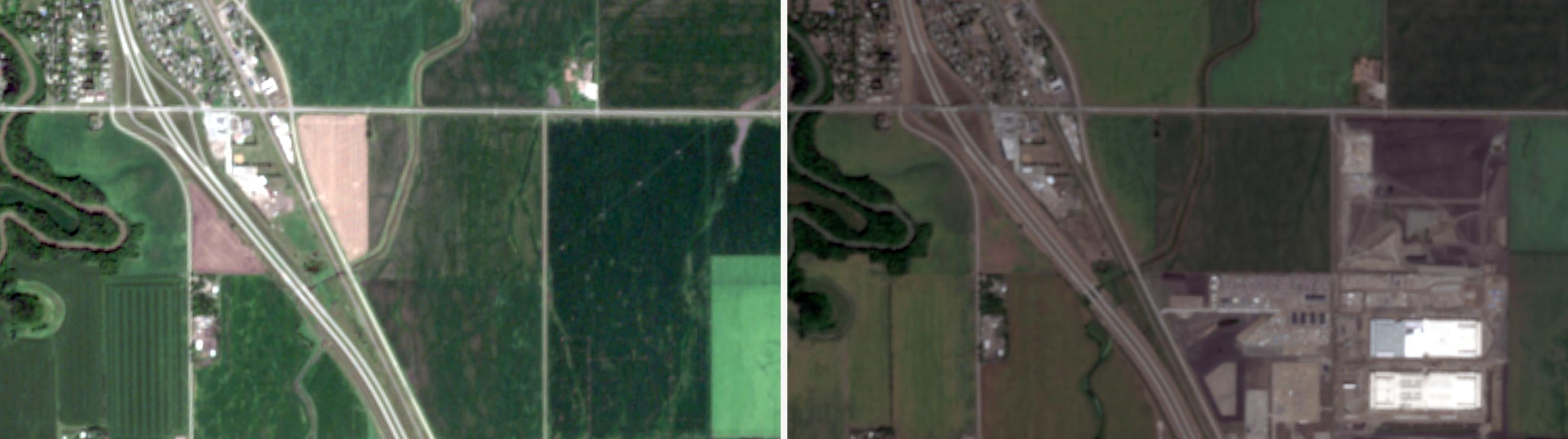
Harwood, North Dakota was platted in 1881 when the railroad reached that spot on the Red River Valley floor. It has a grain elevator on Chapin Drive and a K-5 school that had 97 kids on the federal rolls. Population was 794 at the last census. In September 2025, more than a mile away, crews broke ground on Polaris Forge 2, two structures of 907,000 square feet each. Together they out-measure the biggest building in the state, a 1.2 million-square-foot Amazon fulfillment center two miles south. A year later, roughly 1,800 workers are finishing them.
Nick Phillips, Applied Digital's executive vice president of public affairs and real estate acquisition, put a number on it when The Forum toured the site in late August: roughly 86,000 data center electrical connections when the buildings are finished. We could not find a count that specific from anyone else building at this scale. Applied Digital did not say what it counts as one.
"It's like a small city," David Nehring, the company's director of local and regional affairs in the Midwest, said on the same tour.
The Computers Get a Quarter of the Building
Phillips put the split this way: "About 25% of each building is the rooms that the computers go inside of. Then the other 75% is all of the systems that support those computers and how they function."
Three-quarters of 907,000 square feet, twice, is the job, and the power path runs a long way upstream of the rack. A new 345-kilovolt line into the Agassiz substation, medium-voltage switchgear inside the fence, a medium-voltage static UPS, transformers stepping down to low-voltage switchgear and switchboards, power distribution units and remote power panels on the hall floor, overhead busway across the rows, and the whip that drops to each rack. ABB is supplying the low and medium voltage architecture for the campus and says its medium-voltage design lets a data center "scale in larger 25 MW blocks, reducing cabling."
Six data halls per building sit inside a closed-loop cooling system that runs water to rooftop fans and back. The generators run 12 to a room and eight rooms to a building, some of those counted as backup, the company's civil structure architecture superintendent told The Forum. That comes to 96 per building and 192 on the campus. Applied Digital has not published the size of the units.
A typical 2,500-kilowatt data center generator pushes about 3,760 amps at 480 volts and about 131 amps at 13,800 volts. Push the voltage up and the conductor gets smaller, the lug count drops. What is left is harder to pull, and worse than that, harder to terminate. A 15 kV termination means a cold-shrink or heat-shrink kit built by a qualified splicer and then tested, and the estimating manual carries it as its own line item, priced nothing like landing a 600-volt feeder on a breaker.
86,000 Data Center Electrical Connections, Priced in Labor Units
Applied Digital did not define "connection." The count runs from torqued feeder terminations down to control and instrumentation points, fire alarm modules, grounding bonds, and network landings. Only the power side of that list gets a torque wrench.
Estimators price this work in decimal hours. NECA's labor units are the baseline, then estimating software and the shop's own history adjust them. The publicly posted Durand & Associates labor-unit tables put a #12 branch-circuit termination at about four minutes, a 500 MCM conductor landed on a breaker at about 23 minutes, and a loose compression lug on 500 MCM at about 36 minutes with termination included. A 4,000-amp distribution section is roughly 44 hours to set before a single conductor lands in it. NECA prints Normal, Difficult, and Very Difficult columns for conditions, and estimators carry their own allowance for what sustained 60-hour weeks do to production.
Nobody has published the mix at Harwood, so this is a guess. If most of the 86,000 are small wire and a minority are feeders, the terminations run to something like 15,000 labor hours. Against the whole electrical scope that is small change. Most of the hours are in duct bank, ground grid, cable tray, strut, conduit racks, the pulls, and rigging and setting gear. Whether Harwood's gear showed up stick-built or as factory skids is not public either, and that decides how many of the 86,000 get made in the field at Harwood and how many in a factory.
Hardhats on the site run augmented reality that checks whether parts are where they belong and whether the crew is on schedule, the same superintendent told The Forum. The paper did not name the equipment, and neither will we.
Every connection is supposed to get the same treatment. Torque to spec, then a stripe of torque seal across the lug so the next hand can see it was done and has not moved, and the value goes into a termination log with the tool used and the installer's initials. Harwood's own torque procedure is not public. In the commissioning sequence Cumulus Digital Systems publishes, Level 2 is installation verification, every connection checked for torque, wiring, and alignment before anything is energized. At the end they set load banks to stand in for the computers and open the utility feed on purpose to see whether the generators pick it up, though where that test sits in the numbering depends on whose levels you are reading.
Who Is Calling for Hands at the Harwood Data Center
Applied Digital has not named its electrical subcontractors, but the hall that covers Fargo, IBEW Local 1426, posts who is calling for hands. The Harwood data center jobs on its board as of mid-September list Parsons Electric, an ArchKey Solutions company with a Fargo office, plus Northern Valley Electrical Service, Electric Construction Company, and Colstrip Electric, with a lineman call in Harwood and a substation-tech call at Agassiz posted alongside.
The wireman calls list journeyman wiremen at $44.80 an hour on six tens, with a $100-a-day incentive Monday through Friday, $150 on Saturdays and Sundays, and another $100 a day for a North Dakota license, both subject to the contractor's attendance policy, plus $100 a day non-taxable per diem for hands based 100 or more GPS miles out. On the Parsons calls a reciprocated license within 30 days is accepted, and the hall has paused its strike system, so no strikes are being issued on any call right now. The lineman call is its own package, $58.50 an hour on six twelves, $100 a day Monday through Friday, $150 for Saturday, and $100 a day per diem for each day worked.
There were 600 to 700 on site in May and roughly 1,800 by September. "There are definitely people renting space all over," Phillips said of where they live. The company paid to add a turn lane to the county road, according to Cass County's administrator, and a Fargo restaurant, Brew Bird, caters out of a temporary dining hall. Part of the Harwood, North Dakota data center is on pace to be operating by the end of 2026, Phillips said, with the rest opening in early 2027, and between 200 and 250 people will work there once it does.
The Dakotas Electrical Apprenticeship, the joint NECA-IBEW program Local 1426 feeds, trains on 1st Avenue North in Fargo and names data centers among the places its electricians work. You can also come in through NDSCS in Wahpeton, whose electrical degree qualifies most graduates for 2,000 hours of apprenticeship credit, or through ABC's merit-shop apprenticeship, where you are hired first and trained after.
Where the 280 Megawatts Comes From
The campus will draw up to 280 megawatts at peak, the figure Applied Digital announced and Cass County Electric plans around; ABB's release puts the campus at 300 MW across two buildings and quotes Applied Digital's own chief development officer on "two 150-megawatt buildings," and no source reconciles that with 280. Cass County Electric Cooperative is a member-owned co-op serving nearly 61,000 members, and the data center will roughly double its peak demand, according to president and CEO Paul Matthys. Minnkota Power Cooperative feeds that co-op and put its own 2024 peak demand at about 1,008 megawatts in its ten-year plan filing, so this one customer is a bit more than a quarter of Minnkota's peak load.
Minnkota is building the Agassiz substation and a 1.74-mile double-circuit 345-kilovolt transmission line beside Interstate 29, permitted by the state's Public Service Commission in April and targeted to be live about now. Applied Digital is paying for it, $112 million for the substation and transmission upgrades, Phillips told The Forum. The project's cost rose from $75 million to $110 million between March and April, a roughly 45% jump that Minnkota officials tied to the fall deadline, scarce materials, and tariffs.
Ellendale Went First
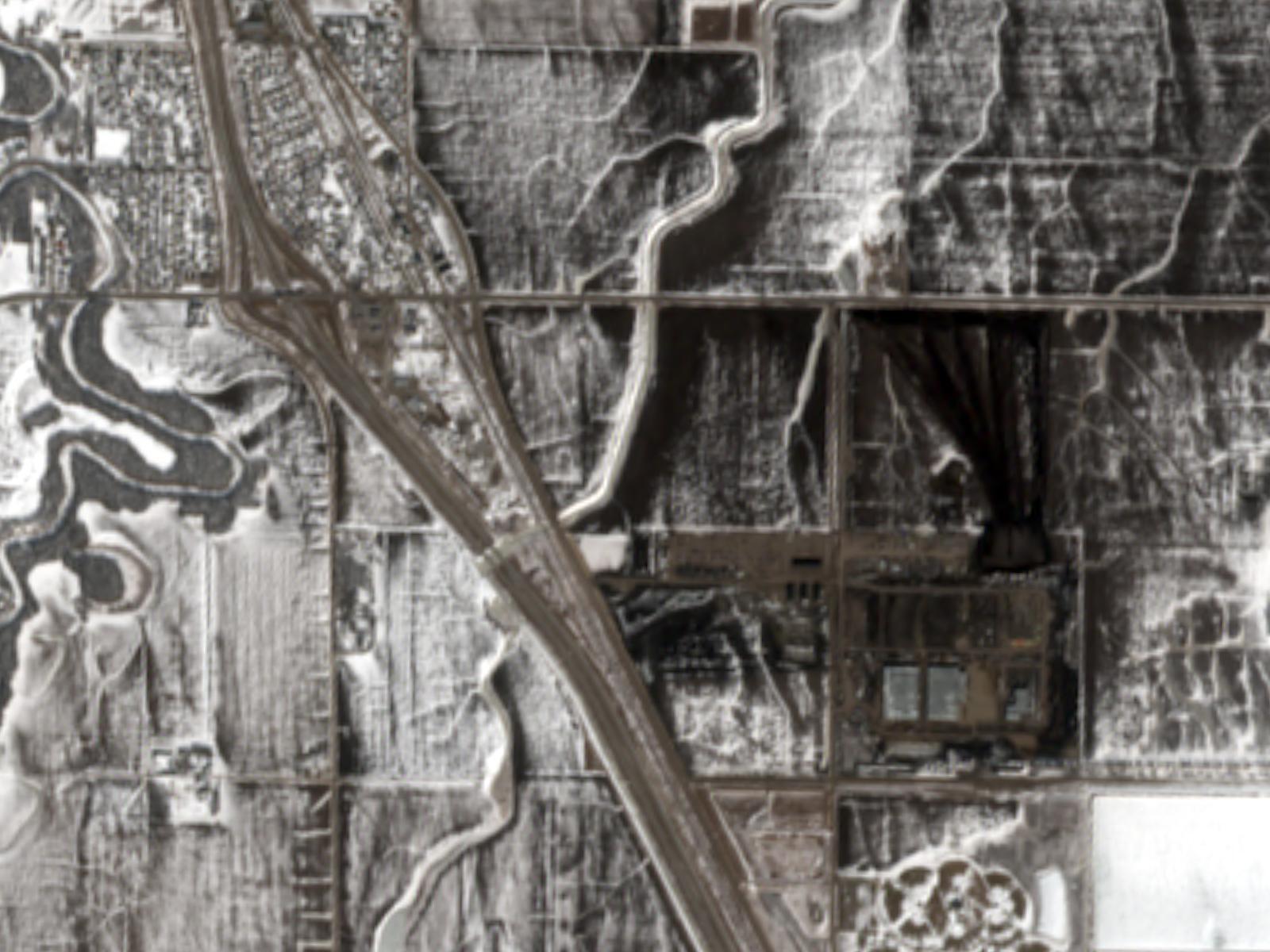
Harwood's population has ticked up every year since the census, to an estimated 845 in 2025. About 150 miles southwest of Fargo, the company's first Polaris Forge campus in Ellendale has been through this already. Ellendale's mayor, Don Flaherty, said this month that a small town's job is to "befriend them, get to know them, build relationships with them, welcome them to our community, not as a threat but as someone who is going to strengthen our community."
Screw up on a site that is already running and you have caused an outage, not a callback. Hands who have set and terminated gear on one know that without being told, and it is in the rate.
Roughly 86,000 connections across two buildings. Somebody has to stand there and make each one, torque wrench then torque seal, more than a mile up the road from a K-5 with 97 kids.
Sources: The Forum / InForum, "An inside look at the Harwood data center as it nears completion," April Baumgarten, September 12, 2026 (syndicated by Forum News Service September 13); North Dakota Monitor (August 18, 2025; March 23, April 2, April 15, September 9, and September 11, 2026); Minot Daily News, May 7, 2026; Applied Digital press releases (August 2025, September 2025, July 2026); ABB press release, November 13, 2025; North Dakota Public Service Commission Case PU-26-22 (Agassiz Transmission Line and Substation); IBEW Local 1426 job calls page, September 2026; Dakotas Electrical Apprenticeship; NDSCS; ABC Minnesota/North Dakota; NECA Manual of Labor Units index and Durand & Associates labor-unit tables; mtu 20V4000 DS2500 specification sheet; SemiAnalysis, "Datacenter Anatomy Part 1"; Cumulus Digital Systems commissioning guide; Minnkota Power Cooperative Ten-Year Plan (2024); Cass County Electric Cooperative; U.S. Census Bureau population estimates (2020 to 2025); City of Harwood; NCES school directory. Featured image: contains modified Copernicus Sentinel-2 data 2026, processed by Esri (Sentinel-2 Views), acquired August 27, 2026.