
Fire Prevention Week 2026 runs Sunday, October 4 through Saturday, October 10. Roughly 13 percent of U.S. home structure fires are electrical. NFPA has sponsored the observance since 1922, and NFPA also writes NFPA 70, the National Electrical Code, plus 70E and 51B.
Calvin Coolidge picked the same calendar dates 101 years earlier. Proclamation 1746, signed September 11, 1925, recommended that "the week beginning Sunday, October 4th, be observed as National Fire Prevention Week," and put the previous year's property loss at "exceeding $548,000,000 in value."
When is Fire Prevention Week 2026, and what is the theme?
The dates are October 4 to 10, on NFPA's own campaign page. The 2026 theme is "Charge into Fire Safety: Safe Charging Is a Superpower." That is the second year running on lithium-ion batteries.
One caveat sits in NFPA's theme announcement. NFPA does not yet track data on the number of U.S. home fires involving lithium-ion batteries. There is no national home-fire count for these batteries, only agency incident tallies and department-level cause codes.
What causes electrical fires, according to the data
NFPA Research published a new report in May 2026, written by Tucker McGree. For 2020 through 2024, fire departments responded to an estimated annual average of 46,652 home electrical structure fires, and an electrical failure or malfunction contributed to ignition in 77 percent of them.
Arcing from operating equipment was the heat source in 64 percent. What caught fire first was most often the wire or its insulation, 36 percent.
The count is not falling. NFPA counted an estimated 41,390 home electrical fires in 2010, 49,940 in 2022, and 48,757 in 2024.
What AFCIs and GFCIs do, and where the NEC requires them
The U.S. Consumer Product Safety Commission states the difference in one sentence in Publication 5133. "AFCIs are intended to address fire hazards; GFCIs address shock hazards." A standard breaker does not do the AFCI job. Typical household fuses and breakers, CPSC says, "do not respond to early arcing and sparking conditions in home wiring."
AFCIs entered the 1999 NEC, bedroom receptacle outlets only. The 2008 NEC added family rooms, hallways and closets, and the 2014 NEC added kitchens and laundry areas. Under 210.12 the protection covers the whole branch circuit, which catches people on a remodel or a panel change.
"AFCI circuitry has become one of the most important and loathed safety devices in residential construction for electricians 'wiring up' dwelling units and mobile homes," says Harold De Loach, master electrician and director of education and training at Leaders of Electrical License Preparation, in EC&M in January 2025.
Most nuisance trips come from the wiring. A shared neutral on a multiwire branch circuit, a neutral landed on the wrong bar, a backstabbed device with a loose tail.
On the shock side, 2023 NEC 210.8(A) requires GFCI protection for 125-volt through 250-volt receptacles in eleven listed locations. The 2026 NEC widened 210.8(F) to outdoor outlets rated 60 amperes or less, up from 50, and Exception No. 2 for listed HVAC equipment expired on September 1, 2026. North Dakota adopted the 2026 NEC effective July 1, 2026. A traveler who crosses a state line is often working under a different code edition.
What an electrician finds in an older house
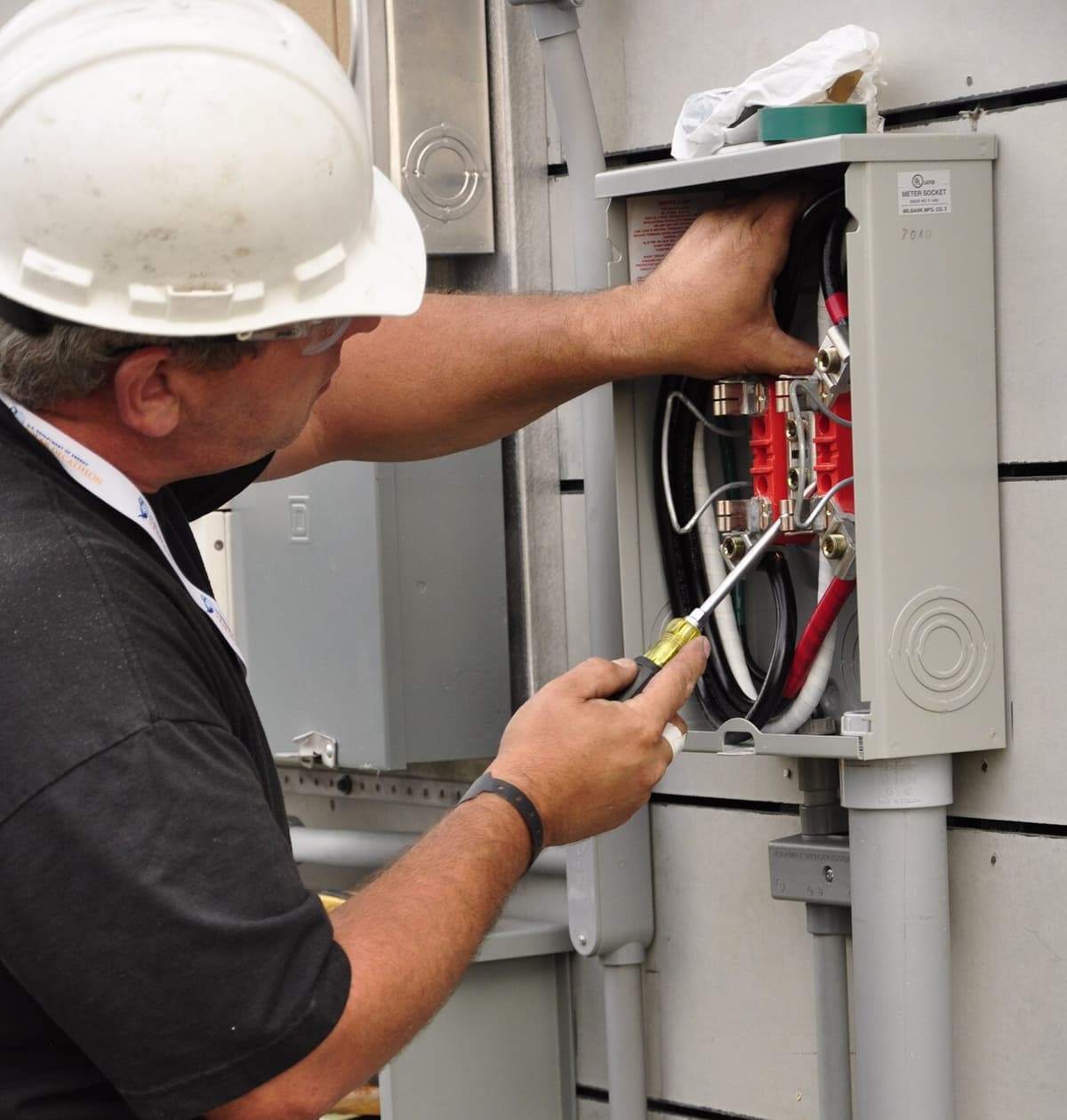
The panel cover comes off first. Under it, the usual finds are double-tapped breakers, a neutral and a ground under one screw on the bar, backstabbed devices at the end of a long run, and a 60-amp service feeding a house that has since grown a hot tub and two mini splits.
CPSC Publication 516 says homes built before 1972 and wired with aluminum are 55 times more likely to have an outlet connection reach "Fire Hazard Conditions" than homes wired with copper. CPSC's recommended repair is a COPALUM crimp. It has never approved twisting aluminum to copper under a wire nut.
Terminations are the other thing. "Loose connections due to improper torqueing lead to increased resistance over time at the termination causing a temperature rise at the connection," says NEMA Technical Services Bulletin No. 120, dated March 17, 2021. NEC 110.14(D) arrived in 2017 requiring a calibrated torque tool where the manufacturer gives a numeric value, and the 2023 edition broadened it to an approved means. NEMA also says do not re-torque existing terminations as a check. NEMA says to use infrared scans.
"Only about 25% of connections performed without a torque wrench are within +/- 20% of the manufacturer's recommended torque value. That means 75% of the connections are wrong!" says Rhonda Parkhurst, electrical specialist for the City of Palo Alto, in IAEI Magazine in January 2015. The figure is eleven years old.
Fire Prevention Week on the job site: what a crew can check
OSHA 29 CFR 1926.416(e)(1) is short. "Worn or frayed electric cords or cables shall not be used." Section 1926.405(g)(1)(iii) bars flexible cord "as a substitute for the fixed wiring of a structure," or run through holes in walls.
For temporary power, 1926.404(b)(1) gives an employer two options. One is GFCI protection on 120-volt, single-phase, 15- and 20-ampere receptacles. The other is a written assured equipment grounding conductor program, with a competent person, a visual inspection of every cord set before each day's use, and testing at intervals not exceeding three months. The assured grounding path is the heavier lift.
The two hot-work rules give different numbers. OSHA's general industry rule, 1910.252(a)(2), wants precautions set out "preferably in the form of a written permit," with a fire watch of at least a half hour after the work. The construction rule, 1926.352(e), sets no clock at all, only "a sufficient period of time after completion of the work." NFPA 51B has required a minimum of one hour since its 2019 edition, and the 2024 edition keeps the hour. A one-hour watch meets both rules that set a number.
Battery charging is a job site problem too.
"The fires aren't just caused by e-bikes in apartment buildings in New York," says Marcy Ost of the Office of the North Dakota State Fire Marshal, in an October 11, 2024 post. "They're happening everyday right here in North Dakota."
West Fargo Fire Department logged a lithium-ion battery fire on August 20, 2026.
"Never leave batteries on a charger for long periods," says Jordan VanBerkum, deputy fire marshal in that same office, in a June 2, 2025 post that adds, in parentheses, "If the battery is charged, remove it."
NFPA's 2026 campaign says to charge larger items, power tools included, outside when possible and away from exits. The Power Tool Institute says not to charge outdoors and to keep packs out of direct sunlight. They disagree on that one point. Both say to use the charger made for the pack. OSHA's 2019 bulletin on lithium batteries says to follow the manufacturer's instructions for charging and to take packs off the charger once they are full.
The short list to check at home this week
NFPA's homeowner guidance repeats the same items year to year. One heat-producing appliance per receptacle outlet at a time, and extension cords are for temporary use only. NFPA says to test AFCIs and GFCIs once a month and to replace any smoke alarm ten years after its manufacturing date.
The electrician's version starts at home, at your own panel. Double-taps, scorch or rust on the bus stabs, aluminum landed on a device not rated for it. Push the test button on every AFCI and GFCI in the house, the shop and the cord reels. Anything that will not trip gets replaced.
Coolidge's proclamation put it this way in 1925. "There is need for earnest study of the principles of fire protection, as a practical measure of national economy."
Rinvio is a construction staffing company that places electricians with contractors on W-2.
Sources
- Celebrate NFPA Fire Prevention Week (FPW), October 4-10, NFPA campaign page, accessed September 27, 2026 (the October 4 to 10, 2026 dates; the theme is quoted in the news release wording).
- Fire Prevention Week, Oct. 4-10, focuses on lithium-ion battery charging safety, NFPA news release, June 15, 2026 (the theme, the charge-outside tip and the statement that NFPA does not track lithium-ion home fire counts).
- "Charge into Fire Safety: Lithium-Ion Batteries in Your Home" is theme for Fire Prevention Week, October 5 to 11, 2025, NFPA news release, June 9, 2025.
- History of FPW, NFPA, accessed September 27, 2026 (the 1922 sponsorship).
- Proclamation 1746, National Fire Prevention Week, 1925, Calvin Coolidge, The American Presidency Project, UC Santa Barbara, September 11, 1925.
- Home Electrical Fires, Tucker McGree, NFPA Research, May 2026 (the 46,652 annual average, the 77, 64 and 36 percent findings and the 2010, 2022 and 2024 counts).
- Electrical Home Fire Safety, NFPA, accessed September 27, 2026 (the 13 percent share and the homeowner checklist).
- Learn More About Smoke Alarms, NFPA, accessed September 27, 2026 (the ten-year replacement line).
- Preventing Home Fires: Arc Fault Circuit Interrupters (AFCIs), Publication 5133, U.S. Consumer Product Safety Commission, revised April 2012.
- Repairing Aluminum Wiring, Publication 516, U.S. Consumer Product Safety Commission, June 2011 (the 55 times figure and the COPALUM repair).
- The Apprentice's Guide to AFCIs and the NEC, Harold De Loach, EC&M, January 31, 2025 (the AFCI quote and the 2008 and 2014 expansions).
- Suggested Amendments to the 2023 National Electrical Code, National Association of Home Builders, April 25, 2023 (2023 NEC 210.8(A) and 210.12 text as reproduced).
- What Changed in the 2026 NEC?, NFPA blog, January 29, 2026 (210.8(F) and the September 1, 2026 expiration of Exception No. 2).
- The Coordination Between Model Codes and Standards: 2026 National Electrical Code (NEC), Michal Hofkin, UL Solutions, The Code Authority, accessed September 27, 2026 (the 60-ampere limit in 210.8(F)).
- 2026 Laws, Rules, Wiring and Conveyance Standards of North Dakota, North Dakota State Electrical Board, effective July 1, 2026.
- NEC enforcement maps, NFPA, accessed September 27, 2026.
- Using Torque Tools for Terminating Building Wire, Technical Services Department Bulletin No. 120, NEMA, March 17, 2021 (with NEC 110.14(D) as written in the 2017 and 2023 editions).
- Inspecting Electrical Connections for Proper Torque, Rhonda Parkhurst, IAEI Magazine, January 15, 2015.
- 29 CFR 1926.416, General requirements, Occupational Safety and Health Administration, accessed September 27, 2026.
- 29 CFR 1926.405, Wiring methods, components, and equipment for general use, Occupational Safety and Health Administration, accessed September 27, 2026.
- 29 CFR 1926.404, Wiring design and protection, Occupational Safety and Health Administration, accessed September 27, 2026.
- 29 CFR 1926.352, Fire prevention, Occupational Safety and Health Administration, accessed September 27, 2026.
- 29 CFR 1910.252, General requirements (welding, cutting and brazing), Occupational Safety and Health Administration, accessed September 27, 2026.
- NFPA 51B, Standard for Fire Prevention During Welding, Cutting, and Other Hot Work, standard development page (2024 edition), NFPA, accessed September 27, 2026.
- Updated Fire Watch Requirements, Code Red Consultants, January 2, 2024 (the one-hour fire watch introduced in the 2019 edition of NFPA 51B).
- Lithium-ion batteries: Focusing on community risk reduction, Marcy Ost, Office of the North Dakota State Fire Marshal, October 11, 2024 (Internet Archive copy, read after firemarshal.nd.gov was redirected).
- Hobby appliances and power tools that can be a hazard, Jordan VanBerkum, Office of the North Dakota State Fire Marshal, June 2, 2025 (Internet Archive copy).
- West Fargo Fire Department responds to Thursday, Aug. 20 lithium-ion battery fire, West Fargo Fire Department News Flash, August 2026.
- Cordless Battery Safety, Power Tool Institute, accessed September 27, 2026.
Featured photo: Tom Sulcer, via Wikimedia Commons, CC0 1.0