
Every October, people go looking for something scary behind the walls. Electricians and home inspectors find it in March too. The electrical problems in old houses are ordinary. A penny wedged behind a fuse, a splice floating loose in an attic, a lamp cord feeding a room it was never sized for. Most of it was done by somebody keeping the lights on with what was on hand.
Here are the eight that keep turning up.
Dangerous wiring in old houses is usually a loose connection. Richard Campbell of NFPA Research reported an estimated average of 32,620 home fires a year from electrical distribution and lighting equipment for 2015 through 2019, and arcing was the heat source in 73 percent. Campbell says faulty wiring in concealed spaces can "start fires that burn for a prolonged period before detection."
David A. Dini, P.E., of Underwriters Laboratories pulled wiring and devices out of 30 American houses, 30 to 110 years old, and lab-tested them for NFPA's Fire Protection Research Foundation, reporting in 2008.
1. A penny behind the fuse
Dini's crew found one house with two pennies bridging blown plug fuses. A penny behind the fuse shorts out the only protection that circuit has, and nothing then limits the current except the wire inside the wall, which heats until the insulation gives up. Dini says the trick was used "to by-pass a blown fuse when a new one was not available."
Alan Carson, writing in the ASHI Reporter, says a doctored fuse sits out farther than the ones beside it.
2. A 30-amp fuse on No. 14 wire
Most fused houses Dini opened also had 30-amp fuses over No. 14 or No. 12 copper, the thin wire that feeds lights and receptacles. Carson says overfusing "is the most common adverse condition in fused panels," and the fix is a rejection-base Type S fuse, which will not accept a bigger one. NEC 240.4(D) caps 14 AWG copper at 15 amps and 12 AWG at 20. The fuse protects the wire in the wall, not the toaster at the end of it.
A fuse that keeps blowing is doing its job.
3. Knob and tube buried in insulation
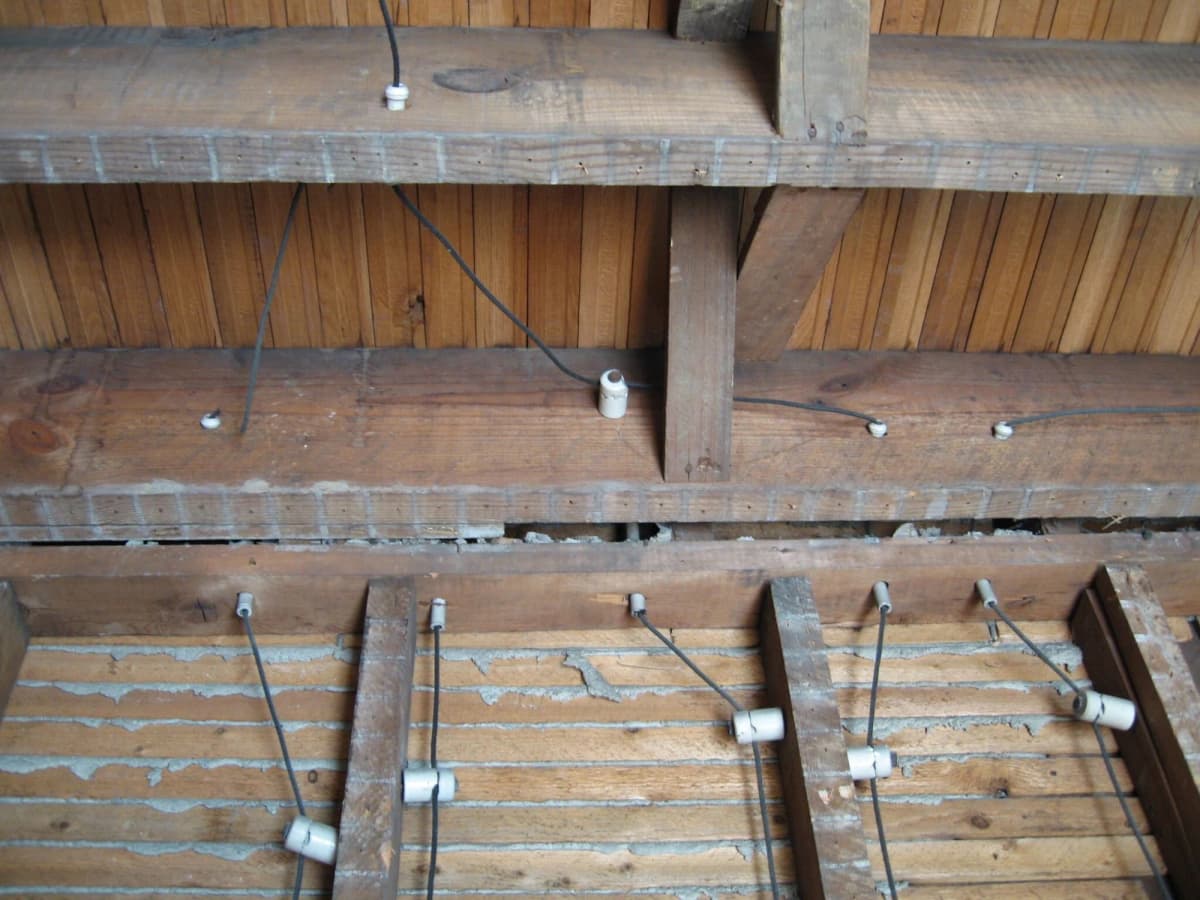
Knob and tube wiring is not dangerous by itself. Bruce Barker, chair of the ASHI Standards Committee when he wrote it, says "there's nothing wrong with knob and tube wiring if it's installed correctly; if the circuit isn't overloaded; and if the insulation, knobs and tubes are intact and safe." The method was built to run in open air.
Blown-in insulation takes that away, and NEC 394.12 bars concealed knob-and-tube from spaces filled with loose, rolled or foamed-in-place insulation that envelops the wires. That prohibition arrived in the 1987 code, so whoever insulated the attic in 1975 broke nothing.
Reuben Saltzman, CEO of Structure Tech Home Inspections in Minneapolis, says "in nearly every home that we inspect with knob and tube wiring, we find unsafe alterations that need repair."
4. Aluminum branch wiring
The copper shortage of the mid-1960s pushed aluminum into ordinary 15- and 20-amp branch circuits. That alloy creeps out from under a terminal screw, oxidizes where it loosens, and heats up there. Cable run between 1965 and the mid-1970s may have it, marked "Al" on the jacket. None of this is about the larger aluminum conductors at the service or the feeder to a range, which CPSC's repair guidance does not cover.
Consumer Product Safety Commission Publication 516 says a survey done for the agency found pre-1972 aluminum-wired homes 55 times more likely to have an outlet connection reach what the survey called fire hazard conditions: cover plate screws at 300 degrees F (149 C), sparks out of the receptacle, or charring.
CPSC accepts three permanent repairs. Rewiring in copper, which it calls the best method available. A crimp-sleeve repair made with a dedicated power tool by a manufacturer-trained electrician. Or, where that is not available, a set-screw pigtail connector. Twist-on wire nuts are not among them, including the ones sold for aluminum to copper.
5. Two wires under one screw
Saltzman says a double tapped breaker is one of the most common electrical defects home inspectors find, and that "loose conductors can lead to overheating, arcing, and possibly a fire." Dini found two or more conductors crammed into a terminal built for one in nine of his 30 houses. It is not always a violation. NEC 110.14(A) allows a terminal to take more than one conductor when it is identified for that, and a breaker listed for two wires is marked.
"One overcurrent device = one circuit," wrote Mike Twitty, a licensed electrician and ASHI Certified Inspector.
The neutral bar is stricter. NEC 408.41 requires each grounded conductor to have its own terminal. Back a shared screw out to free the circuit you killed, and you can open the neutral on the live circuit beside it.
6. Backstabbed receptacles
A backstab is a round hole that grabs the wire with a spring blade, and once it relaxes there is nothing to tighten. A back-wire terminal is different, and the screw that drives a plate down onto the wire can be torqued.
Twitty wrote that push-in connections "are compliant by manufacturer's specs and are not considered a defect," and also wrote, "in my opinion, they are not a best-practice installation." Of the 254 receptacles Dini's lab tested, every kind of termination included, 53 never got under a 20 degree C temperature rise, and the push-in ones could not be retightened at all.
7. A splice with no box
Russ LeBlanc, master electrician and owner of LeBlanc Consulting Services in North Reading, Massachusetts, writes up this work in EC&M's code violation columns. Of one find he says, "the black wire is spliced in the air, and the wire connector is floating in the breeze." NEC 300.15 wants a box at every splice, and NEC 314.29 wants that box reachable without taking the building apart, which is why a box buried under blown-in cellulose is a problem. Flexible cord used in place of fixed wiring turned up in nine of the same 30 houses, and NEC 400.12 forbids it.
8. A cord with a plug on both ends
CPSC calls it a male-to-male extension cord, and the trade has a grimmer name for it. It is a short cord with a male plug on each end, made to backfeed a generator into the house through a wall outlet. Whichever end goes in second has live pins in your hand. With the main breaker still closed, the generator feeds backward out the service drop and into the utility transformer, which steps it up to primary voltage on the line outside, where the crew restoring your power cannot know it is there.
The fix is a transfer switch or a listed interlock kit at the panel. CPSC's generator alert says never to power house wiring by plugging a generator into a wall outlet, and the agency warned about these cords again in March 2026.
What to do about electrical problems in old houses
An old house is not a bad house. Dini's lab found the thermoplastic wire used from the 1950s onward has held up well. The trouble is in the work that came after.
If nobody has opened the panel in forty years, get a licensed electrician into it and the attic, and ask about arc-fault and ground-fault protection. CPSC says ordinary breakers and fuses "do not respond to early arcing and sparking conditions in home wiring." No arc-fault breaker fits a fuse panel, so in a fused house the choice is an arc-fault receptacle at the first outlet on a circuit or a new panel.
"You owe it to yourself, your family, and anyone who may enter or occupy the property in the future that all electrical work is done properly," the North Dakota State Electrical Board's handout for homeowners says.
Rinvio staffs electricians on W-2 for data center and grid construction nationwide.
Sources
- Home Fires Caused by Electrical Distribution and Lighting Equipment, Richard Campbell, NFPA Research, February 2022 (2015 to 2019 data).
- Residential Electrical System Aging Research Project Technical Report, David A. Dini, P.E., Underwriters Laboratories, for the Fire Protection Research Foundation, July 1, 2008 (copy hosted by IEEE).
- Distribution Panels: Fuse Fundamentals, Alan Carson, ASHI Reporter, July 2, 2018.
- Old Wiring Methods, Bruce Barker, ASHI Reporter, November 1, 2013.
- Inspecting Electrical Connections, Mike Twitty, ACI, ASHI Reporter, October 1, 2019.
- Knob and tube wiring concerns: safety and insurance, Reuben Saltzman, Structure Tech Home Inspections, August 13, 2019.
- How to fix double-tapped circuit breakers, Reuben Saltzman, Structure Tech Home Inspections, October 1, 2019.
- Illustrated Catastrophes: A Cluster of Catastrophes, Russ LeBlanc, EC&M, May 19, 2026.
- Repairing Aluminum Wiring, Publication 516, U.S. Consumer Product Safety Commission, June 2011.
- Preventing Home Fires: Arc Fault Circuit Interrupters, Publication 5133, U.S. Consumer Product Safety Commission, April 2012.
- Portable Generator Hazards, Safety Alert Publication 5123, U.S. Consumer Product Safety Commission, October 2021.
- CPSC Warns Consumers to Stop Using Male-to-Male Extension Cords, Secures Delisting Commitments from e-Commerce Platforms, U.S. Consumer Product Safety Commission, March 31, 2026.
- Stumped by the Code? When to Place Two Conductors on the Same Terminal, Mike Holt, EC&M, December 18, 2014 (NEC 110.14(A) and 408.41).
- Stumped by the Code? Code Requirement for Sizing the Overcurrent Protection of Conductors, Mike Holt, EC&M, May 15, 2018 (NEC 240.4(D)).
- Illustrated Catastrophes: A Boxless Splice, Russ LeBlanc, EC&M, October 17, 2019 (NEC 300.15).
- Illustrated Catastrophes: A Buried Treasure, Russ LeBlanc, EC&M, December 28, 2021 (NEC 314.29).
- Article 394 Concealed Knob-and-Tube Wiring, NFPA 70, 2023 edition, UpCodes, accessed September 27, 2026 (NEC 394.12).
- 400.12 Uses Not Permitted, NFPA 70, 2023 edition, UpCodes, accessed September 27, 2026.
- Inspecting Electrical Renovations, Frederic P. Hartwell, IAEI Magazine, March 16, 2003 (the 1987 origin of the knob-and-tube insulation rule).
- Information and Requirements for Self Wiring, North Dakota State Electrical Board, accessed September 27, 2026.
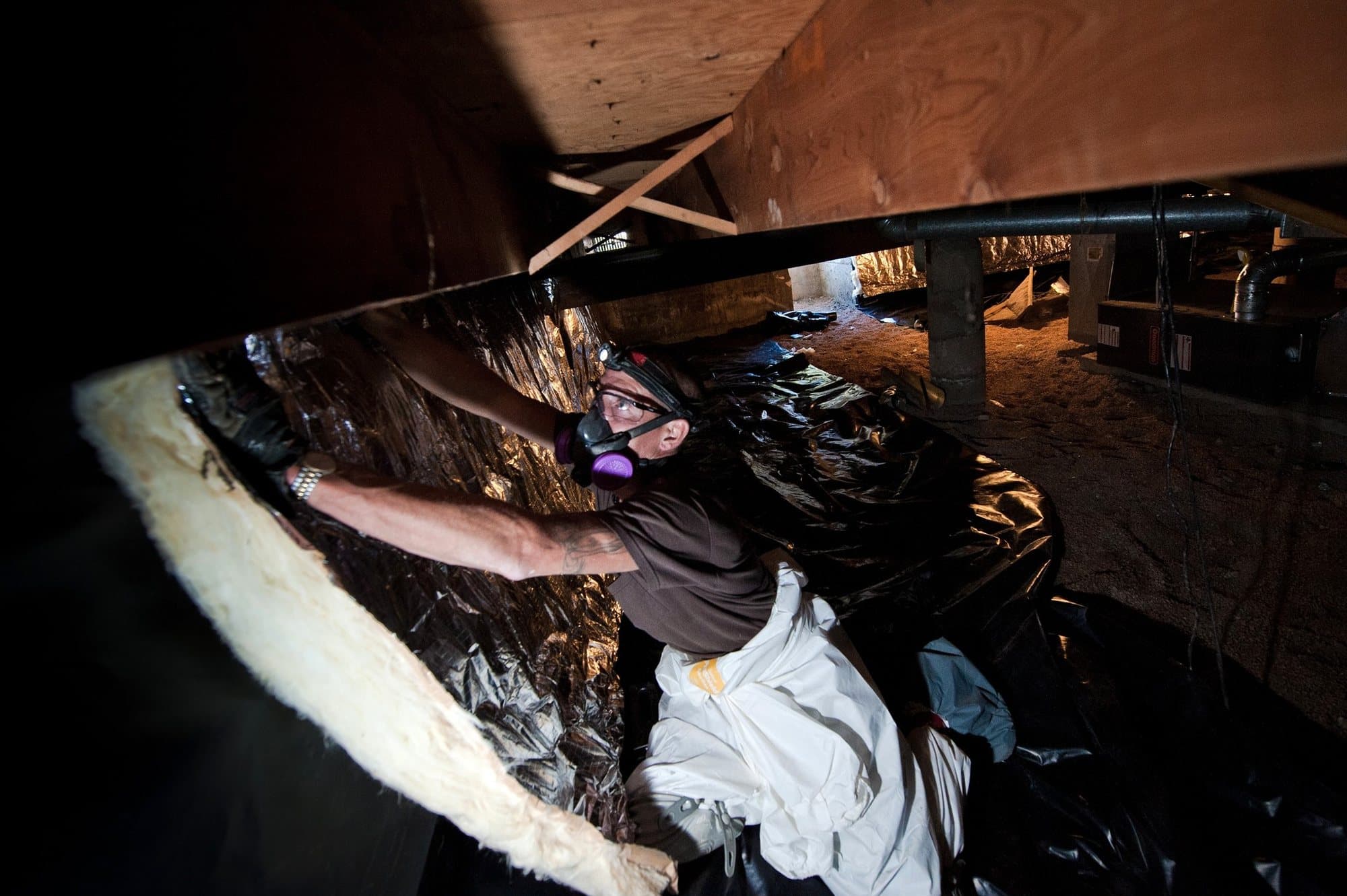
Featured photo: Dennis Schroeder / NREL for the U.S. Department of Energy (public domain)