
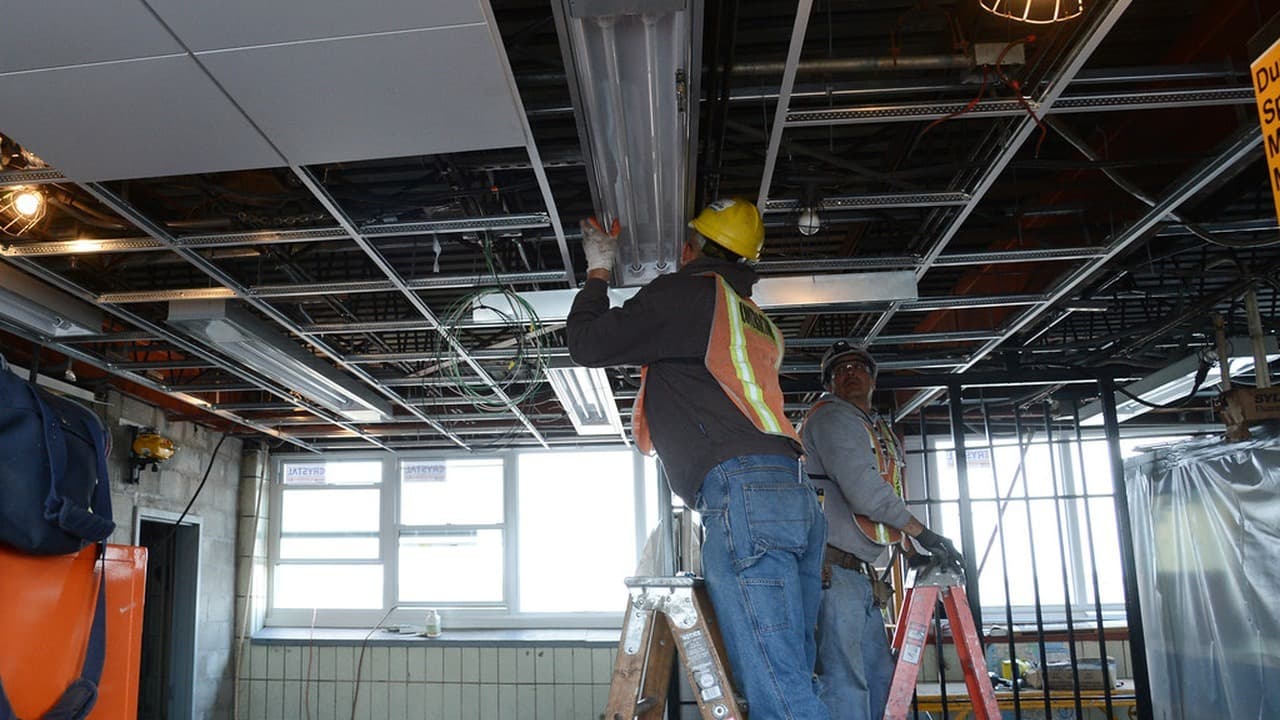
A pump swap is one line on an outage schedule. It stays mechanical work until somebody has to lift the motor leads, and from that point OSHA's electrical rules decide who does what. Under 29 CFR 1910.333(b)(2)(iv)(B), a qualified person has to use test equipment and verify that the circuit parts are deenergized, and under (b)(2)(v)(A) a qualified person has to check that the tools, jumpers, shorts and grounds are off before the motor is energized again. The millwright who set the pump picks up that duty only if he is a qualified person for that equipment.
So the skill mix starts with tasks. Trade titles come second.
A trade title does not tell you who is qualified
A note to OSHA's definition of a qualified person in 29 CFR 1910.399 calls it "possible and, in fact, likely" that one employee is qualified on certain equipment in a workplace and unqualified on other equipment. A second note covers trainees. One who has shown he can do the duties safely at his level of training, and who works under the direct supervision of a qualified person, counts as qualified for those duties. The apprentice count on a crew is a supervision question.
Brian Lines, an associate professor of civil, environmental and architectural engineering at the University of Kansas, is lead author of a 2026 national field study of multiskilled crews, and he defines the idea at the task level too. Workers are "qualified to perform selected tasks safely and competently," Lines says. He said it at an Associated Builders and Contractors (ABC) event on September 2, and Construction Dive reported it. Selected tasks. That is the unit to plan in.
Testing credentials work the same way. A NETA Level 3 testing technician needs five years of related experience and can supervise Level 1 trainees and Level 2 assistants; Level 4 needs ten years and, in NETA's wording, "supervises large projects and multiple crews." Two testing technicians listed the same way on a crew sheet can be five years apart in required experience.
Break the job apart wherever the authority changes
Split the pump package wherever the required capability or signature changes. Energy control goes to people authorized under the employer's lockout program for that equipment. Disconnecting and reconnecting a 480-volt motor goes to an electrician qualified on it. Pulling and setting the pump goes to a millwright, with a qualified rigger for the lift. The transmitter calibration and the loop checks go to an I&E technician. The guarded test run belongs to operations.
For every row, write down the hands-on capability, the license or site authorization the task needs, who can release the area or change the sequence, and who accepts the finished work. Often that is four different people. A mechanic can replace a coupling and still have no authority to change an isolation.
Put names against the rows and look for gaps. If one I&E technician is booked for three loop-check fronts on the same shift, the schedule has a capability conflict even when total headcount looks fine. Joel Dutton, preconstruction manager at Evans General Contractors, says this changes the estimate. When you "know your crew mix and what your level of multiskilling abilities are," Dutton says, "you can be more aggressive in how much labor hours you're going to put towards a specific system or area." He was speaking at the same September 2 ABC webinar, ENR reported.
Ratios come from the statute and the work
No universal ratio of electricians to mechanics holds up. Washington State writes its electrical crew ratios into RCW 19.28.161, and they change with the type of work. On journey-level work the limit is one noncertified worker per certified electrician, and specialty work allows two. A certified electrician has to be on the same jobsite as the noncertified worker at least 75 percent of each working day unless the chapter says otherwise. The statute makes one exception: a certified electrician may take up to four students enrolled in and working as part of an electrical construction program at a public community or technical college or a nonprofit, nationally accredited trade school. At one to three or one to four, that electrician has to directly supervise and instruct, must be on site 100 percent of each working day, and may not do the installing himself.
Doc Palmer, author of McGraw-Hill's Maintenance Planning and Scheduling Handbook, puts planners at one for every 20 to 30 craftspersons in a June 2024 Plant Services column, and then gives the reasons a plant might need more. "A single facility might have only 10 craftspersons, but several crafts being mechanics, electricians, and instrument techs that would keep a single planner busy," Palmer wrote.
Supervision needs its own line too. "Remember, assigning direct labor hours to a foreman's rate indicates that you are expecting the foreman to work with the tools 100% of the time," Don Kiper, an independent electrical estimating trainer and consultant, wrote in EC&M in October 2022. A foreman who cannot see three fronts at once is not covering them, and that is a foreman problem more hands will not fix.
Count the scarce crafts first
The smallest labor pools tend to set the schedule.
| Occupation | Jobs, 2025 |
|---|---|
| Electricians | 821,000 |
| Plumbers, pipefitters and steamfitters | 510,600 |
| Industrial machinery mechanics | 446,900 |
| Commercial and industrial electrical and electronics equipment repairers | 65,500 |
| Millwrights | 40,700 |
| Powerhouse, substation and relay repairers | 20,900 |
That works out to roughly one millwright for every 20 electricians nationally, per the BLS electricians page and its millwrights page. Electricians are still the craft contractors most often report as hard to hire. In the AGC and NCCER 2026 Workforce Survey, which drew 1,830 respondents, 81 percent of firms with electrician openings reported difficulty filling them, 75 percent of firms with superintendent openings said the same, and 50 percent of respondents said available candidates lacked the skills, certificates or licenses the work called for.
ACE Electric in Valdosta, Georgia, gives new hires written and hands-on skill tests, and when a worker tests below the level claimed in recruiting, the company may offer a lower classification and wage instead of sending the worker home. According to ENR, 83 percent of the workers offered one over the past year took it. Mindy Bates, ACE's human resources director, says the harder gap is leadership. "We do have to turn down work," Bates says. "The majority of the time that we're having to turn things down, it is for the leadership it takes to run those jobs, especially the big hyperscale ones."
Handoffs are where the time goes
Lines says the strongest opportunities for multiskilling occur "anywhere that you have trades who are working in sequence and handing off work to one another." His team logged 11,407 work-sampling observations of 644 workers in 60 crews for the Simplar Foundation study. The researchers followed one electrical contractor on data-center jobs operating under different work rules, and at one site its electricians could not unload material shipped from the company's own prefab shop. The result, Lines says, was "awkward handoffs and some waiting around that probably didn't need to occur."
OSHA already writes handoff rules for energy control. When more than one crew or craft works under a group lockout, 29 CFR 1910.147(f)(3)(ii)(C) gives overall lockout control for the job to one authorized employee who coordinates the affected work forces, and (f)(4) requires procedures for the orderly transfer of lockout protection between off-going and oncoming employees at shift change. A usable handoff between crafts states the equipment and its energy state, the work finished and records attached, open punch items, any readings the next crew needs, the next permitted action and the name of the person taking the package. "Mechanical complete" by itself is not a handoff.
Acceptance should be written down just as plainly. The Department of Veterans Affairs electrical commissioning spec, Section 26 08 00, has the commissioning agent write the functional test procedures and the Resident Engineer approve them; the contractor supplies the labor, materials and test equipment, the commissioning agent witnesses, and the contractor signs the test reports.
With a staffing firm on the job, OSHA's Protecting Temporary Workers page says the agency and the host employer share responsibility for worker safety and recommends that they set out their respective responsibilities in their contract. OSHA's lockout bulletin for temporary workers adds that the two should jointly review the task assignments before work begins.
Ask for capabilities by package and shift
A request for "12 multi-craft hands" gives nobody enough to match. Name the packages and shifts first, and after them the counts by capability (the electrician headcount is its own exercise). A pump package might call for rotating-equipment millwrights, electricians for the specified motor work, one I&E technician per loop-check front, and a foreman with authority over defined areas. List required credentials apart from preferred experience.
Entergy's release for the April 2023 refueling outage at Arkansas Nuclear One Unit 2 said more than 1,100 contract workers would help, and it named 11 kinds of contract workers, from pipefitters and millwrights to valve technicians and radiation protection technicians. At Vogtle Units 3 and 4 in Georgia, Bechtel sized the peak by craft. "At our peak, we currently project a need of 1,500 electricians and 1,400 pipefitters," project director Ty Troutman says in a July 2018 ENR interview. In September 2021, Georgia Power told regulators the Unit 4 date depended in part on "appropriate levels of craft labor, particularly electricians and pipefitters, being added and maintained," ENR reported. Two months later, Southern Co. chairman and CEO Thomas Fanning traced lost productivity on Unit 3 to "slower-than-expected onboarding of new electricians, field engineers and supervisors," and said "craft labor and support resources have been temporarily shifted to support Unit 3's completion effort," according to ENR's November 2021 report.
Sources
- 29 CFR 1910.333, Selection and use of work practices, eCFR, accessed September 29, 2026.
- 29 CFR 1910.399, Definitions applicable to this subpart, eCFR, accessed September 29, 2026.
- 29 CFR 1910.147, The control of hazardous energy (lockout/tagout), eCFR, accessed September 29, 2026.
- RCW 19.28.161, Certification, apprentices and trainees, supervision, ratio of noncertified and certified workers, trainee hours verification, Washington State Legislature, last amended 2018, accessed September 29, 2026.
- Labor squeeze prompts revised construction workforce strategies, Construction Dive, September 14, 2026.
- Technician Certification, InterNational Electrical Testing Association, accessed September 29, 2026.
- Can Multiskilled Crews Ease Construction's Labor Crunch?, ENR, September 2, 2026.
- What is the right ratio of planners to craftspersons for my manufacturing plant?, Doc Palmer, Plant Services, June 25, 2024.
- Understanding Labor Hours and Labor Costs, Don Kiper, EC&M, October 14, 2022.
- Electricians, Occupational Outlook Handbook, U.S. Bureau of Labor Statistics, last modified August 27, 2026.
- Industrial Machinery Mechanics, Machinery Maintenance Workers, and Millwrights, Occupational Outlook Handbook, U.S. Bureau of Labor Statistics, last modified August 27, 2026.
- Plumbers, Pipefitters, and Steamfitters, Occupational Outlook Handbook, U.S. Bureau of Labor Statistics, last modified August 27, 2026.
- Electrical and Electronics Installers and Repairers, Occupational Outlook Handbook, U.S. Bureau of Labor Statistics, last modified August 27, 2026.
- 2026 Workforce Survey Analysis, Associated General Contractors of America and NCCER, September 3, 2026.
- Even as Contractors Cut Headcount, 73% Still Plan to Hire, ENR, September 3, 2026.
- Work-Time Utilization and Staffing Level Impacts in Construction Crews, Brian Lines and others, Simplar Foundation, 2026.
- Section 26 08 00, Commissioning of Electrical Systems, U.S. Department of Veterans Affairs, November 1, 2016.
- Protecting Temporary Workers, Occupational Safety and Health Administration, accessed September 29, 2026.
- Temporary Worker Initiative Bulletin No. 10, The Control of Hazardous Energy (Lockout/Tagout), OSHA 3964, Occupational Safety and Health Administration, November 2018.
- Arkansas Nuclear One begins 29th Unit 2 refueling outage, Entergy, April 18, 2023.
- Vogtle Seeks Help as it Heads Toward Peak Construction, ENR, July 25, 2018.
- NRC Cites Vogtle Safety Violations as Georgia Power Projects Construction Delays, ENR, September 7, 2021.
- Vogtle Nuke Project Delayed Again as Utility Co-Owners Resist Rising Costs, ENR, November 8, 2021.
Featured image: MTAPhotos, via Flickr (CC BY 2.0).