
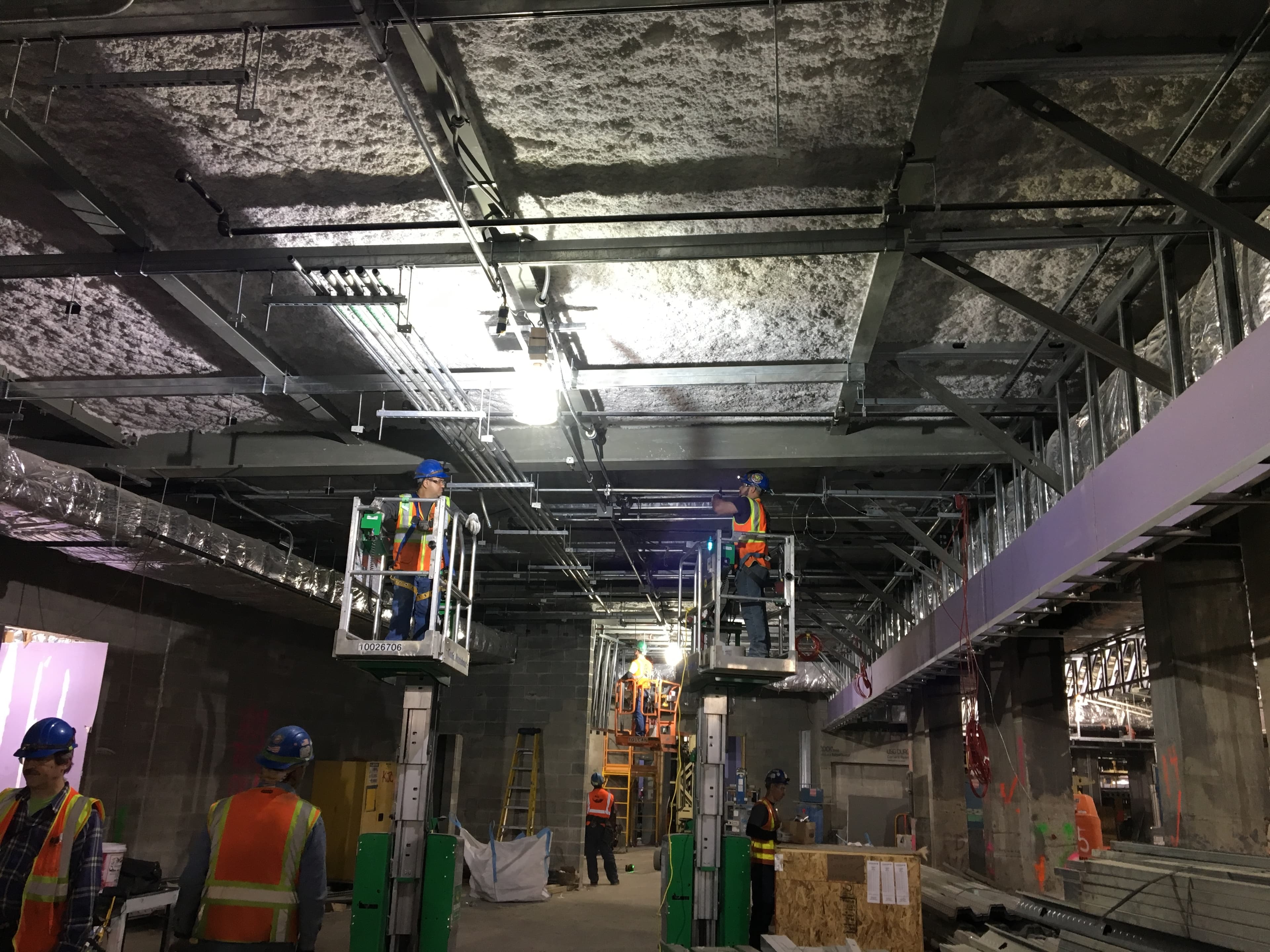
The request usually comes in as a round number. Twelve electricians, Monday, 6 a.m. Sometimes twelve is right, and sometimes six of them can work while the other six wait on a lift, a released drawing or a foreman who has time to lay out the next room.
Crew size should follow the work that is ready to install. The schedule gap is a separate number.
On Vogtle Unit 4, fewer electricians meant better productivity at first
The clearest public case comes from Plant Vogtle in Georgia. In December 2018 the Atlanta Journal-Constitution, citing a Public Service Commission staff report, said the nuclear project was short nearly 350 electricians and another 350 pipefitters, and that hiring had produced "very little progress." Two years later COVID-19 cut the supply of electricians, and many were moved off Unit 4 and over to Unit 3. The smaller Unit 4 electrical crew then got more productive by the project's own cost measure.
Donald N. Grace, vice president of engineering for the Vogtle Monitoring Group, described it in sworn testimony to the Georgia Public Service Commission on Nov. 24, 2020. With fewer electricians on Unit 4, he testified, their productivity, measured by the cost performance index, "initially improved due to their being less congestion." He listed poor construction productivity on Unit 3, "primarily Electrical," as a schedule problem, and he called the "stacking of multiple craft" inside the tight Unit 3 containment "a major issue."
Unit 3 needed more electricians and was crowded with craft in the same months.
The count starts with installable hours
Break the electrical package into quantities the field can see and count, like feet of conduit, tray sections, feeders and terminations, and split each one by area and release date. The NECA Manual of Labor Units gives three labor units per item (Normal, Difficult and Very Difficult). In the normal column, as reprinted by Champion Fiberglass, 3/4-inch EMT runs 5 labor-hours per 100 feet. So 30,000 feet of 3/4-inch EMT is roughly 1,500 labor-hours before any job factor, and that total says very little if only one floor has approved drawings and material on site.
Two details in the MLU matter for crew size. Its units already include "normal non-productive labor." They also "do not include any labor for supervision of any type," according to NECA, so foreman hours need a line of their own in the plan.
Write down which column each rate came from.
Shook's formula assumes six productive hours
Stan Shook, an electrical estimator in California who wrote Electrical Contractor's estimating column from 2005 to 2012, published the arithmetic in 2008. Total man-hours divided by actual working days, divided by 8 hours a day, gives the number of electricians. His example was 4,000 hours on a six-month contract. At about 20 working days a month that is roughly 120 days, and 4,000 hours works out to 4.17 electricians.
His next paragraph corrects it. "You'll be lucky to get six fully productive labor hours per day, per electrician," Shook wrote, and he swapped the 8 for a 6. The same job now needs 5.5 electricians, which means six on the ground. Over 120 days those six are paid for 5,760 hours against the 4,000 the first formula counted, and Shook tallies 1,440 of them as paid, unproductive time.
Field measurement puts even six hours on the generous side. A 2017 work-sampling study by Hajikazemi, Andersen and Langlo observed four electricians on each of eight Norwegian projects for one full working day. The observers recorded what each electrician was doing every 60 seconds, and 61.1 percent of the time went to direct value-added work. The activities with the most room for improvement were moving material, amendments to finished installation, personal needs and waiting.
On an eight-hour shift, 61.1 percent is about 4.9 hours.
Workable shifts are fewer than calendar days
Contract time and workable time differ. Take out planned outages, orientation, inspection holds, holidays and any shift where the area is not released. Jeff Buckley, prefab and virtual design and construction program manager at Aldridge Electric, says a Washington Metro job replacing safety lights under train platforms came down to one fixed window. "We had a 44-hour shutdown period to demo, install, test and terminate," he says. On a job like that, the divisor is 44 hours.
Coordination between employers takes time as well. OSHA's recommended practices have host employers, contractors and staffing agencies "coordinate on work planning, scheduling, and resolving program differences," and the host shares hazard information "before on-site work starts." Its Protecting Temporary Workers page describes shared responsibilities, where the agency might provide general safety and health training and the host provides training specific to its own equipment and hazards.
Extra electricians in a crowded area cost productivity
A 2002 benchmark by Hanna, Peterson and Lee, drawn from 31 electrical projects, gives a reference loading curve. An electrical job of 10,000 work-hours should peak around 17 workers, they found, and the final 25 percent of the schedule uses only 20 percent of the hours. Data-hall work is covered separately in what drives electrician headcount in a data hall.
Putting more electricians in an area than it has room for costs hours. The Mechanical Contractors Association of America (MCAA) prices crew-size inefficiency and trade stacking at 10, 20 or 30 percent lost productivity for minor, average and severe conditions, according to a 2016 review by Ibbs and Sun, and its table says added workers break up "original team effort." In the 1996 Appeal of Stroh Corporation, a chiller replacement where the government held to the original completion date and Stroh had to put a bigger crew on the job, the superintendent testified that the crew was "larger than optimum" and that his own supervision slowed down. The board accepted a 10 percent crew-size loss. The same review cites a 2011 critique by Dieterle and Gaines, who point out that MCAA wrote the factors as a forward-pricing tool for change orders and that the publication does not recommend applying them to actual labor costs.
Overtime is no cheaper. MCAA's overtime primer was written for mechanical crews, but one of the four studies its table averages is NECA's 1989 study, Overtime and Productivity in Electrical Construction. At 60 hours a week the productivity index drops to 0.81 by week four and 0.64 by week eight. The loss applies "to all hours worked by a crew performing on an overtime schedule and not just the overtime hours." Multiply it out. A 60-hour week in week eight yields about 38.4 effective hours, which is less than a straight 40. Run the overtime or flex crew comparison before approving a long schedule.
Role mix is set by law as much as by budget
Headcount does not describe capability. Shook wrote that if a job was bid with 30 percent apprentice labor and can staff only 10 percent, "the remaining 20 percent might be billed at higher journeyman, or worse, foreman rates."
State rules cap the mix. In California, 8 CCR 296.3(a) lets a certified electrician supervise no more than one electrician trainee, and registered apprentices are not counted toward that limit. Washington's RCW 19.28.161(4)(b) allows "not more than one noncertified individual" for each certified journey level or master journey level electrician on a jobsite. On federal Davis-Bacon work, 29 CFR 5.5(a)(4)(i)(C) holds apprentices on the job site to the registered program's ratio (or the ratio for the project's locality), and any apprentice over it must be paid the wage-determination rate for the work actually performed.
Supervision needs its own count too. Eric Walker, installation and planning manager at Alterman in San Antonio and a general foreman there from 2012 to 2020, says kitting tools and material frees foremen to supervise. Alterman sends a crew of six to 10 no more than a week of material kits at a time. "Electricians can focus on the installation and foremen can focus on managing people and solving problems," Walker says.
Experience at scale belongs in the mix too. On large hyperscale projects, Katie Lane, chief talent officer at Clayco, told Construction Dive, "we've got people working on them who have never done this before at this scale," so the company is re-educating its own people for that work.
Recount the crew as the job moves
Jennifer Daneshgari, vice president of financial services at MCA Inc., and Hannah Durant, a business operations analyst there, wrote in EC&M in August 2026 that the labor plan should start from a work breakdown structure built by the field team, as ASTM E2691 suggests, and be re-evaluated at 25, 50 and 75 percent complete, or every few months on a long job. "If a project needs a larger crew in four weeks, that information is much more useful today than it is three days before the need arrives," they wrote.
Weekly crew planning showed up in the next week's numbers. In a 2006 Penn State study of one electrical contractor, how well a crew's plan held up one week correlated at 0.73 with that crew's productivity the following week.
Electricians are hard to find either way. In the AGC and NCCER 2026 Workforce Survey of 1,830 respondents, 81 percent of firms with electrician openings reported difficulty filling them, 42 percent said shortages of their own or their subcontractors' workers had delayed projects, and 20 percent said they use craft staffing firms.
Sources
- Direct Testimony of Donald N. Grace, P.E., Docket No. 29849, Twenty-Third Semi-Annual Vogtle Construction Monitoring Report, Georgia Public Service Commission, Nov. 24, 2020.
- PSC staff concerned more project delays ahead for Vogtle nuclear plant, Anastaciah Ondieki, Atlanta Journal-Constitution, Dec. 23, 2018.
- NECA Manual of Labor Units (MLU), 2025 to 2027 edition, National Electrical Contractors Association, accessed Sept. 29, 2026.
- NECA Manual of Labor Units conduit and elbow table (reprint), Champion Fiberglass, 2025.
- Calculating Manpower, Stan Shook, Electrical Contractor, May 15, 2008.
- Analyzing electrical installation labor productivity through work sampling, Hajikazemi, Andersen and Langlo, International Journal of Productivity and Performance Management, vol. 66 no. 4, 2017.
- The Right Tools, Right on Time, Susan DeGrane, Electrical Contractor, Nov. 15, 2024.
- Communication and Coordination for Host Employers, Contractors, and Staffing Agencies, Occupational Safety and Health Administration, accessed Sept. 29, 2026.
- Protecting Temporary Workers, Occupational Safety and Health Administration, accessed Sept. 29, 2026.
- Benchmarking Productivity Indicators for Electrical/Mechanical Projects, Hanna, Peterson and Lee, Journal of Construction Engineering and Management, August 2002.
- Use of Mechanical Contractors Association of America Method in Loss of Productivity Claims, Ibbs and Sun, Journal of Legal Affairs and Dispute Resolution in Engineering and Construction, November 2016.
- Change Orders, Productivity, Overtime, A Primer for the Construction Industry, Mechanical Contractors Association of America, 2016 edition.
- 8 CCR 296.3, Employment of Electrician Trainees, California Department of Industrial Relations, accessed Sept. 29, 2026.
- RCW 19.28.161, Washington State Legislature, accessed Sept. 29, 2026.
- 29 CFR 5.5, Legal Information Institute, Cornell Law School, accessed Sept. 29, 2026.
- 'It's about taking care of people': How top contractors staff data center jobs, Construction Dive, Sept. 2, 2026.
- Staying Ahead of Job-Site Changes, Jennifer Daneshgari and Hannah Durant, EC&M, Aug. 17, 2026.
- Sequence Planning for Electrical Construction, Horman, Orosz and Riley, Journal of Construction Engineering and Management, April 2006.
- 2026 Workforce Survey Analysis, Associated General Contractors of America and NCCER, Sept. 3, 2026.
Featured image: MTA Capital Construction, via Wikimedia Commons (CC BY 2.0).