
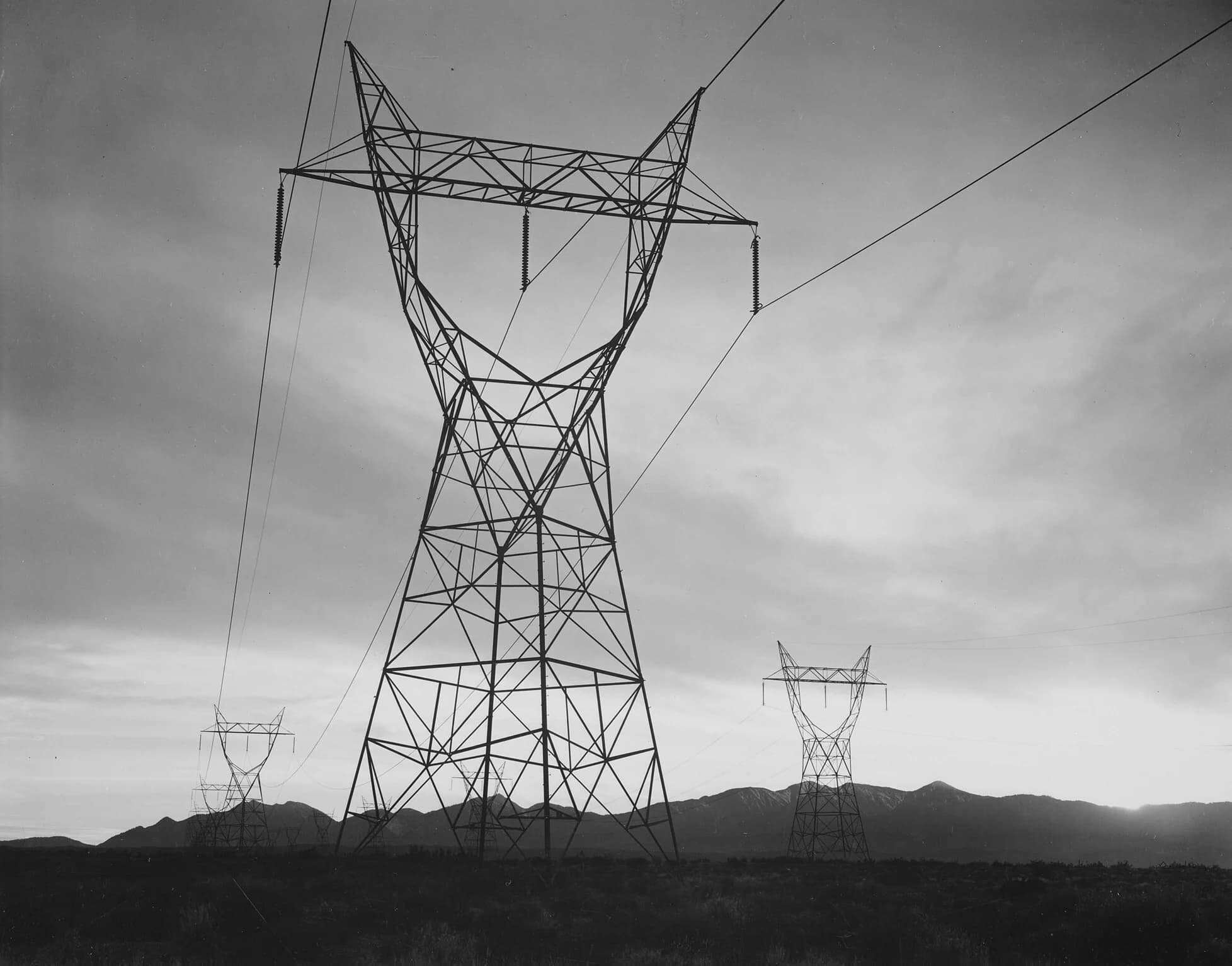
At 7:36 p.m. on October 9, 1936, Elizabeth Scattergood pressed a key in Los Angeles. The key closed the circuits of the Hoover Dam transmission line, and the first Hoover Dam power to reach the city came 266 miles to strike an electric arc in the Civic Center and light 16 searchlights on the City Hall tower. LADWP estimates a million people turned out that night for the Light on Parade.
Her father, Ezra F. Scattergood, was chief electrical engineer of the city's Bureau of Power and Light, which designed and built the line. "At the time of construction, these lines transmitted electricity at a higher voltage than any other long-distance transmission line in the world," says the Historic American Engineering Record (HAER) survey of the line at Hoover Dam, prepared in 2004 by Kurt P. Schweigert, a historian with Associated Cultural Resource Experts.
Parts of it are still hot 90 years later, LADWP says.
When did Hoover Dam start producing electricity for Los Angeles?
Hoover Dam power first reached Los Angeles on October 9, 1936, when generator N-2 was used briefly for the opening ceremony. The dam had made electricity before that. On September 11, 1936, President Roosevelt pressed a key in Washington that started a 3,500-horsepower station-service unit at the dam, and N-2 first ran on September 28, according to The Reclamation Era.
N-2 went into general service on October 22 and into regular operation under contract on October 26, LADWP says. The Bureau of Reclamation chronology dates N-2's "full operation" to October 26.
"Commercial power production at Hoover Dam power plant began on October 26, 1936," the HAER survey says.
How crews built the Hoover Dam transmission line
The Bureau of Power and Light started construction in June 1933 with a $22.8 million Reconstruction Finance Corporation loan, which covered most of the $30.2 million cost. LADWP says there were 1,608 workers in seven camps, about 30 miles apart, and four field headquarters. Its history says the heat sometimes hit 135 degrees.
The first tower went up on December 19, 1933, a mile east of Kingston Camp, before the right-of-way surveys were even finished. Between Victorville and Silver Lake, crews usually poured tower footings at night because of the heat, and steel crews took breaks every 15 minutes. LADWP's history says the 13-man assembly crews "were eventually able to erect each transmission tower in five and a half hours." In the spring of 1934, Harvard Camp set an unofficial record of 48 footings poured in a single shift.
Stringing started on March 18, 1935. Four crews of 50 men each ran a stringing machine and averaged three one-mile pulls per working day. They pulled the conductor under tension, controlled by an 8-foot capstan and brake, and handled it with special tools LADWP engineers designed to keep the hollow conductor from being scratched or kinked. The last tower was finished at Baldwin Park on July 22, 1936. Stringing wrapped up that August, and by then crews had strung 1,596 miles of conductor.
"Working on a tower is the best office in the world, when it is not raining or blowing a gale," Liam White, an overhead line engineer in Leeds, England, with 36 years in the line trade, says in an August 10 T&D World article.
LADWP counts 2,695 towers, 2,422 of them single-circuit. HAER gives the single-circuit towers as 109 feet 2 inches tall, with standard suspension strings of 24 ten-inch porcelain insulators.
The conductor was a hollow copper tube 1.4 inches in diameter, a type "developed in Germany" that "had not been previously used in the United States," the HAER survey says. The large diameter kept down corona loss (power lost as the conductor ionizes the surrounding air) without the weight and cost of solid copper. For lightning, crews strung two overhead ground wires and plowed bare copper counterpoise into the ground under the line. The whole 266 miles was patrolled daily once the line was hot.
Why 287,500 volts
The record before this line was 220,000 volts (220 kV), which PG&E says it first sent over its Pit River line on September 30, 1922. Scattergood's May 1935 paper in Electrical Engineering says two 275 kV lines would have nearly the theoretical power limit of three 220 kV lines (265,000 kilowatts against 280,000) at roughly 17 percent less cost per peak kilowatt. "Since the 275 kv lines were the most economical and fitted in best with the desirable size of receiving station already established, this voltage was selected," the paper says. The design called for 287,500 volts at the dam end and 275,000 volts at the Los Angeles end, a ratio Scattergood's engineers held with synchronous condensers at the receiving station. Rupert B. Spearman, a Bureau of Reclamation assistant engineer, says in The Reclamation Era of October 1938 that it was "the highest transmission voltage ever used in commercial operation."
"Nothing shall be constructed that is not far in advance of the standards of the moment," Scattergood told his staff from the outset, LADWP's 2026 booklet says.
Forty years earlier, the Niagara Falls to Buffalo line of November 1896 ran 26 miles at 11,000 volts, and Electrical Review reported the power delivered at Buffalo "one minute after midnight" on the night of Sunday, November 15. By those figures, the Hoover line ran about 26 times Niagara's voltage and about ten times as far.
The powerhouse and the first generators
Four 82,500-kilowatt generators, units N-1 through N-4 in the Nevada wing, were set aside for the Los Angeles circuits. Reclamation historian Wm. Joe Simonds says General Electric got the contract for the first two generators and Westinghouse the other two.
At the dam, LADWP's history says, a rigging team that included foreman Otto A. Steen strung conductors 594 feet from the towers on the canyon rim down to a steel rack on the Nevada powerhouse roof.
In October 1936, when N-2 ran alone and only for a few days, the plant produced 6,125,444 kilowatt-hours.
What Hoover Dam power did for Los Angeles
At first, Hoover Dam power covered as much as 97 percent of the city's needs, by LADWP's count. Today it is about 2 percent. In the fiscal year that ended June 30, 1938, Los Angeles took 1,136,011,638 kilowatt-hours from the plant. LADWP says it went 36 years without raising rates.
Does the line still run at 287.5 kV?
The line opened with two circuits, Boulder Lines I and II; a third, Line III, came later. LADWP upgraded stretches of Line III to 500 kV in 1970 and of Line II in 1980. "Several 287.5 kV segments of the Boulder Transmission Line remain in operation," LADWP says, and they are regularly run at more than 300 kV, mostly on the original hollow copper and insulators.
The City of Los Angeles, through LADWP, still owns the line.
After the 1994 Northridge earthquake, LADWP sent Hoover power over the 287.5 kV sections of Boulder Lines I and II and restored initial power to Watts in 38 minutes.
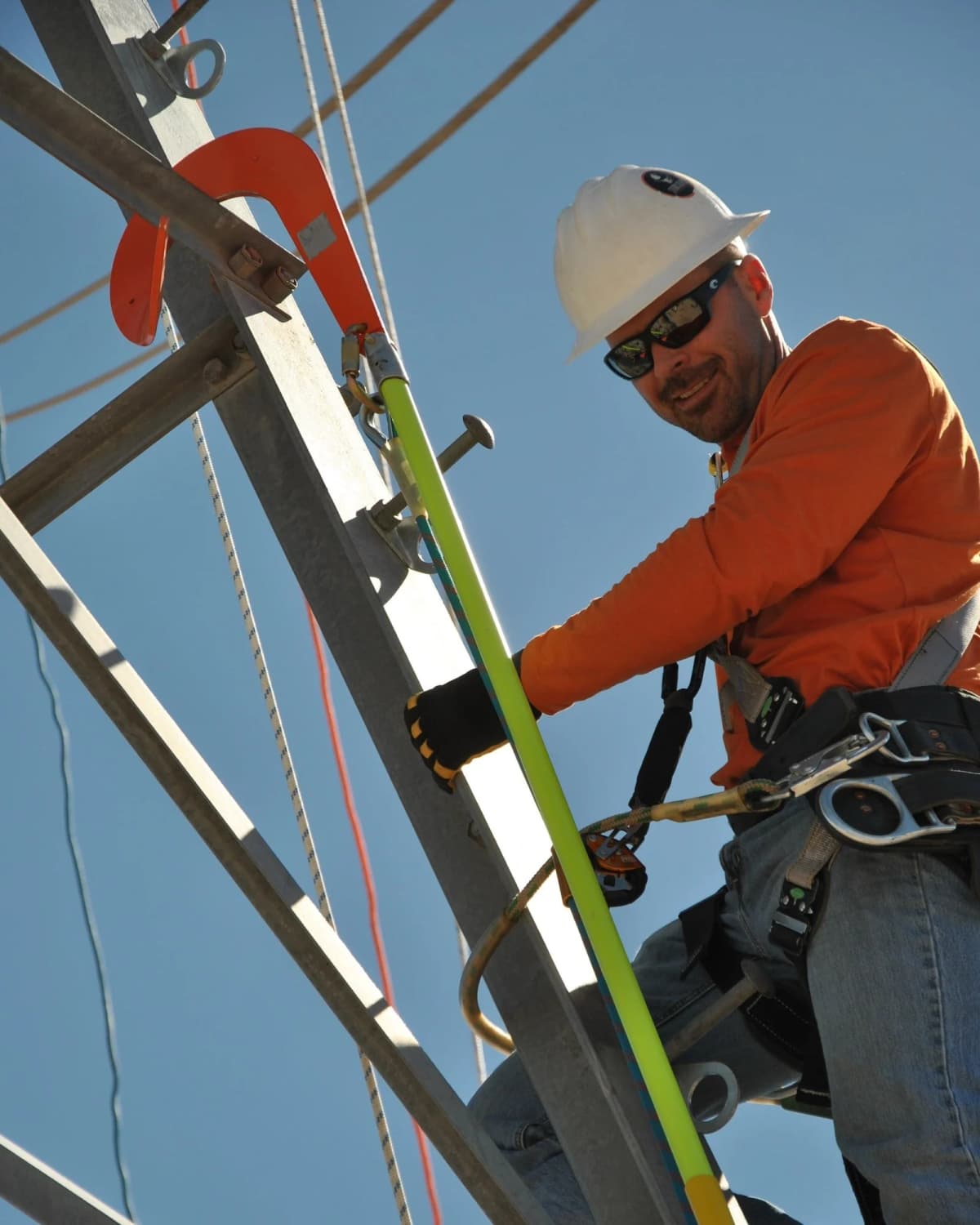
Transmission construction in 2026
LADWP's McCullough-Victorville Lines 1 and 2, the 162 miles from Boulder City, Nevada, to Victorville, are the upgraded eastern stretch of the old Boulder lines. The first of them went into service at 287.5 kV in 1936. Today they are 500 kV lines on about 1,750 towers. LADWP's proposal would replace every tower and add 475 megawatts. Construction is scheduled for mid-2027 through late 2029.
NERC, the North American Electric Reliability Corporation, says in its 2025 Long-Term Reliability Assessment that new data centers account for most of the projected rise in North American electricity demand over the next ten years. It says 41,000 miles of transmission above 100 kV are under construction or in development for that decade, up from 28,275 miles a year earlier. NERC says most of the increase is in planning and that construction has yet to grow much over past-year levels.
Sources
- Historical Overview, Los Angeles Department of Water and Power, accessed September 27, 2026.
- LADWP's Presence in Boulder City, Los Angeles Department of Water and Power, accessed September 27, 2026.
- Boulder Transmission System, Los Angeles Department of Water and Power, accessed September 27, 2026.
- Boulder Transmission Line Facts, Los Angeles Department of Water and Power, March 2026.
- Boulder Transmission System, Boulder City & Hoover Dam, Los Angeles Department of Water and Power, 2026 booklet.
- McCullough-Victorville Transmission Lines 1 and 2, Los Angeles Department of Water and Power, project page, accessed September 27, 2026.
- Early Power Transmission, Water and Power Associates (LADWP archive captions), accessed September 27, 2026.
- Historic American Engineering Record NV-27-M, Hoover Dam, Los Angeles Bureau of Power & Light Lines 1-3, Kurt P. Schweigert, Associated Cultural Resource Experts, Library of Congress, 2004, addendum 2005.
- Hoover Dam Chronology, U.S. Bureau of Reclamation, accessed September 27, 2026.
- The Boulder Canyon Project: Hoover Dam, Wm. Joe Simonds, U.S. Bureau of Reclamation, 1995.
- The Reclamation Era, volume 26 (1936), including the October 1936 issue, U.S. Bureau of Reclamation, via the Internet Archive.
- The Reclamation Era, volume 27 (1937), including the May 1937 issue, U.S. Bureau of Reclamation, via the Internet Archive.
- Power Development at Boulder Dam, Rupert B. Spearman, The Reclamation Era, October 1938, via the Internet Archive.
- Engineering Features of the Boulder Dam-Los Angeles Lines, E. F. Scattergood, Electrical Engineering, May 1935 (Bureau of Power and Light reprint via Water and Power Associates).
- A Century of Clean Power: Events Marked the 100th Anniversary of Pit 1 Powerhouse and Vaca-Dixon Substation, Pacific Gas and Electric, PG&E Currents, October 1, 2022 (Internet Archive copy).
- Niagara Falls Power in Buffalo, Electrical Review, vol. 29 no. 21, November 18, 1896 (transcription at reference.insulators.info).
- Lineworkers Around the World, Amy Fischbach, T&D World, August 10, 2026.
- 2025 Long-Term Reliability Assessment, North American Electric Reliability Corporation, January 2026.
Featured photo: Ansel Adams, 1941. U.S. National Archives, Records of the National Park Service (79-AAB-3). Public domain.