
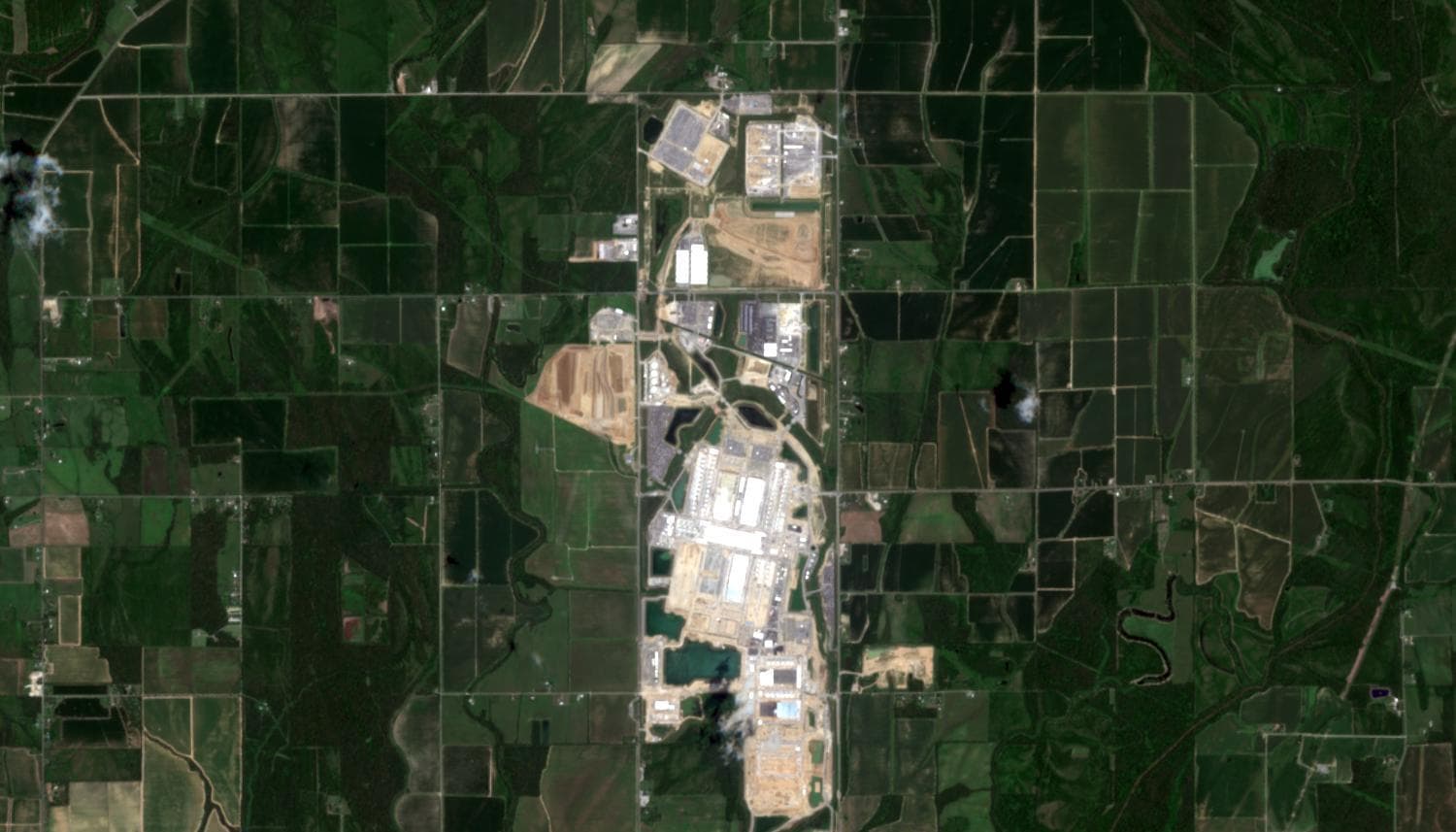
Between Rayville and Delhi, Louisiana, there's a stretch of farmland worked for generations, in a parish of 500-plus farms growing soybeans, corn, and cotton. Meta is turning it into an AI data-center campus called Hyperion, designed to scale to 5 gigawatts of electricity. Bloomberg has reported that's roughly as much power as New York City draws on a winter day.
Five gigawatts is enough for about 4.2 million American homes, by IEEE Spectrum's math. For scale, the parish it sits in has 20,043 people. And feeding it will take as many as ten new power plants, built for a single customer.
The field that waited eighteen years
The land is called Franklin Farms, and it has a backstory. Sharecropping families worked it for generations until 2006, when the owners sold it to the State of Louisiana. The state pitched the land as a megasite and hoped to land an auto plant.
The auto plant never came. Then on December 4, 2024, Meta announced a $10 billion data center across 2,250 acres of the property, and dirt started moving that same month.
The numbers kept climbing. In October 2025, Meta and Blue Owl Capital formed a joint venture that put total development costs for the campus around $27 billion. By the end of 2025, Meta had quietly picked up another 1,400 acres next door for expansion.
The size of the thing
The construction site runs five miles long and up to a mile wide. IEEE Spectrum measured the whole thing at about a quarter of Manhattan's area. The plan calls for 11 buildings totaling about 4 million square feet, each one drawing just under 500 megawatts, roughly a full power plant's worth of demand per building.
When he announced this class of campus, Zuckerberg put it this way: "Just one of these covers a significant part of the footprint of Manhattan."
What the electricians are actually wiring
At full build, IEEE Spectrum estimates the campus could hold more than 41,000 rack-scale computing systems. A single rack of the type IEEE describes weighs up to 3,400 pounds and draws about 120 kilowatts. One cabinet pulls as much power as about 100 homes.
Multiply by 41,000, then route all of it through utility interconnects, switchgear, distribution, and redundant feeds, gear that crews land and test by hand.
The structure is just as far off the standard playbook. IEEE Spectrum describes concrete floor panels spanning up to 75 feet, rated for floor loads over 600 pounds per square foot, more than double what building codes typically define for heavy industrial floors. The magazine's read on the project is that it has engineers throwing out the rule book.
Ten power plants for one customer
Hyperion needs so much electricity that Entergy is building new power plants specifically to feed it. Louisiana regulators approved the first three gas plants in August 2025, with Meta committed to covering the plants' full costs for their first 15 years, and Entergy is stringing about 100 miles of new 500-kilovolt transmission line across the state to move the power.
The order grew in March 2026, when Fortune reported an agreement for seven more gas plants, ten in all, with about 7.5 gigawatts of combined capacity estimated at nearly $11 billion, plus up to 2.5 gigawatts of renewables and battery storage. The seven new plants still need commission approval, but the full ten-plant fleet would raise Louisiana's entire grid capacity by more than 30 percent.
Six of the ten would sit in Richland Parish itself. Power plant construction is its own army of trades, from pipefitters and boilermakers to linemen and yet more electricians, which makes the data center only half the job.
Boomtown
Meta says the project will employ more than 5,000 construction and skilled-trade workers at peak. About 3,700 were already on site in March 2026, with peak expected within months.
The parish is absorbing them in real time. One contractor built a 130-acre workforce housing complex with more than 300 full-service RV sites. Two more parks under construction on one rural road are expected to add up to 700 hookups.
Meta is also funding upgrades to local roads and water infrastructure, work that stays in the parish long after the build wraps.
A resident told Fortune the glow from the overnight construction lights is visible from her front steps, and that it reminds her of New York City.
The first 2-gigawatt phase is slated for completion by 2030, and once the cranes leave, the campus will support more than 500 permanent jobs.
Who builds a thing like this
Every watt of those 5 gigawatts passes through terminations somebody torqued to spec. Thousands of tradespeople are standing up what may be the most power-hungry campus ever attempted, on ground that sat empty two years ago, and all of it, from the racks to the transmission lines, gets built by people who learned a trade.
The electrician shortage and the data-center boom were always going to land in the same place, and Hyperion is that place at full scale. It's far from the only campus like it going up right now, either. A build like this swallows electricians by the hundred, and every contractor in that corridor is short the same thing: hands.
That shortage is our day job. Rinvio staffs W-2 crews for exactly this class of build, and the pay for that work is posted on our jobs board.
The field waited eighteen years for a factory. What it got instead was five miles of job site and every trade in the book.
Sources
- Hello, Louisiana!, Meta Data Centers, December 4, 2024, for the $10 billion announcement, the 4 million square feet, the more than 5,000 construction workers at peak and the more than 500 operational jobs.
- Meta Announces Joint Venture With Funds Managed by Blue Owl Capital to Develop Hyperion Data Center, Meta, October 21, 2025, for the roughly $27 billion in total development costs.
- Meta Selects Northeast Louisiana as Site of $10 Billion Artificial Intelligence Optimized Data Center; Governor Jeff Landry Calls Investment 'A New Chapter' for State, Louisiana Economic Development, December 4, 2024, for the 2,250-acre Franklin Farm site between Rayville and Delhi and the road and water commitments.
- What Will It Take to Build the World's Largest Data Center?, by Matthew S. Smith, IEEE Spectrum, March 24, 2026, for the 4.2 million homes, the site's share of Manhattan, the 11 buildings, the 41,000 racks, rack weight and power, the floor spans and loads, and the 2030 first phase.
- Meta's $27 billion AI data center is causing chaos in small town Louisiana, by Sharon Goldman, Fortune, March 26, 2026, for the Franklin Farms history, the 3,700 workers, the workforce housing and RV parks, the infrastructure spending and the resident's description of the site lights.
- Meta orders 10 gas power plants for Hyperion AI campus in Louisiana, over triple the initial plans, by Jordan Blum, Fortune, March 27, 2026, for the seven added plants, the 7.5 gigawatts, the nearly $11 billion cost, the 2.5 gigawatts of renewables and storage and the 30 percent grid figure.
- Meta is quietly expanding its $10 billion Hyperion AI data center to four times the size of NYC's Central Park, by Sharon Goldman, Fortune, February 4, 2026, for the additional 1,400 acres.
- The power play behind Hyperion, Mark Zuckerberg's colossal data center being built in rural Louisiana, by Jon Keegan, Sherwood News, December 15, 2025, for the parish's 500-plus farms and its population of 20,043.
- Entergy gains regulatory approval for massive Meta power project, by Wesley Muller, Fox 8/WVUE, August 20, 2025, for the August 2025 approval of the first three gas plants and Meta covering their cost.
- Bloomberg (as reported), for the New York City winter-day comparison.
- Minutes of the August 20, 2025 open session, Docket U-37425, Louisiana Public Service Commission, for the vote approving Entergy Louisiana's generation and transmission for the Meta project.
Satellite image: contains modified Copernicus Sentinel-2 data (2026), rendered via Esri Sentinel-2 Views.