
Ask what a data center is made of and you get an inventory of the room: servers, storage, hot aisles. Central Conduit, which stocks raceway for hyperscale jobs, says its conduit programs are built for projects that measure conduit in "truckloads, not cart loads." A superintendent counts it the same way.
Microsoft published the quantities for one campus in September 2025, in its own account of Fairwater at Mount Pleasant, Wisconsin: 315 acres, three buildings, 1.2 million square feet under roof, and to build it, "46.6 miles of deep foundation piles, 26.5 million pounds of structural steel, 120 miles of medium-voltage underground cable and 72.6 miles of mechanical piping." Nearly 10,000 construction workers over roughly two years, according to Wisconsin's construction trade paper, which has it from Microsoft officials and does not say whether that is a headcount or a running total. The steel figure is the easiest one to put on a road. The carrier ATS publishes 46,000 to 50,000 pounds as a legal flatbed payload under the federal 80,000-pound gross limit. Call it 48,000 and 26.5 million pounds of structural steel is roughly 550 loads†. A real shipping list runs higher, because joists and deck fill a trailer before they weigh it out, and long members ride step decks under permit.
Where the $10 Billion Goes
Cushman & Wakefield's 2026 Data Center Development Cost Guide, published September 3, puts all-in greenfield development in the United States and Canada at $17.6 million per megawatt for the most modern facilities, up 21 percent since late 2024. That excludes chips and GPUs. Ten billion dollars of construction buys about 570 megawatts of building at that rate†. Announced campus dollars are usually total investment, not construction. Virginia's JLARC Report 598 put construction at about 20 percent of total data center capital investment and IT and mechanical equipment at 68 percent, on Virginia project data from fiscal 2021 through 2023, before the AI build-out. JLL has both halves in one report: up to $25 million per megawatt for the tech fit-out, the servers, GPUs and network, against $11.3 million per megawatt for shell and core. The splits differ by source. The equipment still costs more than the building.
Inside the construction dollar, Turner & Townsend's 2025 benchmark gives an air-cooled hyperscale build 54 percent electrical, 22 percent mechanical and 14 percent shell. Go liquid-cooled and electrical drops to 48, mechanical goes to 33, the shell to 9. That model covers a 30 to 50 megawatt build and excludes land, utility work, sitework and active IT equipment, so read the shares against construction, not an all-in campus budget. IBEW's own magazine has put electrical at 45 to 70 percent of the budget. The electrical share is large because the gear is expensive and long-lead: medium-voltage switchgear lineups, UPS modules, transformers, generator sets, busway. Nobody publishes the labor share inside that line, and the dollar split will not tell you either. Crew size comes off the termination count.
What Is a Data Center Made Of? The Bill of Materials, in Build Order
The list runs in build order: dirt, piles, duct bank, concrete, steel, skin, overhead racks and raceway, gear, pipe, racks, fiber. Every quantity below is as published by the named project, its contractor or utility partner, or the trade press that reported it, or by a manufacturer spec sheet where marked. Figures marked † are our arithmetic on the quantity beside them, at a 10-yard ready-mix truck, a 48,000-pound flatbed payload, and a 45,000-pound enclosed-van payload where the load is racks. NRMCA gives 9 to 11 yards as the typical truck mixer, held there by weight laws rather than drum size. Procurement runs on a different calendar. Transformers, switchgear and generators go on order first, because everything else waits on their lead times.
| Line item | Documented quantity | What that is on the road | Who installs it |
|---|---|---|---|
| Dirt | More than 1,000,000 cubic yards moved across 300 acres for a 907,000 sq ft data center in DeKalb, Illinois (Curran Contracting) | At least 18,000 haul cycles in a 55-yard off-highway truck, more once the dirt swells in the body† | Operators, laborers, teamsters |
| Piles | 46.6 miles of deep foundation piles at Microsoft Fairwater, Wisconsin | 246,000 linear feet†; Microsoft publishes length, not count | Pile drivers, operators |
| Underground conduit | About 25 miles of underground conduit at Meta Temple, Texas (JE Dunn) | 25 miles of conduit; the trench is a fraction of that, since a duct bank carries many ducts in one cut | Electricians, operators, laborers |
| Concrete | About 45,000 cubic yards for the 60 MW CTX2 campus in Houston (Cemex); up to 4,000 yards a day at the Crusoe campus in Abilene, Texas, the Stargate site (DPR Construction) | 4,500 mixer loads at CTX2 at 10 yards a truck, 5,000 at 9†; 400 trucks a day at Abilene† | Finishers, carpenters, rodbusters, pump operators |
| Tilt-up walls | 191 panels, 214,650 sq ft of wall, heaviest panel 206,000 lb, Digital Loudoun Building P, Ashburn, Virginia (Tilt-Up Concrete Association) | The heaviest panel is 2.6 times the legal gross weight of a whole truck†; it is cast on the slab it stands beside | Carpenters, rodbusters, crane crews |
| Structural steel | 26.5 million lb at Fairwater (Microsoft); 28,000 tons at QTS Cedar Rapids, Iowa (Alliant Energy); 12,000 tons at Meta Mesa, Arizona (Construction Dive) | Roughly 550 flatbeds at Fairwater and 1,170 at Cedar Rapids by weight alone†, more on a real shipping list | Ironworkers |
| Exterior panels | More than 5,000 prefabricated panels across eight buildings at Abilene, each about 10 ft wide and up to 42 ft tall (DPR) | Set at 15 to 20 panels a day on the first two buildings (ENR) | Ironworkers, sheet metal |
| Multi-trade racks | 750 prefabricated overhead multi-trade racks and more than 75 pieces of equipment over 100,000 lb each at Meta Temple (JE Dunn) | An MTR is a shop-built overhead assembly of pipe, conduit and tray, trucked as an oversize load and flown into place | Electricians, pipefitters, sheet metal, riggers |
| EMT conduit | 80,000 ft of 3-inch EMT for a 300,000 sq ft, 22.5 MW facility in Dallas, figures as of 2014 (Wheatland Tube) | 4.4 flatbeds; the truck hits its weight limit before it runs out of deck† | Electricians |
| Medium-voltage cable | 120 miles at Fairwater (Microsoft) | 633,600 feet of cable†, and more of conductor if those are multi-conductor cables; Microsoft does not publish the construction | Electricians, cable splicers |
| Main transformers | Four 135/180/225 MVA units for one Texas data center, each 370,545 lb shipping weight without oil (Pennsylvania Transformer) | Each unit is its own load; radiators, bushings and the oil travel separately | Riggers, substation electricians |
| Generators | 12 to a room, eight rooms to a building, two buildings, at Applied Digital Polaris Forge 2, Harwood, North Dakota (InForum, September 12, 2026); unit size unpublished | 96 per building, 192 on the campus†; a 2.5 MW-class set runs about 39,000 to 43,000 lb dry (Caterpillar), and the enclosure, radiator, silencers and fuel tank ship as separate freight | Riggers, electricians, pipefitters |
| Grid-scale storage | A Tesla Megapack 2 XL is listed at a maximum weight of 84,000 lb (Tesla datasheet) | 4,000 lb over the federal gross limit for a whole truck, so a unit that size moves as a permitted heavy haul, one to a trailer† | Riggers, electricians |
| Mechanical piping | 72.6 miles at Fairwater, with "172 20-foot fans" (Microsoft) | 383,000 feet of pipe†; Microsoft does not publish diameters, so no honest load count is possible | Pipefitters and welders, then insulators |
| Racks | An NVL72 rack weighs 3,000 lb (The Register) and carries "over 5,000 coaxial cables," two miles of copper wire (NVIDIA); Abilene is planned for more than 450,000 GPUs per Oracle, or up to 50,000 per building across eight buildings by developer Crusoe's account, 400,000† | About 5,550 to 6,250 racks†, arriving crated and upright; weight fills a trailer long before floor space does, about fifteen to a load†, and nobody publishes the count | Millwrights, riggers, low-voltage techs |
| Fiber | 8 million miles of optical fiber for Meta's Louisiana project, building or campus unspecified, per a Corning estimate | Fiber-miles, counted strand by strand; roughly 4,600 miles of cable at 1,728 fibers per trunk, about 9,300 at 864† | Low-voltage and fiber techs |
| Switchgear, UPS, busway, tray, chillers, CDUs, fire protection | Almost never published; the closest is an electrical contractor's case study on a named 60 MW facility in Midlothian, Texas, four 25 kV switchgear lineups and 48 distribution skids (Cummings Electrical) | The priciest scope on the job, and no hyperscale campus publishes its counts | Electricians, pipefitters, sprinkler fitters |
Before the Slab: Dirt, Piles and 4,000 Yards a Day
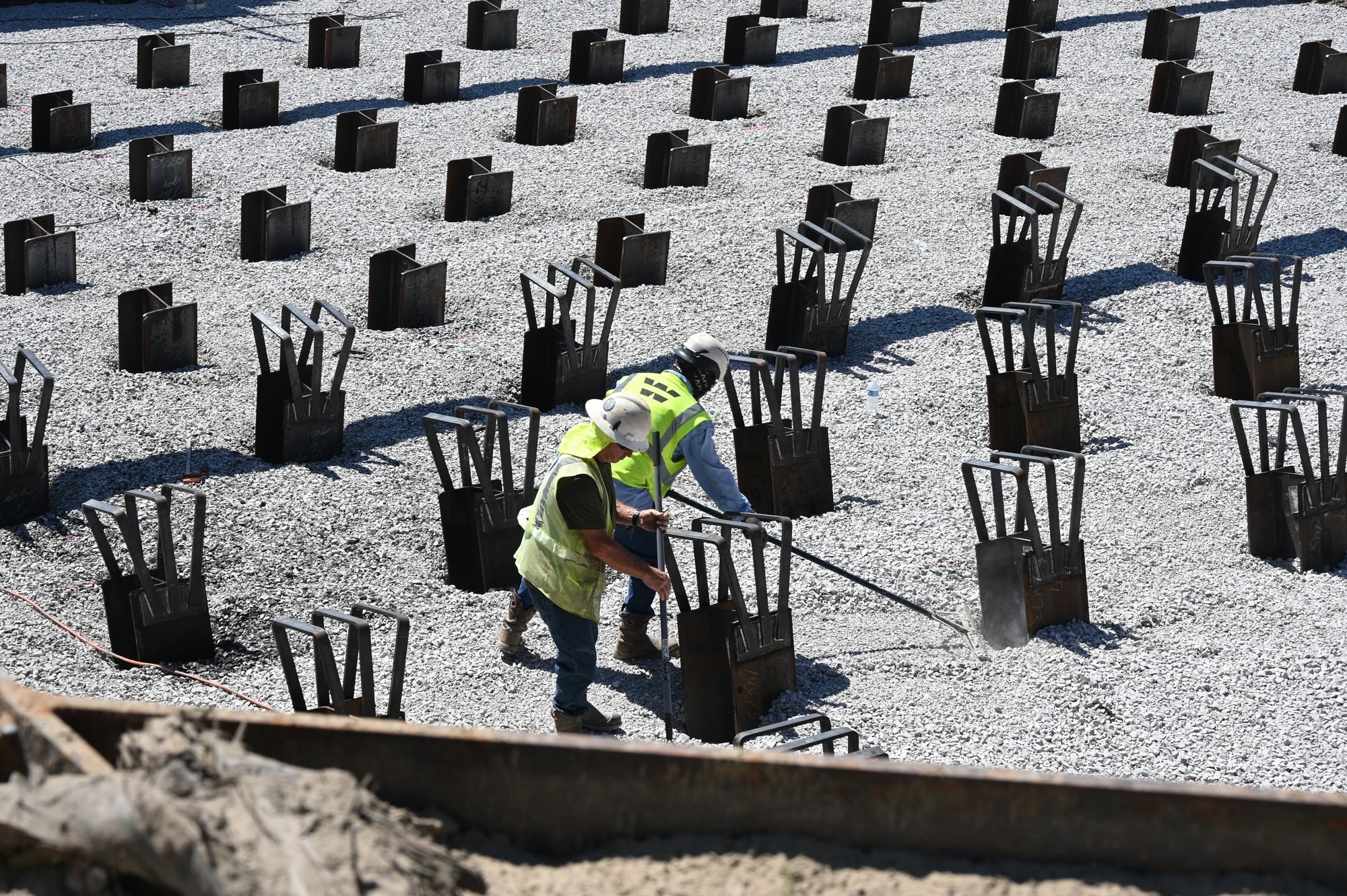
How much concrete is in a data center depends on the building. The dirt comes first either way. Curran Contracting, the site contractor, moved more than a million cubic yards of dirt across 300 acres in DeKalb, Illinois, for a single 907,000-square-foot building, through excavation, structural excavation and backfill. Caterpillar's 775G carries 55.23 heaped yards, so a million bank yards is at least 18,000 haul cycles, and more once you account for swell in the body†. The deep foundation at Fairwater runs 46.6 miles, or 246,000 linear feet†. Length is all Microsoft publishes, not count, so any pile count you see is somebody's assumption about depth.
DPR Construction's own stat block for the Crusoe campus in Abilene reads "Concrete: Up to 4,000 cubic yards poured per day." Four hundred mixer loads in a day at 10 yards a truck†, and on a ten-hour placement that is a truck discharging every 90 seconds†. A mixer takes minutes to empty into a pump hopper, so that pace puts a line of trucks on several pumps at once. Cemex's 45,000 yards at CTX2 in Houston went into a mix designed to pump through roughly 400 feet of line, 4,500 loads for a 60-megawatt build at 10 yards a truck, or 5,000 at 9†.
Doug Bevier, director of development at Clark Pacific, told IEEE Spectrum that some concrete floor panels may now span up to 23 meters, and that they need to handle floor loads up to 3,000 kilograms per square meter. It is more than twice the floor loading international building codes set for manufacturing and industry. In our units, about 614 pounds per square foot†. It is a panel design load, not the rating a finished data hall carries. Giatec puts the hall at 150 to 350 pounds per square foot. An office is 50 to 80.
The Frame and the Skin: How Much Steel Is in a Data Center?
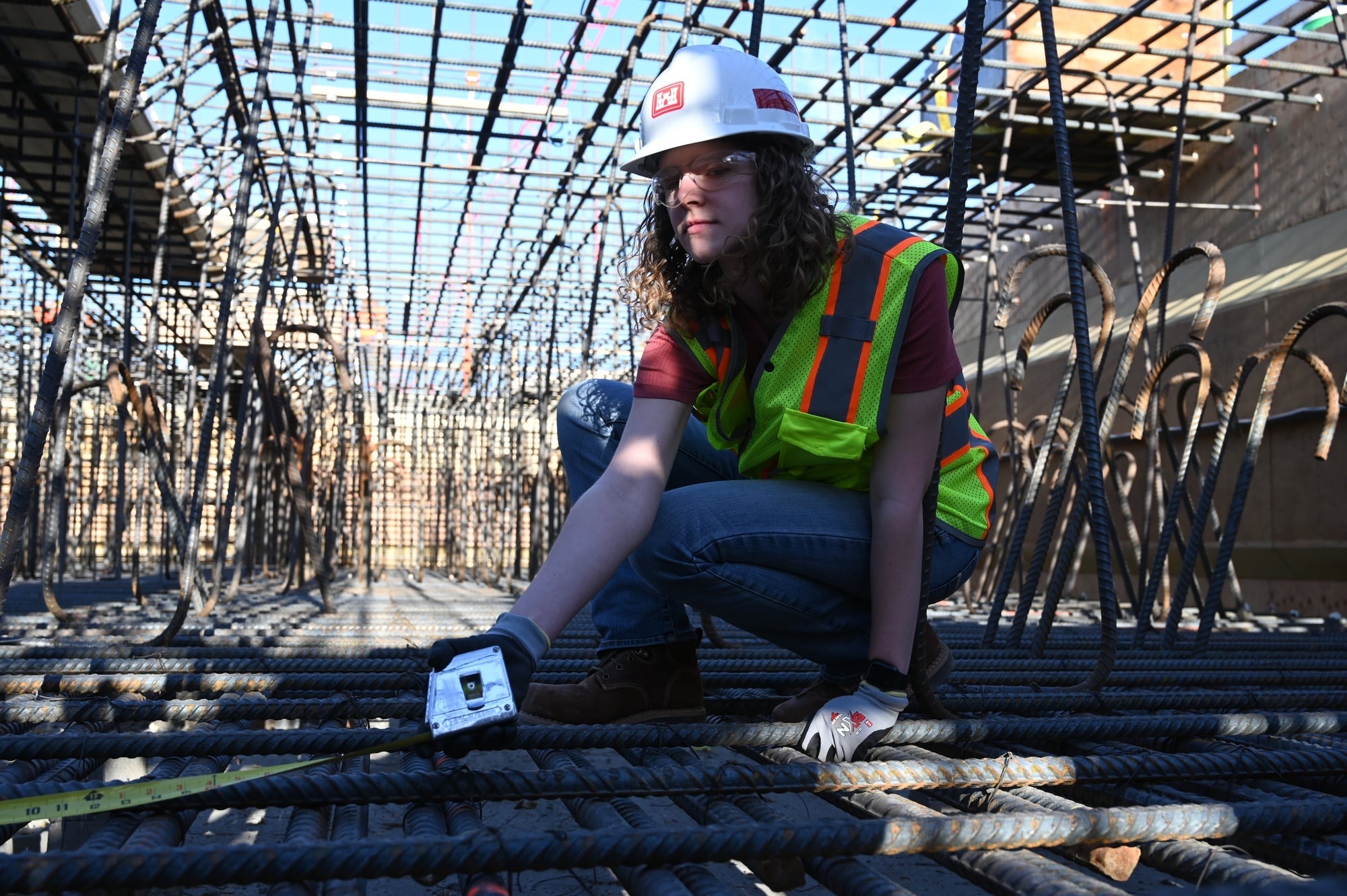
Meta's Mesa campus will use 12,000 tons of steel, 600 miles of framing studs and 700 acres of drywall, figures Mesa Mayor John Giles posted and Construction Dive reported. GP Radar, reporting the same post, put that tonnage at more than the Eiffel Tower's. Seven hundred acres of drywall is 30.5 million square feet of board†. The 600 miles of stud is 3.2 million linear feet†, and Construction Dive does not say whether the acreage counts faces or sheets. QTS's Cedar Rapids campus is going up with 28,000 tons of domestically sourced steel and 8,500 workers on site daily, according to Alliant Energy, the utility partner. Fairwater's 26.5 million pounds over 1.2 million square feet is about 22 pounds of structural steel per square foot†. Mesa's 12,000 tons across more than 2.5 million square feet works out to about 9.6†, but the two are not like for like: Mesa's area includes admin space and the campus is five buildings, where Fairwater's 1.2 million square feet is three. More than 800 projects sit on the American Project Tracker, a longer list than these.
At Abilene, DPR's prefabrication shop turned out more than 5,000 exterior panels for eight buildings, each about 10 feet wide and up to 42 feet tall, and ENR reported crews setting 15 to 20 a day on the first two buildings and closing one in under eight weeks. At Digital Loudoun Building P in Ashburn, the walls are tilt-up: 191 panels, the tallest nearly 66 feet, the heaviest 206,000 pounds. At 206,000 pounds that panel is 2.6 times the 80,000-pound federal gross limit for a loaded truck†. Nothing on a highway hauls that, and nothing has to. Carpenters form it flat on the slab, rodbusters tie it, ready-mix fills it, and a crane stands it up.
Raceway and Cable
Wheatland Tube's case study on the T5 data center in Dallas, with quantities stated as of 2014, lists 80,000 feet of 3-inch EMT for a 300,000-square-foot, 22.5-megawatt facility. The T5 job is a colo rather than an AI campus, and it is here because it is the only job we could find with in-building conduit footage published by trade size, and it was the pipe manufacturer that published it, not the owner. Wheatland's own bundle table puts 3-inch EMT at 2,683 pounds per 1,020-foot master bundle, which is where the 4.4 legal flatbeds† comes from. Same truck, same weight limit: 30 miles of half-inch, or 2.3 miles of 4-inch†.
JE Dunn's Meta Temple project ran about 25 miles of underground conduit. How much trench that took is another question, since a duct bank carries many ducts in one concrete-encased cut, and JE Dunn does not publish the configuration. Overhead, the same job set 750 prefabricated multi-trade racks once the frame was up, plus more than 75 pieces of equipment over 100,000 pounds each. Those racks buy schedule. The pipe, conduit and tray get built in a shop while the building is still going up. Fairwater's 120 miles of medium-voltage cable comes to 633,600 feet†. How much conductor that is depends on how many conductors ride inside a cable, and Microsoft has not said. Electricians and cable splicers pull and terminate every foot of it, which is why the crew list here looks nothing like an office tower's.
Transformers, Batteries, Gensets
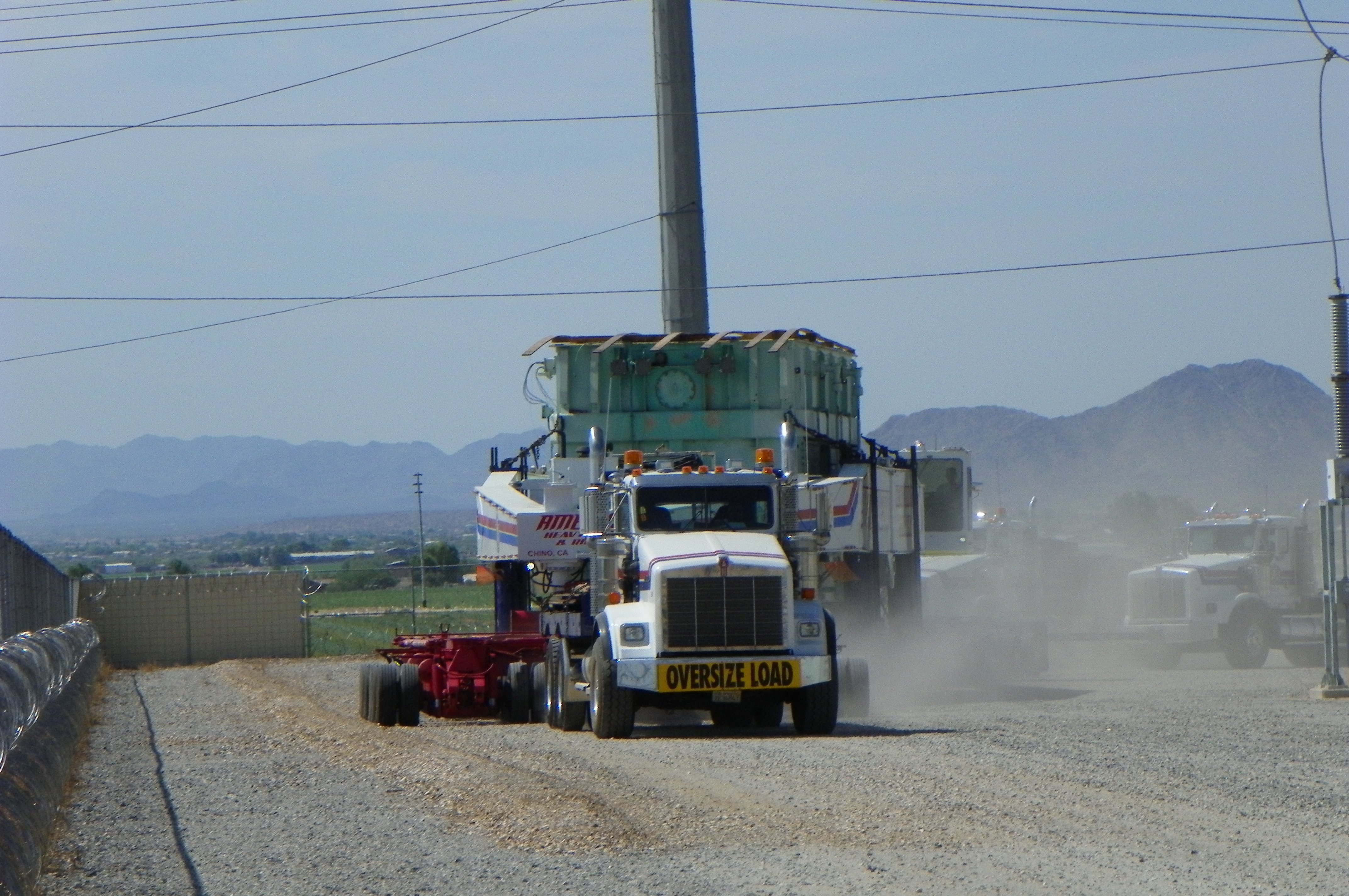
Pennsylvania Transformer built four identical 135/180/225 MVA transformers for a Texas data center at 370,545 pounds shipping weight each, without oil. It documents the final unit's trip: about 1,375 miles by rail across three railroads, then about 11 miles by road to the pad. At that weight a transformer is its own load, and the radiators, bushings and the oil itself arrive separately. A Tesla Megapack 2 XL's datasheet lists a maximum 84,000 pounds, more than a legal truck and its load are allowed to weigh together. It moves under permit, one to a trailer†. The Megapack is grid-scale storage outside the fence; the batteries that carry a facility through a transfer sit in UPS battery rooms, and no named campus publishes what is in them.
A Caterpillar 3516C generator set rated 1,650 to 2,500 ekW weighs 35,880 to 38,780 pounds dry, the C175-16 rated 2,500 to 3,100 ekW runs 42,750 to 50,500, and the C175-20 rated 3,150 to 4,000 ekW weighs up to 66,200, from Caterpillar's spec sheets. Applied Digital's Polaris Forge 2 campus at Harwood, North Dakota will hold 12 generators to a room, eight rooms to a building and two buildings, which is 96 per building† and 192 across the campus†. The company has not published their size. The engine and alternator ride in on their own skid. The enclosure, radiator, silencers, sub-base tank and controls follow as separate loads. Nick Phillips, an Applied Digital executive vice president, told InForum the two buildings will have roughly 86,000 electrical connections. Every one of them gets landed by hand.
Pipe and Fans
Microsoft's 72.6 miles of mechanical piping at Fairwater feeds what it calls the second largest water-cooled chiller plant on the planet, with "172 20-foot fans" on the sides of the building. The closed loop fills once and then recirculates. Microsoft says the initial fill at its Atlanta Fairwater buildings is equivalent to what 20 homes consume in a year, and is designed for six-plus years. QTS says each of its seven Cedar Rapids buildings begins operations with cooling water equivalent to an Olympic-sized swimming pool, per Alliant Energy. NVIDIA's DGX GB200 NVL72 rack takes 2 liters of coolant per second on the rack side. Abilene is planned for more than 450,000 GPUs by Oracle's account, or up to 50,000 per building across eight buildings by developer Crusoe's account, which comes to 400,000†. Either way that is about 5,550 to 6,250 racks at 72 GPUs each†. That is on the order of 180,000 to 200,000 gallons a minute†, spread across thousands of rack loops behind the coolant distribution units on each row.
Inside One Rack, and How Many GPUs Are in a 1 GW Data Center
An NVL72 weighs 3,000 pounds and holds 72 GPUs, per The Register's briefing write-up, and NVIDIA says its NVLink spine is built from "over 5,000 coaxial cables," two miles of copper wire inside one cabinet. The same rack is how you size a gigawatt. At 120 kilowatts and 72 GPUs to a rack, a gigawatt of rack load is 8,333 racks†, or about 600,000 GPUs†. That counts rack power only, before cooling and distribution take their share. They come in crated and upright, about fifteen to a trailer by weight†.
Dr. Dong Hao of Corning, speaking at the Broadband Nation Expo in November 2025, estimated 8 million miles of optical fiber for Meta's Louisiana project, counted strand by strand rather than by cable. The reporting does not say whether he meant one building or the whole campus. Trunk size decides what a crew actually pulls. At 1,728 fibers per cable, a common high count for AI backbone trunks, that is roughly 4,600 cable-miles†; at 864 fibers it is closer to 9,300†, and inside the halls, on lower counts, the pulled mileage runs higher still.
Who Puts It There
Virginia's auditors put one data center building at 12 to 18 months and a campus at five years or more, and data center representatives told them about 1,500 workers are on site at the height of construction. Fairwater's nearly 10,000 reads like a running total across every trade on that first facility, and Microsoft has not published a peak. Michael Ervin, organizing director of Operating Engineers Local 139, said of his members on that job: "Since day one, they have helped build it safely, professionally and with pride in their craft." Ralph Oropeza, business manager of the Greater Kansas City Building and Construction Trades Council: "It's like the '90s on steroids. Those jobs were in the millions (of dollars). Now we're talking about jobs in the billions."
The World Economic Forum and Kearney put around 60 to 75 tonnes of minerals in every megawatt, most of it in the power and cooling systems rather than the servers. In the same analysis, Microsoft's 80-megawatt Chicago site used about 2,100 tonnes of copper, a figure that dates to the site's 2009 completion and is still in circulation. That is 26 tonnes per megawatt with the on-site and near-site power connections counted in, about 12 for the facility by itself. Scale the all-in figure to a gigawatt and the copper is about 1,200 flatbeds†; the facility-only figure is about 550†.
Sources: Microsoft, "Inside the world's most powerful AI datacenter" (Fairwater, September 18, 2025) and Fairwater Atlanta materials; The Daily Reporter (Wisconsin), June 24, 2026; Central Conduit; ATS flatbed payload guidance; FHWA vehicle weight limits; NRMCA, About Concrete (truck mixer capacity); Cushman & Wakefield, 2026 Data Center Development Cost Guide (September 3, 2026); JLL, 2026 Global Data Center Outlook; Virginia JLARC Report 598 (December 2024); Turner & Townsend Data Centre Cost Index 2025; IBEW Electrical Worker; Curran Contracting (DeKalb); Cummings Electrical (MDN Data Center, Midlothian, Texas); Caterpillar 775G Specalog and 3516C / C175 generator set specifications; Cemex (CTX2 Houston); DPR Construction (Abilene); ENR, "Project Team Pushes Limits on Abilene Data Center Job" (enr.com, August 4, 2025; August 11, 2025 issue); Tilt-Up Concrete Association project database (Digital Loudoun Building P); Alliant Energy (QTS Cedar Rapids, May 7, 2026); Construction Dive and GP Radar (Meta Mesa, Mayor John Giles); IEEE Spectrum; Giatec; JE Dunn (Meta Temple); Wheatland Tube (T5 Dallas case study and EMT submittal sheet); Pennsylvania Transformer Technology; Tesla Megapack 2 XL datasheet; InForum, September 12, 2026 (Polaris Forge 2); NVIDIA; The Register; Oracle AI World keynote coverage and Crusoe; Corning remarks at Broadband Nation Expo (November 18, 2025); World Economic Forum and Kearney (December 10, 2025); Operating Engineers Local 139 and Greater Kansas City Building and Construction Trades Council statements as reported. Featured photo: U.S. Army Corps of Engineers photo by Ryan Labadens, via DVIDS (public domain); the appearance of U.S. Department of Defense visual information does not imply or constitute DoD endorsement.