
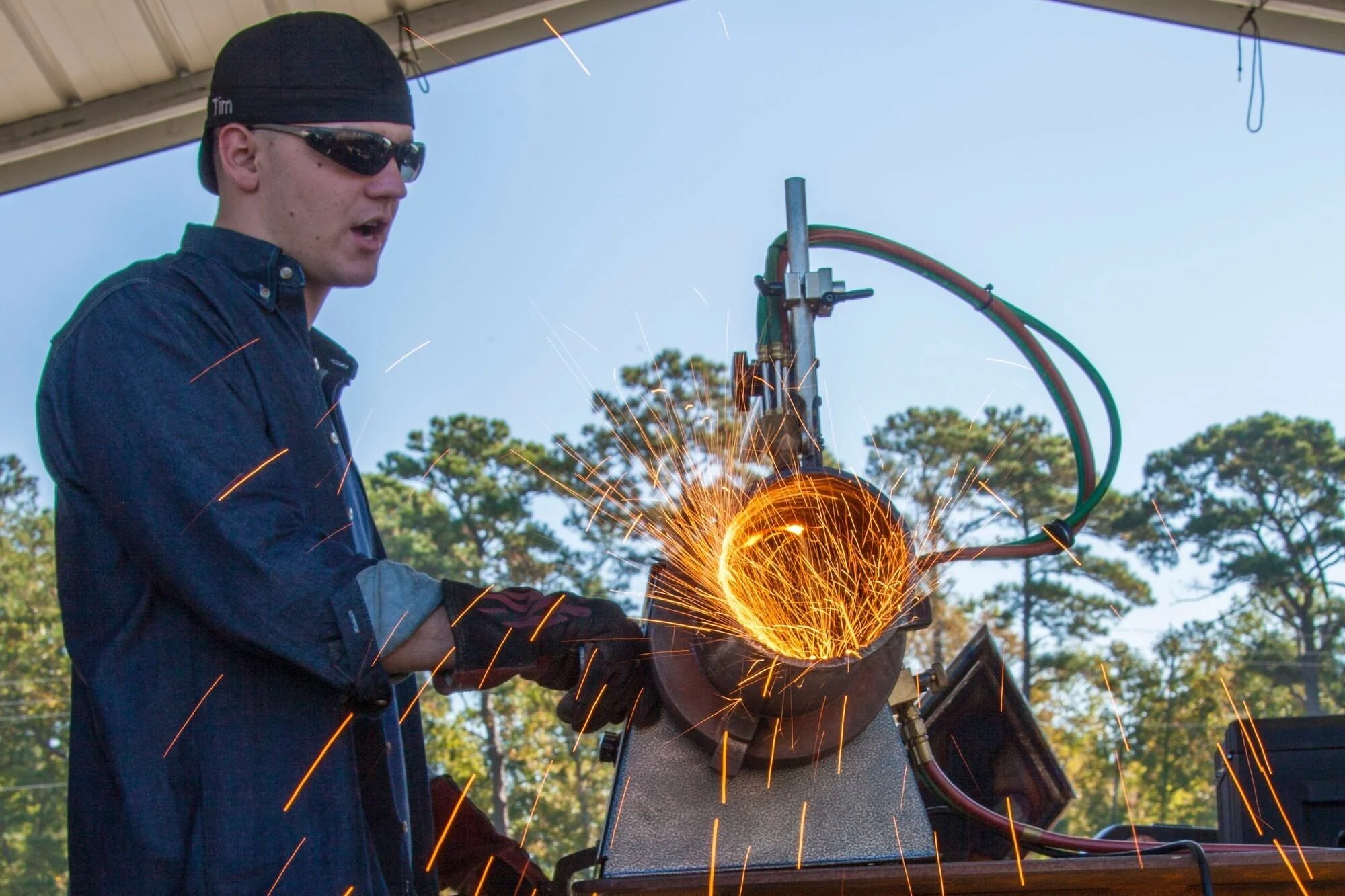
You can spend four years pulling wire in uniform and walk out holding no license in any state. What you walk out with is credit. The move from military to electrician runs through a civilian apprenticeship, which pays from the first day. Navy Construction Electricians train 20 weeks at Sheppard Air Force Base. Air Force electrical systems specialists, the 3E0X1s, do 99 days at the same base. Neither sends anybody home with a journeyman card.
You do not start over.
You start in a registered apprenticeship, a program the Labor Department or a state agency has approved, with a wage that steps up on a schedule and hours that count toward a license.
What the numbers say about veterans in the skilled trades
Veterans do not flood into construction. In the Bureau of Labor Statistics 2025 annual averages, released April 28, 2026, construction and extraction occupations account for 5.2 percent of employed veterans and the same 5.2 percent of nonveterans. The gap shows up one category over. Installation, maintenance and repair work accounts for 6.8 percent of employed veterans against 2.9 percent of nonveterans. BLS warns that its 2025 figures are 11-month averages excluding October, after the shutdown stopped collection.
The trade is hiring. BLS puts the median electrician wage at $63,190 a year, or $30.38 an hour, in May 2025, with about 72,700 openings a year through 2035. Read that median for what it is. It pools every electrician in the country, apprentices included.
Three ways to go from military to electrician
If you are still in, SkillBridge is the first option. It puts you in civilian training during your last 180 days on active duty, and you keep military pay; the host pays you nothing, by rule, and its FAQ says finishing entitles you to no job with that host. Approval comes from the first field-grade commander in your chain, O-4 or above, who holds non-judicial punishment authority under Article 15 of the UCMJ, and you need 180 continuous days of active duty behind you.
If you are already out, the Veteran's Electrical Entry Program is the second. VEEP takes applicants up to five years past separation, from every component, with an Honorable or General (Under Honorable) discharge. Tuition and books are covered, and its FAQ says no particular military occupation code is required. Finish the pre-apprenticeship and VEEP's Protech Skills Institute arranges direct entry at the IBEW/NECA training center with jurisdiction over where you want to live. The electrical training ALLIANCE has funded VEEP since its 2019 founding. Cohort length varies by site. The hours after that do not. An inside wireman works 8,000 hours on the job before turning out.
Mike Smith is the IBEW's international representative for veterans affairs, and he spent ten years in the Navy before getting out as a petty officer first class.
"But VEEP graduates upon entering an IBEW/NECA apprenticeship are still under a 2,000-hour probationary period, like any other apprentice," he says. "That gives the local the leverage to see if this person works out, veteran or non-veteran."
Direct entry does not move your pay. VEEP's own FAQ puts you in as a first-year apprentice, and the 8,000 hours start from zero. Rank does not travel.
Helmets to Hardhats is the third. "Helmets to Hardhats is not a job referral but a job information deal," Smith says. You register online, a staff member in your region is assigned to you, and the counter on its About page reads 41,000-plus service members assisted into careers.
The pipe trades run their version on base, before you separate. UA Veterans in Piping is 118 days and 720 hours, taught at seven installations, open only to active-duty members whose 180-day transition window covers the course. It costs nothing and does not touch your GI Bill. It will not make you an electrician. Genaro Soto, a Marine sergeant until 2024 and a third-year HVACR apprentice at UA Local 421 in North Carolina when UA VIP profiled him in June 2026, heard about it from a career planner. "Prior to that, I had never heard of the program, which made me realize that many service members may not be fully aware of the opportunities it provides," he says.
Can you use the GI Bill for an electrician apprenticeship?
Yes, once you separate. Not before. VA rules bar active-duty members from the on-the-job training benefit, so SkillBridge and the GI Bill run in sequence.
Here is the money. Under the Post-9/11 GI Bill, an apprentice draws a monthly housing allowance on top of the paycheck from the contractor or the local. The allowance runs 100 percent of the full BAH rate for months 1 to 6, 80 percent for months 7 to 12, 60 percent for months 13 to 18, 40 percent for months 19 to 24, and 20 percent after two years. The percentage applies to the BAH for an E-5 with dependents at the training zip code, and the rates VA posted run through July 31, 2027. Books and supplies pay up to $83 a month, under a cap of $1,000 an academic year.
Work under 120 hours in a month and the payment drops; nothing arrives until your employer reports the hours, and the program has to be VA-approved, which you check in the GI Bill Comparison Tool.
Somebody at the local certifies those hours to VA. "Very important. I certified those OJT hours at my local," Smith says.
Advanced standing: credit for hours you already served
29 CFR 29.5(b)(12) obliges a registered program to grant credit "for demonstrated competency, acquired experience, training, or skills for all applicants equally, with commensurate wages for any progression step so granted." Credit that moves your position but not your pay step is not compliant credit.
Bring paper. The DD Form 2586 documents military experience and training. On the DD-214, copy 4 or copy 6 shows character of service and copy 1 does not. North Dakota's veterans department spells that out. Guard and Reserve members use the NGB 22.
The Labor Department sponsors the O*NET military crosswalk, which returns anywhere from nine to two dozen civilian matches for each electrical rating and specialty code. Every one of those lists includes 47-2111.00, Electricians. None of it is a prerequisite. "I was an infantryman, so there's not a lot of specific technical skills that pertain to electrical work in that role," says Dalton Thompson, an apprentice wireman at IBEW Local 665 in Lansing, Michigan.
North Dakota's hour count, and the Fargo apprenticeship's veteran policy
Every state counts hours its own way. North Dakota licenses on hours. The State Electrical Board requires 8,000 hours of practical experience, which cannot be earned in under three years, plus 576 hours of training classes. N.D. Admin. Code 24.1-03-01-03 allows up to 2,000 hours of credit for electrical construction experience gained in the armed forces, if the board finds it equivalent to work under a North Dakota licensed contractor. That is a quarter of the requirement.
The Dakotas Electrical Apprenticeship, which runs the Fargo training center at 2901 1st Ave N, writes military service into its entry rules. Applicants with at least three years of active duty and an honorable discharge inside five years of applying may qualify for Direct Entry or Direct Interview. The program runs four years, paid, with classes free beyond a yearly access fee due the first day of class. Its jurisdiction takes in 19 Minnesota counties, so Moorhead applicants apply to the same program.
In those same 11-month 2025 averages, BLS put the unemployment rate among North Dakota's veterans, a population of roughly 44,000, at 0.6 percent.
Nicholas Tardiff spent four years as an Army infantryman and is now an apprentice at Pipefitters Local 537 in Dorchester, Massachusetts. "The military is very rigid and structured, and leaving that environment once you get used to it can be difficult for anybody," he says.
Sources
- Employment Situation of Veterans Summary, 2025, U.S. Bureau of Labor Statistics, April 28, 2026.
- Table 4. Employed people 18 years and over by occupation, sex, veteran status, and period of service, 2025 annual averages, U.S. Bureau of Labor Statistics, April 28, 2026.
- Table 5. Employed people 18 years and over by industry, class of worker, sex, veteran status, and period of service, 2025 annual averages, U.S. Bureau of Labor Statistics, April 28, 2026.
- Table 6A. Employment status of veterans 18 years and over by state, 2025 annual averages, U.S. Bureau of Labor Statistics, April 28, 2026.
- Employment Situation of Veterans, 2025, news release PDF (USDL-26-0666), U.S. Bureau of Labor Statistics, April 28, 2026.
- Electricians, Occupational Outlook Handbook, U.S. Bureau of Labor Statistics, last modified August 27, 2026.
- DoW SkillBridge program site, U.S. Department of War, accessed September 27, 2026.
- SkillBridge FAQ, U.S. Department of War, accessed September 27, 2026.
- 2026 DoW SkillBridge Memorandum of Understanding, section 4.2.11, Office of the Under Secretary of War for Personnel and Readiness, 2026.
- About VEEP: How the Veteran Electrical Entry Program Works, Veteran's Electrical Entry Program, accessed September 27, 2026.
- Upcoming VEEP Cohorts, Veteran's Electrical Entry Program, accessed September 27, 2026.
- VEEP FAQs: Veteran Electrical Entry Program Questions Answered, Veteran's Electrical Entry Program, accessed September 27, 2026.
- A Q&A with Mike Smith: New IBEW Appointee Has Veterans' Backs, The Electrical Worker, IBEW, June 1, 2025.
- VEEP Gets National Stage, Potentially Large Funding Boost, The Electrical Worker, IBEW, November 1, 2025.
- My IBEW Story: Dalton Thompson, The Electrical Worker, IBEW, August 1, 2025.
- FAQs About the Veterans in Piping Program, UA Veterans in Piping, accessed September 27, 2026.
- UA VIP Graduate Genaro Soto Earns Spot in District Competition, UA Veterans in Piping, June 16, 2026.
- VIP Graduate Tardiff Earns Spot in Apprenticeship District Competition, UA Veterans in Piping, June 19, 2026.
- About H2H, Helmets to Hardhats, accessed September 27, 2026.
- Frequently Asked Questions, Helmets to Hardhats, accessed September 27, 2026.
- Post-9/11 GI Bill rates, August 1, 2026 to July 31, 2027, U.S. Department of Veterans Affairs, accessed September 27, 2026.
- On-the-job training and apprenticeships, U.S. Department of Veterans Affairs, accessed September 27, 2026.
- 29 CFR 29.5, Standards of apprenticeship, Electronic Code of Federal Regulations, accessed September 27, 2026.
- What Is Advanced Standing for Military Experience?, Apprenticeship.gov, U.S. Department of Labor, accessed September 27, 2026.
- Military Crosswalk Search, O*NET OnLine, sponsored by the U.S. Department of Labor, accessed September 27, 2026.
- Construction Electrician, U.S. Navy, navy.com, accessed September 27, 2026.
- Electrical Systems Specialist (3E0X1), U.S. Air Force, airforce.com, accessed September 27, 2026.
- Veterans' Preference: Documentation required by applicant, North Dakota Department of Veterans Affairs, accessed September 27, 2026.
- Qualifications for Licensure, North Dakota State Electrical Board, accessed September 27, 2026.
- Apprenticeship Information & Registration, North Dakota State Electrical Board, accessed September 27, 2026.
- N.D. Admin. Code 24.1-03-01-03, Journeyman electrician, North Dakota Legislative Branch, amended effective October 1, 2020.
- Applicants, Dakotas Electrical Apprenticeship, accessed September 27, 2026.
- Geographical Areas Covered, Dakotas Electrical Apprenticeship, accessed September 27, 2026.
Featured photo: U.S. Marine Corps photo by Cpl. Carolyn P. Pichardo, via DVIDS (public domain); the appearance of U.S. Department of Defense visual information does not imply or constitute DoD endorsement