
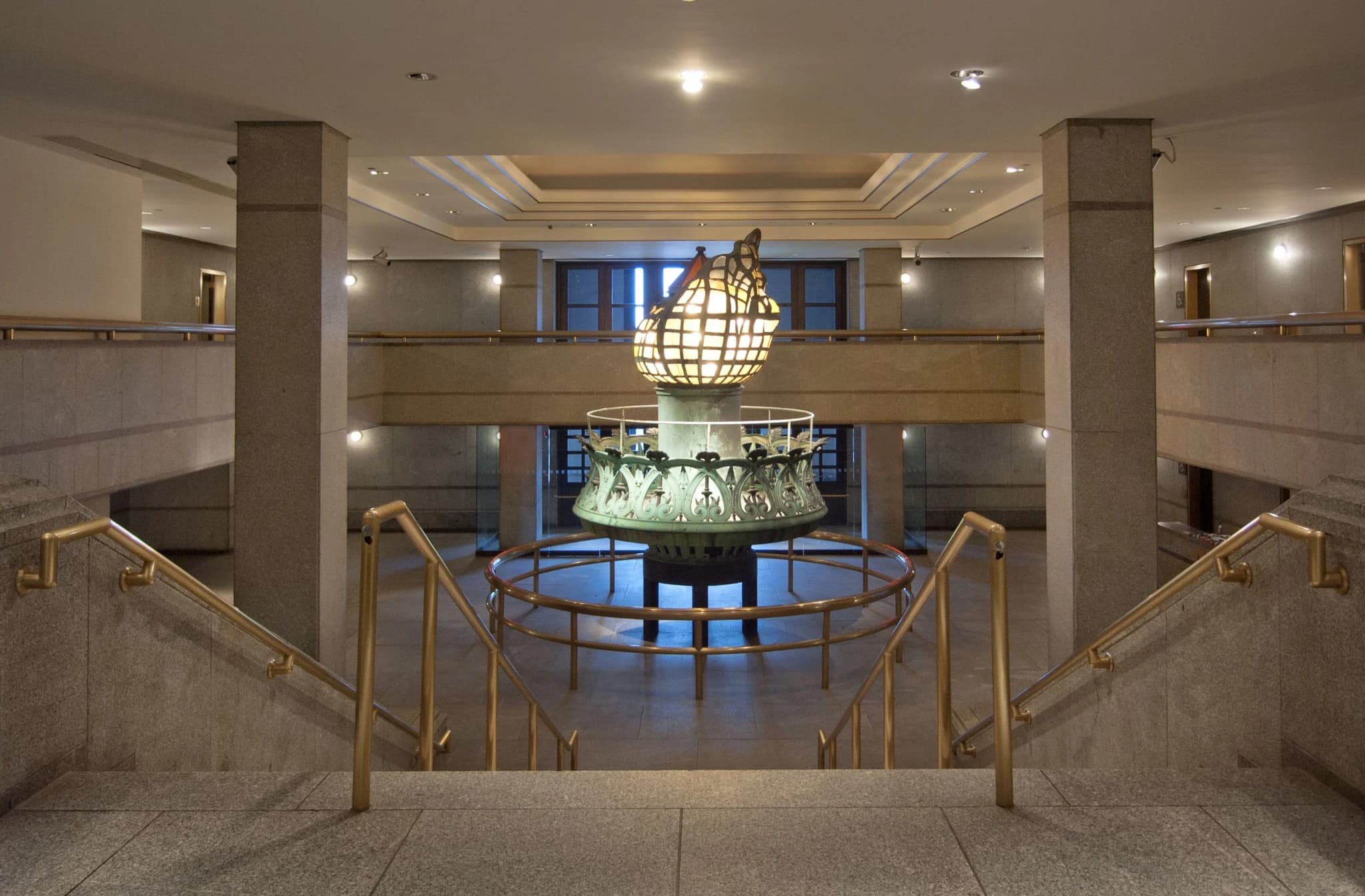
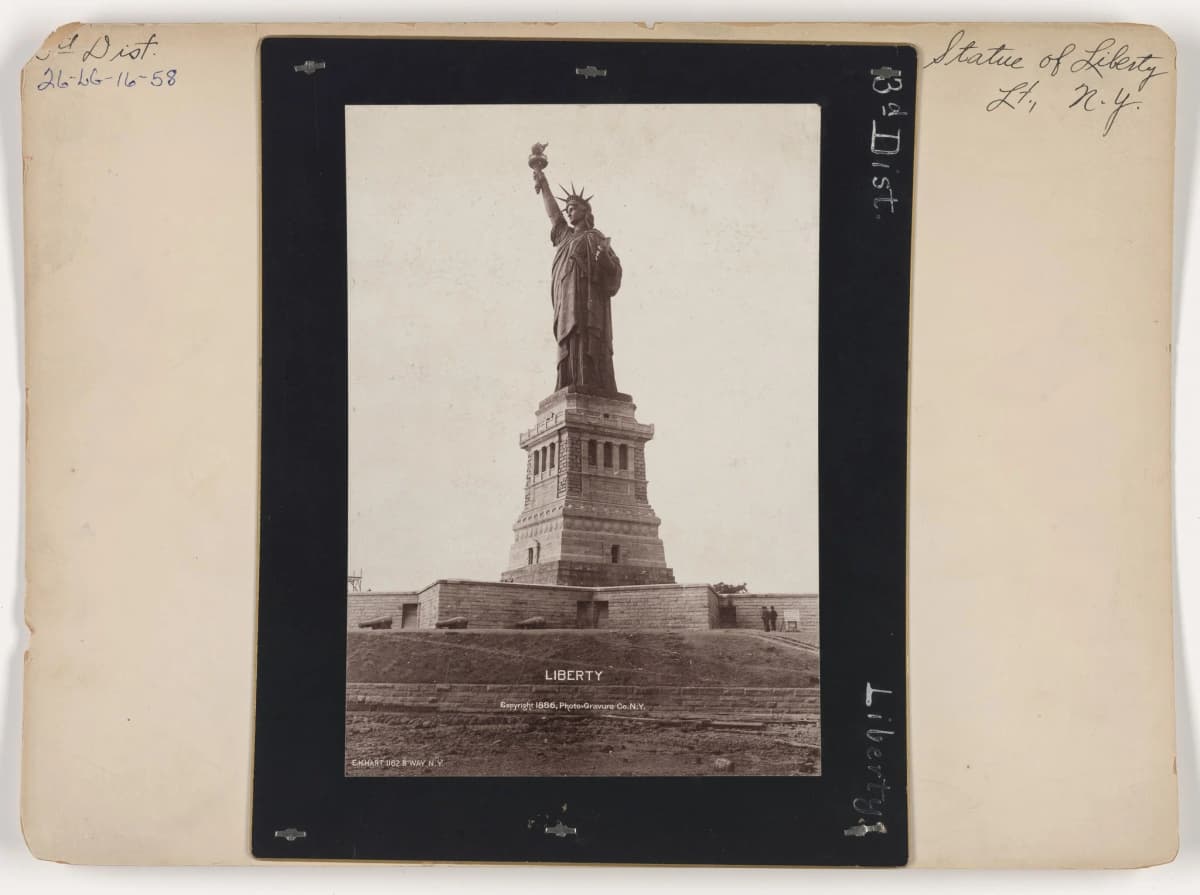
It rained, and fog covered New York Harbor on Thursday, October 28, 1886, the day the statue was dedicated. The torch never came on. The next morning's New-York Tribune ran the front-page line "THE TORCH NOT LIGHTED." The torch was first shown four days later, and three weeks after that the Statue of Liberty lighthouse went into federal service, run by the U.S. Light-House Board off a steam plant in an old Army fort on what was then Bedloe's Island. The dedication's 140th anniversary falls on October 28, 2026.
Was the Statue of Liberty a lighthouse?
Yes. From November 22, 1886, to March 1, 1902, the Light-House Board kept the torch lit as an aid to navigation.
Congress had acted nine years earlier. Its joint resolution of March 3, 1877 (Joint Resolution No. 6, 19 Stat. 410) let the President make rules for the statue's "future maintenance as a beacon." President Grover Cleveland used that power in an order dated November 16, 1886. The order directed that the statue "be at once placed under the care and superintendence of the Light-House Board."
The statue was not the Light-House Board's first electric light, either. The Electrical World of October 25, 1884, says the Board had lit an electric tower at Hallett's Point on the East River on October 20, 1884.
How the Statue of Liberty lighthouse was wired
The job went to John Millis, a first lieutenant of engineers in the U.S. Army. Maj. Gen. J. M. Schofield, whom the President had put in charge of preparations for the dedication, called him in on September 28, 1886. Millis filed a plan on October 11. Schofield approved it two days later.
The plan put 10 arc lamps inside the copper flame, glassed in so the light would show around the whole horizon. Millis wanted a proper lens and had no time to get one. His layout was "the best that the circumstances will admit," Millis says in his October 11 letter.
Joseph Funck, foreman of the lamp shop at the Board's depot, suggested a faster way to open up the flame, and two rows of round holes went in, 11 inches in diameter on top and 10 inches below, each glazed with plate glass. Millis's station report of January 15, 1887, counts 36 holes. Only nine of the planned lamps fit in the flame.
The electrician James J. Wood designed and built the apparatus, a gift to the government, and Millis says the builders put it up in about a month. The Board's annual report for fiscal 1887 lists a 60-horsepower horizontal tubular boiler, a 50-horsepower steam engine, one dynamo, nine duplex arc lamps in the torch, five single arc lamps at the salients (the projecting points) of Fort Wood and one in the engine room. The Electrical World of October 30, 1886, says the dynamo was rated for 15 lamps at 875 revolutions per minute, with 30 amperes at 700 volts. The machine weighed 3,700 pounds.
The boiler sat in the fort's ditch under a temporary shed, which was also the coal shed. The island had no reliable water, so it came over by boat and ran through a pipe to two wooden tanks by the boiler. The dynamo was in a casemate, a vaulted room built into the fort wall. From there, wires ran around the inside crest of the fort to the lamps at the salients and up through the pedestal and statue to the torch, about 300 feet above mean high water.
The first lighting, November 1, 1886
The whole plant passed its first full test at 5 p.m. on October 27.
The Sun's account of Monday, November 1, puts four men in the brick-vaulted engine room. Millis was "in general charge of the lighting," The Sun says, and Andrew J. Schlichter was "in charge of the dynamo and the electrical apparatus," with engineer George River and fireman Walter Scott. Millis had his watch open when he announced "All ready."
"Schlichter slipped the copper wire into place and completed the circuit," The Sun says. Scott started the engine. Schlichter's first order was "Let her go slow," and after that he called for full speed. The Board's report has the light first exhibited at 7:35 p.m.
The torch burned nightly through Saturday, November 6. With no money to run it, it went dark on November 7.
After Cleveland's order, the Board relit it on November 22. "Mistaking the first gun of the salute for the sunset gun, the engineer on Bedlow's Island started the dynamo," The Sun of November 23 says.
How far ships could see the light
In April 1887 Millis asked the harbor pilots how far out they could see it.
"The pilots state that they have seen the light on Liberty statue at about 20 to 23 miles distance in fair weather," says D. A. Nash, secretary of the Board of Commissioners of Pilots, in an April 5 letter.
"Of course, a very large proportion of the light is wasted," Maj. David Porter Heap, engineer of the Third Light-House District, says in the Board's 1892 report. Heap replaced the nine lamps, each about 2,000 candlepower, with one self-focusing 5,000-candlepower lamp. The round holes gave way to an 18-inch belt of plate glass.
Why the Statue of Liberty is no longer a lighthouse
The light had been deemed "useless" for navigation, the Coast Guard history office says. On December 30, 1901, President Theodore Roosevelt approved moving the statue from the Treasury Department to the War Department. A Light-House Board notice dated February 12, 1902, says the "fixed white electric light" would be discontinued on or about March 1, 1902.
Does Lady Liberty's torch light up?
It does, though the light now comes from outside the flame. In 1916 the flame was rebuilt as a glass torch of 600 pieces with lamps inside it, work the Park Service credits to sculptor Gutzon Borglum. Floodlights on the statue came on December 2, 1916. At a dinner that night, Col. John Millis "spoke of the difficulties encountered in devising some means of illuminating the torch" back when "electrical knowledge was meagre," The Sun says.
New floodlights went on October 26, 1931. A replica of sculptor Auguste Bartholdi's original torch design went up in November 1985 and was dedicated on July 4, 1986. Its flame is copper, covered in 24K gold leaf, with no lamp inside it. It is lit at night by 16 LED floodlights.
"National Park Service staff must climb a narrow 40ft. ladder in order to maintain the floodlights that light the torch," the Park Service says.
Sources: Joint Resolution No. 6, 44th Congress, March 3, 1877, 19 Stat. 410 (govinfo.gov); Grover Cleveland, Executive Order of November 16, 1886, The American Presidency Project, UC Santa Barbara; Annual Report of the Light-House Board for the Fiscal Year Ended June 30, 1887, Appendix No. 1, report of Lt. John Millis with letters of D. A. Nash, Board of Commissioners of Pilots (GPO, 1887); Lt. John Millis, Light-House Board station report for Liberty Enlightening the World, January 15, 1887 (U.S. Lighthouse Society transcription); Maj. David Porter Heap, Appendix 4, Report of the Light-House Board, 1892; Arnold B. Johnson, The Modern Light-House Service (Light-House Board, 1889); The Electrical World, October 25, 1884, and October 30, 1886 (Internet Archive); New-York Tribune, October 29, 1886 (Library of Congress, Chronicling America); The Sun (New York), November 2, 1886, November 23, 1886, and December 3, 1916 (Library of Congress, Chronicling America); U.S. Coast Guard Historian's Office, "Statue of Liberty Light" (October 17, 2019); Light-House Board notice of February 12, 1902, signed by Rear-Admiral N. H. Farquhar, as printed in the Congressional Record, 57th Congress, 1st Session, April 1, 1902; Walter Hugins, Statue of Liberty National Monument: Its Origin, Development and Administration (National Park Service, 1958); Benjamin Levine and Isabelle F. Story, National Park Service Historical Handbook No. 11, Statue of Liberty National Monument (1954); National Park Service, Statue of Liberty Historic Structure Report (May 2011); National Park Service, "Statue Statistics" (updated December 30, 2024); National Park Service, "Frequently Asked Questions About the Statue of Liberty" (updated November 3, 2023); National Park Service, news release, "Statue of Liberty's Original Torch Completes Move to New Home" (November 15, 2018); Statue of Liberty-Ellis Island Foundation, "Overview + History" (accessed October 21, 2026). Featured photo: National Park Service (public domain).