
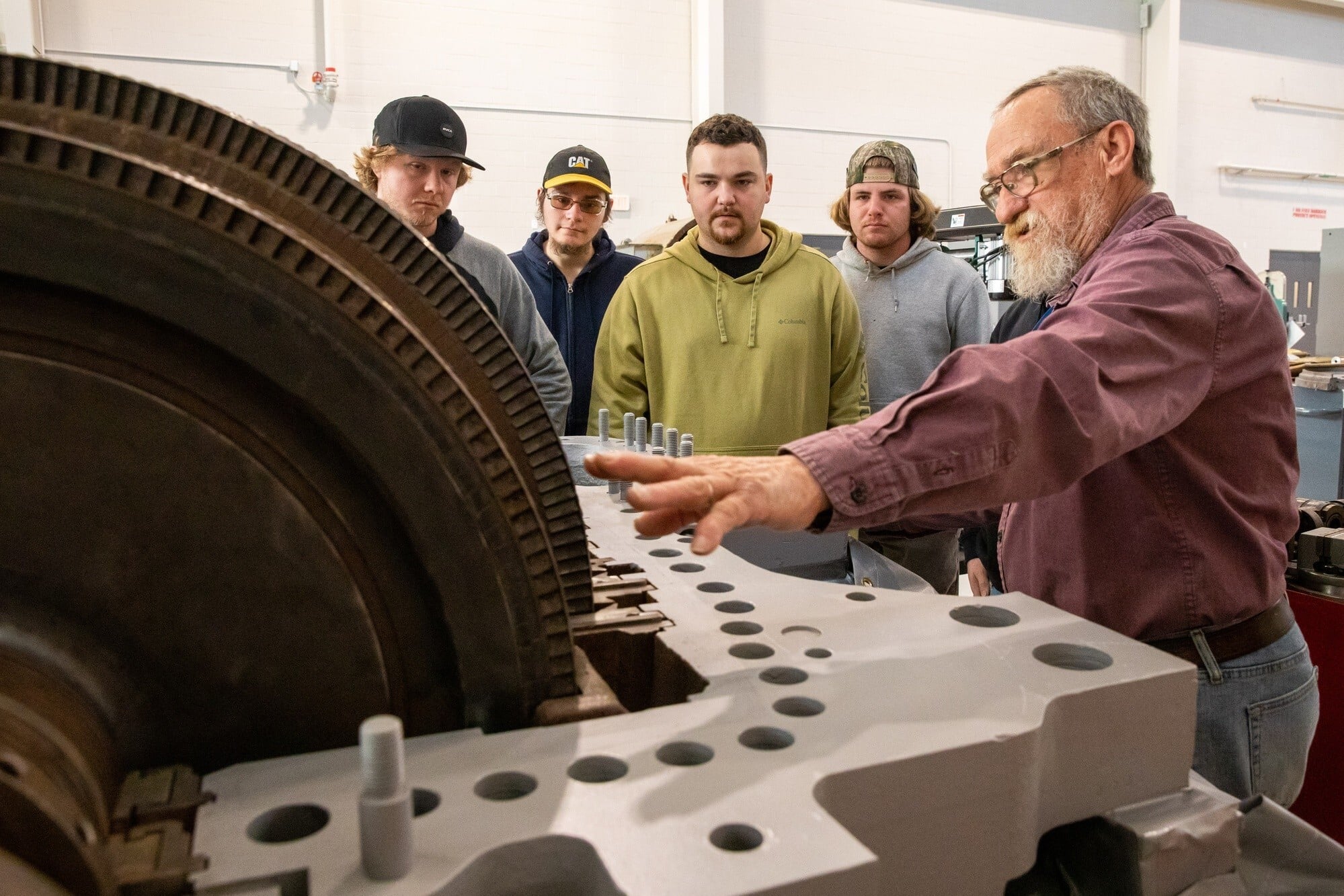
Michael Callanan described the old way of training an apprentice electrician in EC&M back in 2013. New entrants "spent four years literally holding the ladder and handing material to a journey-level worker," he wrote. Their job was "to observe, to assist the journey-level worker, and to wait for their turn to put their hands on the equipment and install the circuit." His next sentence was that apprentices "don't spend much time standing at the bottom of the ladder these days." Plenty of hands over fifty will tell you the year on the ladder is where they learned to see a job, and they have a point, because watching teaches. It takes a year, though, and at the end of it nobody can say exactly what got learned. What never did get solved is the time. Skilled trades mentorship costs a journeyman hours, and on a production schedule those hours were sold before the job started.
Indiana's apprenticeship office tells mentors on its guidance page that "80% of the apprentice's training" and most of their learning "will be accomplished on the job." An electrical apprenticeship typically runs about 8,000 hours of on-the-job training on either track, with the classroom hours on top. A NECA-IBEW training page describes a five-year program with more than 900 classroom hours and 8,000 on the job. ABC's Chesapeake Shores chapter says most of its apprenticeships last four years, or the equivalent of 8,000 supervised OJT hours, plus a minimum of 576 classroom hours, so the length depends on which program the apprentice is in.
Skilled Trades Mentorship on a Production Schedule
A mentoring plan that waits on a quiet afternoon will sit there, because the quiet afternoon keeps not showing up. Put it on the daily plan instead. One task to teach. A clear boundary around it. Enough time to watch a full repetition start to finish, and a date to look again. A full repetition is an offset laid out and bent, or a panel landed and torqued, start to finish. It is not a glance over the shoulder on the way to the next workfront.
Who you pair them with matters at least as much as any of this. On most crews there is somebody who talks the whole time they work, and somebody who says nothing and does clean work. Hand the first-year to whichever one does work you would sign your name to. If that is the quiet one, tell them the job now includes saying the decisions out loud, and most will once somebody asks. The talker is the easier pairing, and there is nothing wrong with going that way. Just remember that a first-year copies the hands well before the words sink in, so start with hands you trust.
Leon Gold, writing in the Training and Development Journal in 1981, traced the four steps to a wartime system for training factory hands in a hurry and listed them as "Prepare, Present, Try out, and Follow up." Under Try Out, the instructions read, "Have the learner 'talk through' the job," and even, "Have the learner instruct the supervisor on how the job is done." Under Follow Up, "Check progress frequently at first," and later, "Gradually taper off progress checks." Gold had a line for the foreman who says there is no time to train. "Ironically, supervisors who 'don't have time to train' are usually kept busy handling problems that wouldn't have occurred if employees had been instructed properly in the first place," he wrote.
Electrical crews already use the talk-through on the work where it counts. On a switching order or a crane pick, the critical part gets repeated back before anybody moves. Rey Gonzalez, owner and president of HOPE Consulting LLC, with 35 years in electrical generation, described the full loop for utility workers in Incident Prevention in 2016. The sender states the message, the receiver repeats the critical parts back, and the sender confirms. Messages "should be kept concise and focus on one action or task at a time," he wrote. He would rather hear right and wrong than correct and incorrect, "because 'incorrect' contains the word 'correct'" and a receiver who is already straining to hear can catch either one.
On the job the loop starts with the next thing the apprentice is cleared to do, which might be reading a print, pulling material for the day, bending an offset, ringing out a dead circuit with a meter, or marking up an as-built. When you can, pick what they are covering in class this term. If they bent conduit in class Tuesday and bend it on your job Thursday, the second one costs you almost nothing to teach. Ask what unit they are on.
Run it once at normal pace, so they see what good looks like and how long it is supposed to take. Go through it again slow and say out loud which decisions matter, what you are looking at when you make them, and what you would do if it came up wrong. They say the steps back to you before they touch anything. While they work, you stand where you can see their hands and can get to the disconnect, close enough that one word stops them before the next move. You will find yourself making two kinds of correction from that spot. If what you are watching is about to hurt somebody or wreck gear, stop it right then, hands off the work, and reset the task from the top. A crooked offset or a slow method can wait until the repetition is finished and the tool is down, and after that they get the one correction that matters most. Show it again if you have to. Put the next look on the calendar, on similar work, and write down what you saw.
"The point here is to avoid over-correcting or blaming too hastily," Gold wrote of that step. "The most constructive attitude assumes that mistakes at this early stage are at least as much the responsibility of the supervisor as the trainee."
Boundaries and the Apprentice to Journeyman Ratio
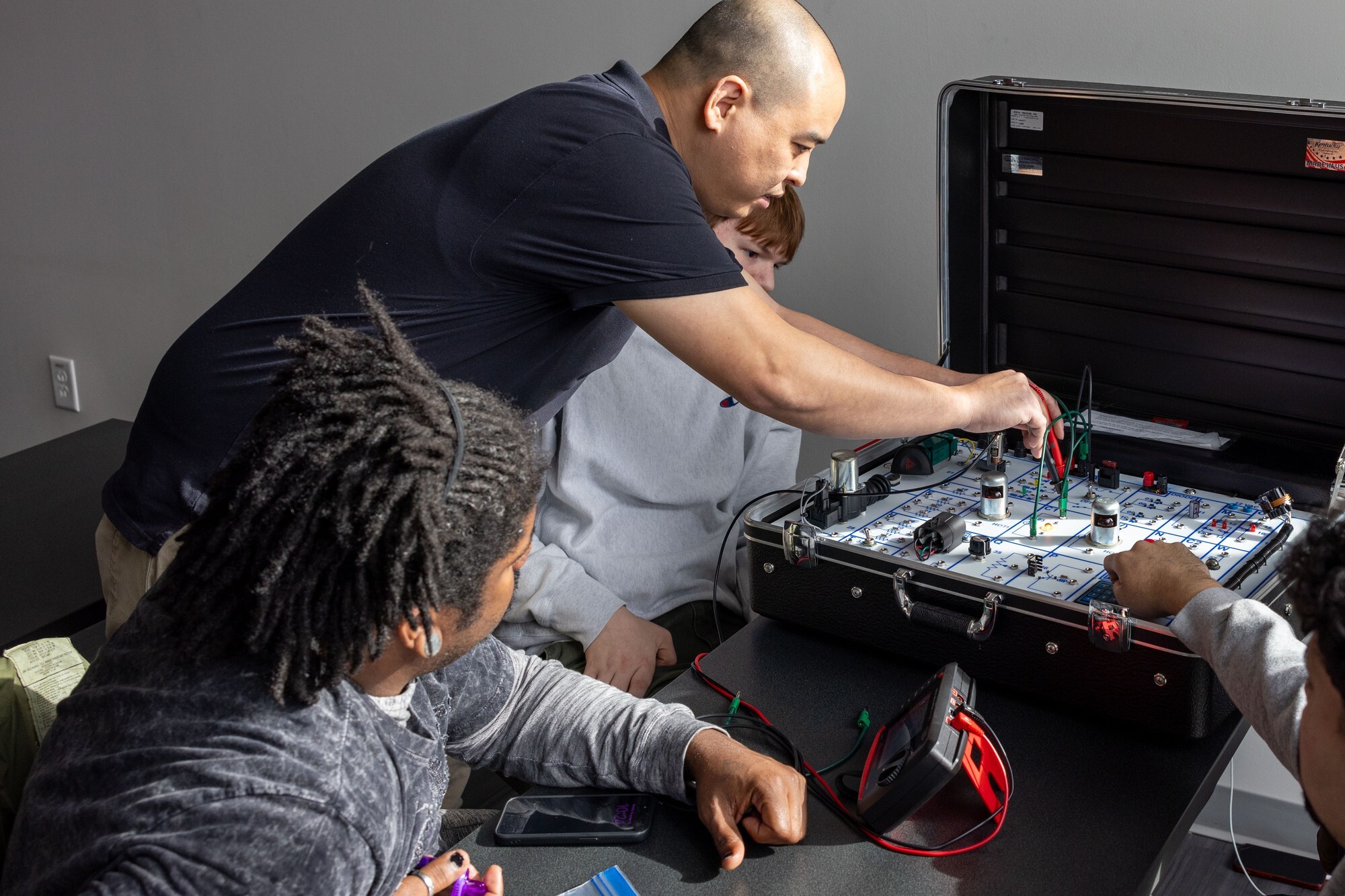
The task has to sit inside what the apprentice is cleared to do. The journeyman also has to be authorized to teach it. Line work and inside work are different trades. The boundary rule is the same on both, and the line side tends to put it in writing. Danny Raines spent 18 years as a lineman at Georgia Power, moved into safety, and retired after 40 years with the company. He is a Lineman's Hall of Fame inductee, and he wrote in Incident Prevention in 2024 that "Apprentices must not be allowed to perform tasks they have not been trained in." On climbing, he added that "Being qualified climbers does not mean they are proficient climbers, but OJT allows them to practice their climbing skills and gain more experience."
Some states write the ratio into law. Washington allows one non-certified individual for every certified master journey level electrician or journey level electrician. It also requires that supervising electrician on the same jobsite for a minimum of 75 percent of each working day. California's rule for electrician trainees puts each one under the direct, on-site supervision of a certified electrician who supervises no more than one trainee. In Oregon the default for construction trades is one apprentice to the first journey worker and one for every three after that, with the rule that "In no event shall an apprentice work without qualified journey worker supervision." Texas sets no number in the apprentice section of its Occupations Code, only that an apprentice works under the supervision of a licensed master electrician.
Your agreement and your program can set a tighter ratio than the state does. On an agreement job the number in the collective bargaining agreement is the one the crew works to, and some owners and GCs tighten it again in the contract. Whichever of those numbers is tightest governs the daily plan, and the teaching gets built on top of it. Worth knowing which one applies to your job before you pair anybody up.
OSHA's recommended practices speak to this kind of teaching directly. "Peer-to-peer training, on-the-job training, and worksite demonstrations can be effective in conveying safety concepts," the agency says, and it asks employers to provide additional training, as necessary, "whenever a worker is assigned a new task."
Making Room for Mentoring Apprentices in Construction
Hand a journeyman full production, the troubleshooting calls, and a first-year to teach, and you already know which of the three gets dropped. Mark the mentor and the task on the daily plan, on the same sheet where the manpower already lives. The PTP is a hazard sheet and stays one, but the crew is already standing together for it before the first tool comes off the truck, so that is where the line gets said out loud, the mentor, the task, and the boundary. That does not take a new form or a name for the program.
Nobody is going to hand you hours off the estimate for training. The production number came out of a bid that went out the door long before anybody knew the apprentice's name. You buy the teaching time out of repetition, and out of the slack early in a phase. Put the lesson on scope you are going to repeat anyway, a floor of identical homeruns, a run of fixture whips, a line of trapeze hangers, so the second and third unit absorb what the first one cost. Teach in week one of a phase, before the crew is fully loaded and the work gets tight, rather than week six.
Name a backup mentor, because sooner or later the first one gets pulled to another workfront. And give the apprentice a fallback task inside what they already know. Otherwise a missing mentor leaves them standing over half-finished work with a decision to make alone.
The locals that have built this out run it on a calendar. IBEW Local 3 in New York asks its members to sign up as mentors. A mentor there follows an apprentice from a TA-1 until they turn out, is required to meet with them at least monthly, takes their calls and talks with them weekly or more if they have questions, and attends a Training the Mentor class. NCCER publishes a curriculum for the same purpose, Mentoring for Craft Professionals, in print since 2016 at 12.5 recommended hours and online since 2024, written for "any craft professional taking on a mentorship role." Chamberlin, a roofing and waterproofing contractor, wrote this year that before it built a one-year mentor pairing program, "only 1 out of 4 new hires were still with the company 12 months after starting." Since 2022, it reports, new-hire retention has "increased by nearly 50%," and 91 percent of the people who finished its NCCER coursework in the past two years are still with the company.
Keep your own record short and about the work. The task, the standard you used, what they finished, what you corrected, and when you are looking again. It is for the next journeyman who gets them, and "not ready" tells that person nothing. Write "landed the branch circuit, missed the torque on two lugs, rechecked Friday" and they know where to start Monday. Keep it separate from the hour report the program wants, and whoever signs that report should read it first. Signing off hours in a category the apprentice did not actually work is a problem for everybody whose name ends up on that sheet, and most of all for the apprentice, whose standing in the program rides on that record. The sheet is easiest to sign honestly when the work has been written down all along.
What Craft Training Is Worth
The Construction Industry Institute studied craft training across the United States and Canada in 2007 and concluded that "each dollar invested in craft training can yield $1.30 to $3.00 in benefits." One heavy industrial contractor in that study tracked four projects over 15 months. Voluntary turnover ran 6.5 percent among workers with no training and 0.6 percent among workers who received it. The report also says that "Training on the job can be formalized through mentoring and through providing performance feedback to the trainee."
The Department of Labor's completion-rate dashboard, read in September 2026, puts construction apprenticeship completion at 44.61 percent for fiscal 2024, up from 39.84 percent in fiscal 2021 and higher in each of the last three years. A 2023 American Institutes for Research brief on completion rates cites Kelly and Wilkinson (2020), which identified lack of mentoring and on-the-job training as one of the top three most frequently reported non-financial challenges faced by apprentices in highway construction in Oregon.
Felicia Wiseman, a 20-year inside wireman out of Detroit Local 58 who now teaches pre-apprenticeship students at Randolph Career and Technical Center, said of those students, "They see that you care. It's a morale thing. They know that somebody is backing them." Darrin Golden, Senior Executive Assistant to the IBEW International Secretary-Treasurer when the union wrote about him in 2020, said of his own apprenticeship at Rockford, Ill., Local 364 that "having a mentor was still beneficial to me." Of the culture inside the trades and the IBEW, he added, "It's more than just the tricks of the trade, it's how we speak and relate to each other."
"The learning curve is continuous over the course of one's career," Raines wrote in a 2020 column on what makes a good trainer. "None of us will ever know it all." Pick the task at the next lookahead. Write it on the daily plan with the mentor's name, the boundary, the backup, and the date. If there is no room for it in the plan, bring that up at the same meeting.
Sources: EC&M, "Training the Electrical Workforce of Tomorrow," Michael Callanan (January 16, 2013); Indiana Department of Workforce Development, Office of Work-Based Learning and Apprenticeship, mentoring guidance; NECA-IBEW Electricians training page and Associated Builders and Contractors, Chesapeake Shores Chapter, apprenticeship and craft training page (8,000 OJT hours); Leon Gold, "Job Instruction: Four Steps To Success," Training and Development Journal (September 1981), via ATD; Rey Gonzalez, "Three-Way Communication for Utility Workers," Incident Prevention (May 20, 2016); Danny Raines, "Apprentice Development Programs: What Should be Included?" (June 17, 2024) and "Voice of Experience: The Need for Seasoned Industry Trainers" (April 13, 2020), Incident Prevention; RCW 19.28.161 (Washington); 8 CCR 296.3 (California); OAR 839-011-0143 (Oregon); Texas Occupations Code 1305.161; OSHA, Recommended Practices for Safety and Health Programs, Education and Training; IBEW Local 3 Mentor Program page; NCCER, Mentoring for Craft Professionals; Chamberlin Roofing & Waterproofing, "From Learner to Leader: The Unique Way Chamberlin Creates Construction Leaders" (August 6, 2026); Construction Industry Institute, Research Summary 231-1 (August 2007); U.S. Department of Labor, Office of Apprenticeship, Apprentice Completion Rate Analysis dashboard (read September 2026); American Institutes for Research, "Improving Apprenticeship Completion Rates" (October 2023), citing Kelly and Wilkinson (2020); IBEW, "Leveling the Playing Field: Pre-Apprenticeships Open Doors to the Middle Class" (February 12, 2020). Featured photo: Shelby West, Norfolk Naval Shipyard, via DVIDS (public domain); the appearance of U.S. Department of Defense visual information does not imply or constitute DoD endorsement