
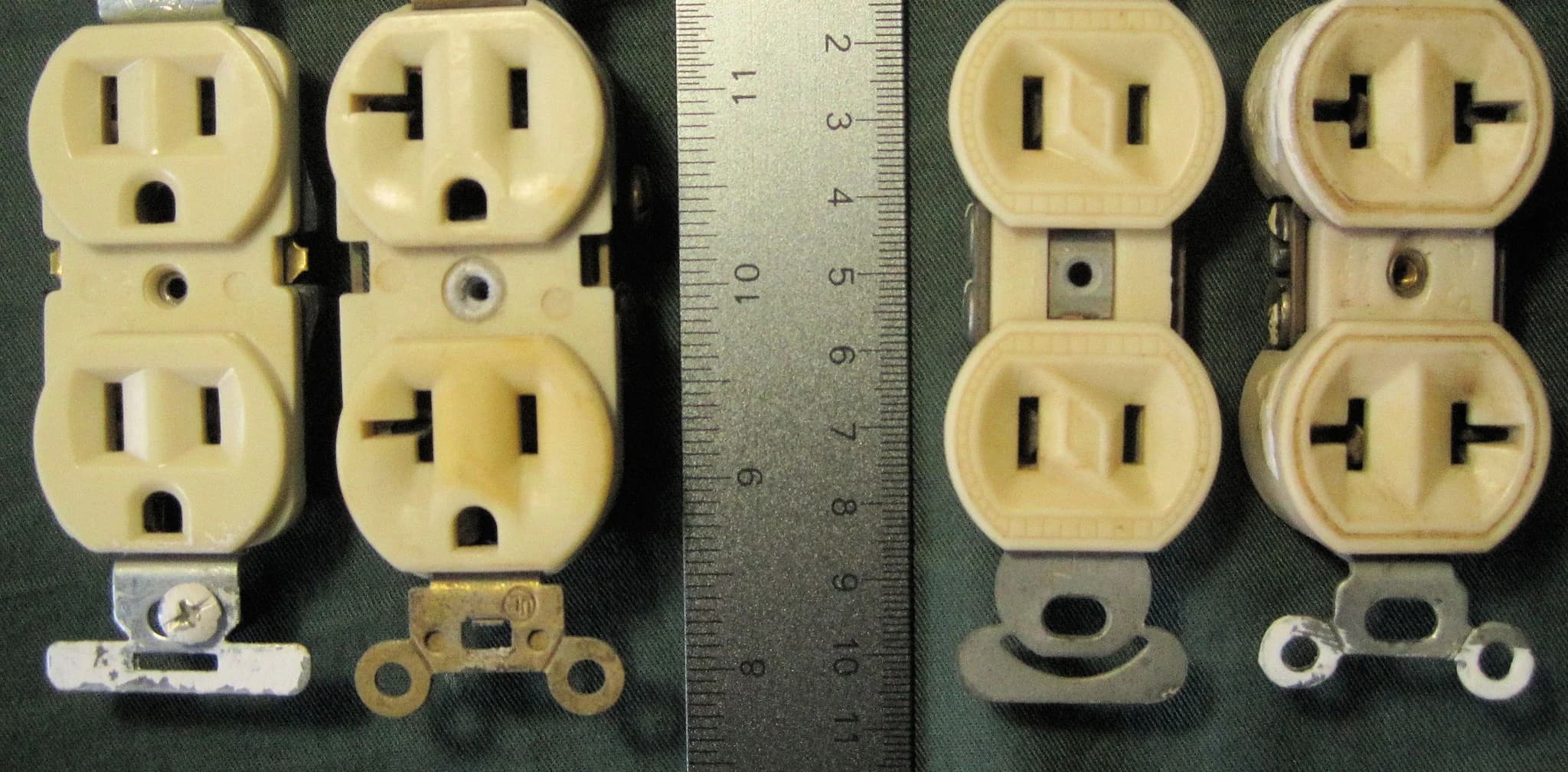
Pick up a NEMA 5-20 plug and look at the blades. The hot blade stands straight up, as on a NEMA 5-15. The neutral blade is turned sideways, 90 degrees from the hot blade.
A 15-amp receptacle has two straight slots. The sideways blade has nowhere to go. A 20-amp receptacle, the NEMA 5-20R, typically has a T-shaped neutral slot, a notch off the side of the straight slot, and it takes either plug.
So a 15-amp plug fits most 20-amp outlets, and a 20-amp plug will not fit a 15-amp outlet.
OSHA writes the one-way fit into its rules. Its construction standard, 29 CFR 1926.405(j)(2)(i), bars any receptacle from accepting a plug of a different voltage or current rating. Its one exception is that "a 20-ampere T-slot receptacle or cord connector may accept a 15-ampere attachment plug of the same voltage rating." The National Electrical Code has the same rule as 406.8, Noninterchangeability, in the 2023 edition.
Randy Hunter, a master electrician who then co-owned Hunter Technical Services, says in IAEI Magazine (December 2, 2014) that each application will have "a unique design intended to prevent the misapplication of devices, such as mixing of voltages or amperages."
Can you plug a 5-15 into a 5-20?
Yes. Both are 125-volt devices. The sideways blade is the visible difference between a NEMA 5-20 plug and a 5-15.
On a circuit with two or more receptacles, 2023 NEC Table 210.21(B)(2) caps the cord-and-plug load on any one receptacle at 80 percent of its rating, which works out to 12 amps on a 15-amp receptacle, 16 on a 20 and 24 on a 30. Russell B. Swanson, then director of OSHA's Directorate of Construction, says the same in a June 12, 2000, interpretation letter: "If more than one 15 ampere receptacle is on the circuit, the maximum allowable load on the receptacle would be 12 ampere."
How to read a NEMA number
The shapes come from a NEMA standard, ANSI/NEMA WD 6, which sets the configuration of each plug and receptacle.
The number before the hyphen names the configuration family. A 5 is 125 volts, two-pole, three-wire grounding, and a 6 is the same at 250 volts. A 14 is 125/250 volts, three-pole, four-wire grounding. The number after the hyphen is the amp rating. R means receptacle and P means plug. An L in front marks a locking device with curved blades, as in L5-20.
What the NEC says about a 20-amp receptacle on a 15-amp circuit
The NEC's own summary table lists the receptacle rating on a 15-amp circuit as "15 max." That is Table 210.24 in the 2023 edition and Tables 210.24(1) and (2) in NFPA's 2026 second draft. OSHA's Table K-4, under 29 CFR 1926.404(b)(2)(ii), also reads "Not over 15" for a 15-amp circuit. For circuits with two or more receptacles, NEC Table 210.21(B)(3) lets a 20-amp circuit use 15- or 20-amp receptacles.
The 2023 edition changed the wording on the 15-amp row. Through the 2020 NEC, ratings had to conform to the table, and that row read "Not over 15." The 2023 NEC says "not less than," so read literally, 210.21(B)(3) no longer bars a 20-amp receptacle on a 15-amp multi-outlet circuit.
In a public comment filed August 28, 2024, Douglas Hansen, a former supervising plans examiner for the City of Santa Clara, asked NFPA to restore the old wording in the 2026 edition. The configuration of a 20-amp receptacle is meant "to restrict their use to circuits capable of supplying the load that necessitated the use of a 20-amp attachment plug," he says in that comment. Code-Making Panel 2 rejected it, and NFPA's second draft for the 2026 edition kept the 2023 wording of 210.21(B)(3).
Swapping a 15-amp outlet so a 20-amp plug fits
Putting a 20-amp receptacle on a 15-amp circuit does not change the breaker or the wire. The breaker is still 15 amps, and the T-slot now lets a 20-amp plug onto that circuit. Which edition of the NEC is in force where you live depends on your state or city, and your local inspector can tell you.
Filing down the sideways blade defeats the design. The Electrical Safety Foundation International says never to force a plug into an outlet or cut off a ground pin to make one fit.

Locking plugs and GFCI on a job site
Temporary power often runs on locking plugs. You push the curved blades in and twist, and a tug on the cord will not pull it out. NEMA's Wiring Devices FAQ (WD 11-2023) says locking devices "are often used in construction and industrial applications to minimize unintended disconnects." They include L5-20 and L5-30 at 125 volts, L6-30 at 250 volts with no neutral, L14-30 at 125/250 volts four-wire, and L21-30 at 120/208 volts three-phase wye, four-pole, five-wire grounding.
In the same June 12, 2000, letter, a German power-tool company asks whether a drill with a 20-amp locking plug and a rated load of 15 amps or less can use an adapter on a 15-amp receptacle. "We are not aware of any 20 ampere to 15 ampere adapters approved by a NRTL," Swanson says. He also says that drill needs "a circuit with a minimum capacity of 20 ampere." NEMA's 2023 FAQ says NEMA has no adapter standard, though a suitable adapter may be sold.
Under 29 CFR 1926.404(b)(1)(i), the construction employer picks ground-fault circuit interrupters or an assured equipment grounding conductor program, and the GFCI paragraph, (b)(1)(ii), covers "All 120-volt, single-phase, 15- and 20-ampere receptacle outlets on construction sites, which are not a part of the permanent wiring of the building or structure and which are in use by employees."
The NEC's temporary-power rule also covers 30-amp receptacles. In the 2023 edition, 590.6(A)(1) requires GFCI protection for 125-volt, single-phase, 15-, 20- and 30-ampere receptacle outlets that are not part of the permanent wiring and are in use by personnel, and NFPA's second draft numbers it 590.7(A)(1). By that wording, a 125-volt L5-30 needs it.
The 10-30 and 14-30 dryer receptacles
Older houses still have the 10-30. It is three-pole, three-wire, 125/250 volts, with no ground pin, and the neutral also grounds the dryer frame. The 14-30 is three-pole, four-wire grounding.
Mark Cook, an electrical education specialist at Faith Technologies, says in The Daily Reporter (May 27, 2022) that the Code was revised in 1996 to require a separate equipment grounding conductor on home dryer and range circuits. He says the old arrangement survives only in existing installations, where you may not bootleg an equipment ground (jumper the neutral to the ground terminal) at the box. In the 2023 NEC, 250.140(B) lets a dryer frame on an existing branch circuit go to the neutral only under conditions that include a neutral of at least 10 AWG copper or 8 AWG aluminum.
Sources: OSHA, 29 CFR 1926.404 and 1926.405 (eCFR, current through October 19, 2026); OSHA standard interpretation letter signed by Russell B. Swanson, Directorate of Construction, June 12, 2000; Randy Hunter, "Article 406: Receptacles, Cord Connectors, and Attachment Plugs," IAEI Magazine, December 2, 2014; NFPA, NFPA 70 2026-cycle Code-Making Panel 2 second draft public comment responses (Public Comment by Douglas Hansen, August 28, 2024) and second revision statements on Table 210.24; NFPA, Code-Making Panel 3 first and second draft reports (590.6 and 590.7); NFPA, Code-Making Panel 5 second revision statements for the 2023 NEC (250.140); Mike Holt Enterprises, 2026 NEC Changes seminar outline (Utah continuing education filing); Charles R. Miller, "The Code in Focus: Article 210, Branch Circuits," Electrical Contractor, December 15, 2001; Mike Holt, "NEC Requirements for Branch Circuits," EC&M, February 24, 2025; NEMA Standards Store listing for ANSI/NEMA WD 6-2026, Wiring Devices, Dimensional Specifications (retrieved October 21, 2026); ANSI/NEMA WD 6-2016 configuration charts; NEMA, WD 11-2023 Wiring Devices Frequently Asked Questions; Electrical Safety Foundation International, Extension Cord Safety Tips; Wikipedia, "NEMA connector" (revision of September 15, 2026); Mark Cook, "3-Wire or 4-Wire? Dryer and Cooking Unit Circuits," The Daily Reporter, May 27, 2022; Ethan Duran, "Wisconsin enacting new residential electrical codes in the fall," The Daily Reporter, June 10, 2026; Abrams Books, Douglas Hansen author biography, Code Check 10th edition page (retrieved October 21, 2026). Featured photo: Yak99 / Wikimedia Commons (public domain, cropped).