
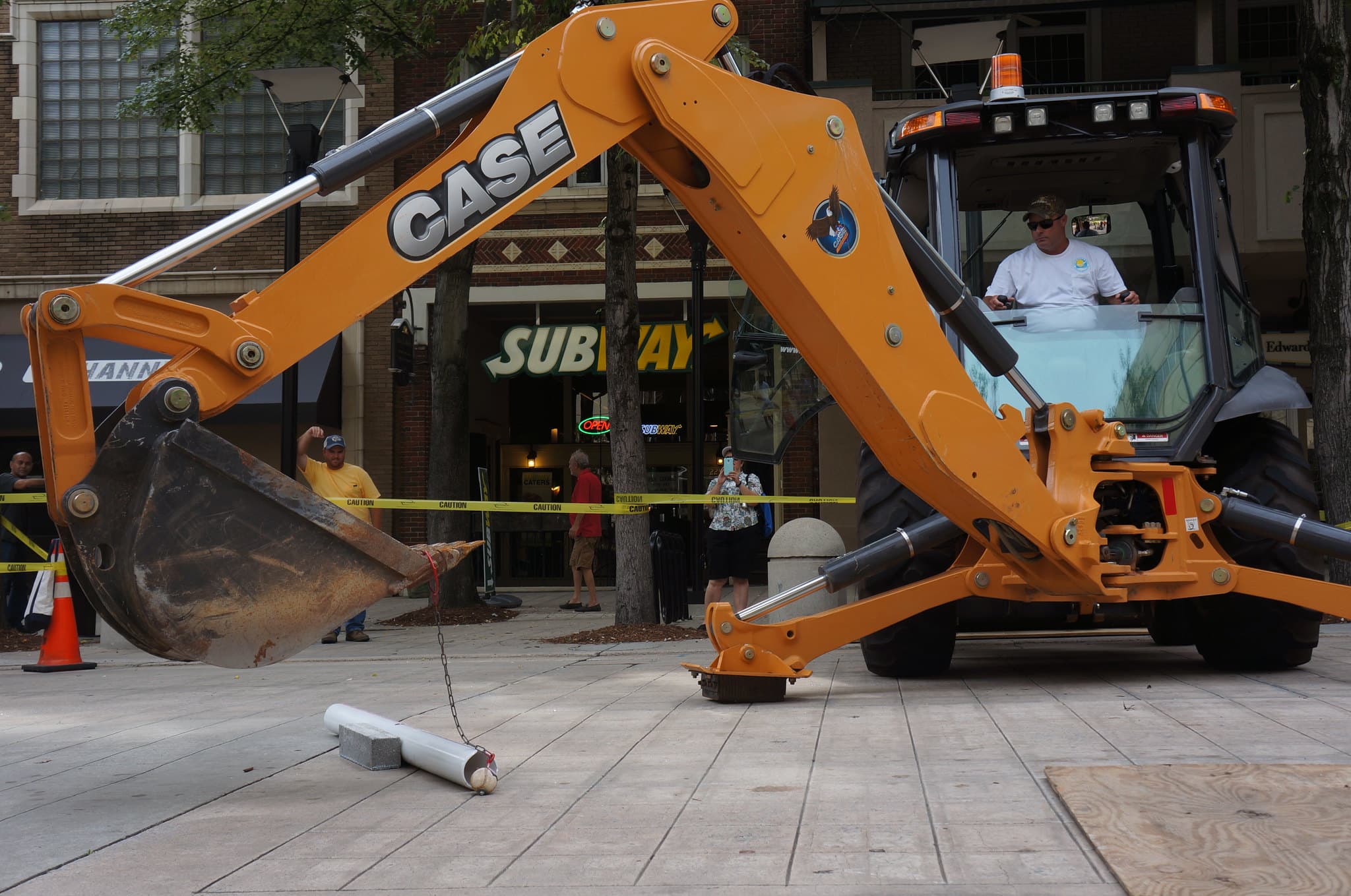
A plastic spoon duct-taped to the bucket of a backhoe, a raw egg on a pile of sand, and one job: scoop it up, swing it across the yard, and set it down unbroken in a nest built from straw and a spare tire. That was the crowd-pleaser in May 2018, when the public works department in Waynesville, North Carolina held its first equipment rodeo. The winner, Nathan Carver, summed up the problem: "You're fighting sand that moves on you, a round egg that rolls, and a flexible spoon." Another competitor accidentally launched his egg across the lot and asked the judges for points on distance.
A backhoe is built to rip a trench through hardpan and load trucks by the yard. A raw egg gives up at about ten pounds of force. That gap is the whole game, and it is the premise of the excavator egg challenge, the trade's favorite public test of what a heavy machine can do when the operator has real touch.
Ten Pounds of Force Against Thirty-Three Thousand
Put real numbers on it. A Cat 320, the classic twenty-ton-class excavator, weighs about 50,100 pounds, and at full curl its bucket digs with roughly 33,700 pounds of force. A 2025 study in Communications Physics measured what a chicken egg can take before the shell fails under gentle compression: about 45 newtons, call it ten pounds.
Breakout force is the machine at full snarl. The egg asks for the opposite. The craft meters that same circuit down to almost nothing. Between what the bucket brings and what the shell takes, the gap runs about three thousand to one.
Where the Touch Actually Comes From
The joystick in an excavator cab does not move the bucket. On a pilot-control machine it opens a small pilot valve, which nudges a spool inside the main control valve, which meters how much high-pressure oil reaches the cylinder; newer machines do the same metering electronically. Move the stick a quarter inch and the spool barely opens; the oil trickles and tons of boom and stick creep along in slow motion. The skill lives in the first inch of stick travel, blending boom, stick, and bucket so nothing moves faster than you told it to. Operators call it feathering. Worn or cheap valves give you no zone to work in; the stick feels like a light switch, on or off, nothing in between. As the public works director in Waynesville put it while his crews chased the egg: "You have to know how much pressure to apply on those backhoe controls."
The feel gets built one hour at a time. Ask an operator how good someone is and the answer comes back in seat time, because there is no other unit that counts. Nobody asks what school you went to.
The Excavator Egg Challenge Is Older Than the Internet
The egg has been the trade's party trick for decades. On the 1992 TV show You Bet, UK trade press reported, Cat demonstrator Alan Dennis worked a brand-new 320L blindfolded, guided only by a colleague's voice, and cracked five eggs sitting in glasses with a bucket tooth without breaking a single glass. Three minutes on the clock.
The county circuit kept the tradition honest. At the Weber County Fair in Ogden, Utah, about twenty operators ran an egg-drop event with a tiny spoon fitted to a backhoe. New Zealand's national excavator competition, running for more than thirty years, has featured an egg scoop among its challenges; in the 2025 field, one competitor reported, "Only two of the guys got it." Then the internet found the game and named it the eggxcavator challenge: pluck a raw egg off a bottle with a full-size machine and set it on another, shell intact. Guinness has certified stranger versions of the same touch, including a Chinese operator who, at a TV event in Italy, flicked fifteen caps off a person's head with an excavator bucket in one minute.
It looks like a stunt, but it is the same discipline that grades a road so water runs where it should, or sets a trench box without scarring the walls.
The World Final Skips the Egg for a Harder Test
At the top of this sport sits the Caterpillar Global Operator Challenge, the biggest heavy equipment operator competition there is. The latest edition drew thousands of operators from more than 40 countries through dealer events before cutting the field to nine finalists in Las Vegas in March 2026. The excavator stage there traded the egg for an uglier problem: thread a corrugated pipe into a slightly larger pipe, then place a manhole cover, with the machine working at full reach.
The man who won it is Brian Hayden, a 24-year-old from Wells, Maine who works at his family's excavation and welding outfit. "I almost dropped the pipe at the end, but I got it in just as I was losing it," he said afterward. He took two of the three stages, which made him the first American world champion in the event's history and $10,000 richer. One of the two was the dozer event, a different animal from an excavator, blade and grade instead of boom and swing, and he won it on maybe 100 to 150 lifetime hours in that seat. His summary of the craft is the best on record: "There is no way to learn this by reading. You physically need to be in the seat."
How Hard Is It to Operate an Excavator, Really?
Honest answer: easy to move, brutal to master. Both hands run separate joysticks, and boom, stick, bucket, and swing are usually moving at once, each on its own circuit, while the whole house, cab and all, swings on top of the tracks. Your hands learn it before your head does. An entry course can have a new operator moving dirt safely in 80 to 120 hours. A union apprenticeship runs about four years at roughly 1,500 on-the-job hours per year before the trade turns you out as a journeyman. The distance between those two numbers is the distance between moving dirt and the egg.
And the culture is clear about which one counts. The forum wisdom repeats on every thread: smooth beats fast. The operator who never looks hurried gets more done by quitting time than the one who beats on the machine every cycle.
The Egg Is Really a Job Interview
Waynesville's public works director gave away the real reason after watching his crews sweat over a chicken egg: "After today, I know exactly who I want digging beside a fiber line."
That is what the game has always measured. The US runs about 539,500 construction equipment operators, median pay $58,320 a year, with roughly 46,200 openings a year expected over the next decade. On a live job site the egg is a gas main, a fiber run, a foundation wall, a coworker's trench box, and the ones every contractor fights to keep are the ones with the touch. It is the first thing worth testing when an operator joins a crew, which is why crews hiring for heavy equipment operator skills screen for feel before anything else.
Twenty tons will tell on you every time. The egg either rides home in the nest, or it doesn't.
Sources
- Backhoe rodeo, by Becky Johnson, The Mountaineer (Waynesville, North Carolina), May 23, 2018, for the Waynesville backhoe rodeo.
- 320 Hydraulic Excavator, specifications page, Caterpillar, December 2025 version of the product page.
- Challenging common notions on how eggs break and the role of strength versus toughness, by Antony Sutanto and colleagues, Communications Physics, May 8, 2025, for the egg-strength figures.
- Eggs less likely to crack when dropped side-on, research reveals, Phys.org, May 8, 2025, reporting the same study.
- Can you crack an egg with a Cat excavator? You Bet you can, The Digger Blog, The Construction Index, February 29, 2012, for the 1992 You Bet feat.
- Contestants bring delicate touch to Backhoe Rodeo at Weber County Fair, by Andreas Rivera, Standard-Examiner, August 8, 2013 (archived copy; the original page is no longer online), for the Weber County Fair backhoe rodeo.
- The women competing to be crowned first female top National Excavator Operator, RNZ, March 13, 2025, for the New Zealand National Excavator Operator Competition.
- Guinness World Records, excavator cap record, 2022.
- Caterpillar Elevates Skilled Trades Through Global Technician and Operator Challenges, Caterpillar via PR Newswire, March 4, 2026, for the 2026 Global Operator Challenge.
- The Secrets to Becoming a World Class Equipment Operator with Brian Hayden, CONEXPO-CON/AGG, June 15, 2026, for Brian Hayden's quotes and seat time.
- Brian Hayden Crowned CAT's Global Operator Champion, Milton CAT, March 6, 2026.
- Brian Hayden Wins Cat Global Operator Challenge, by Craig Mongeau, Construction Equipment Guide, March 6, 2026.
- Hoisting & Portable Operating Engineer, International Union of Operating Engineers, accessed September 27, 2026, for the length of the apprenticeship.
- Apprenticeship Training, International Union of Operating Engineers, accessed September 27, 2026.
- Construction Equipment Operators, Occupational Outlook Handbook, U.S. Bureau of Labor Statistics, 2024-34 edition with May 2024 wage data (the page moved to the 2025-35 edition on August 27, 2026), for 539,500 jobs, the $58,320 median and 46,200 annual openings.
Featured photo: downtown backhoe rodeo, Greenville, South Carolina (Greenville Daily Photo via Flickr, CC0 public domain).