
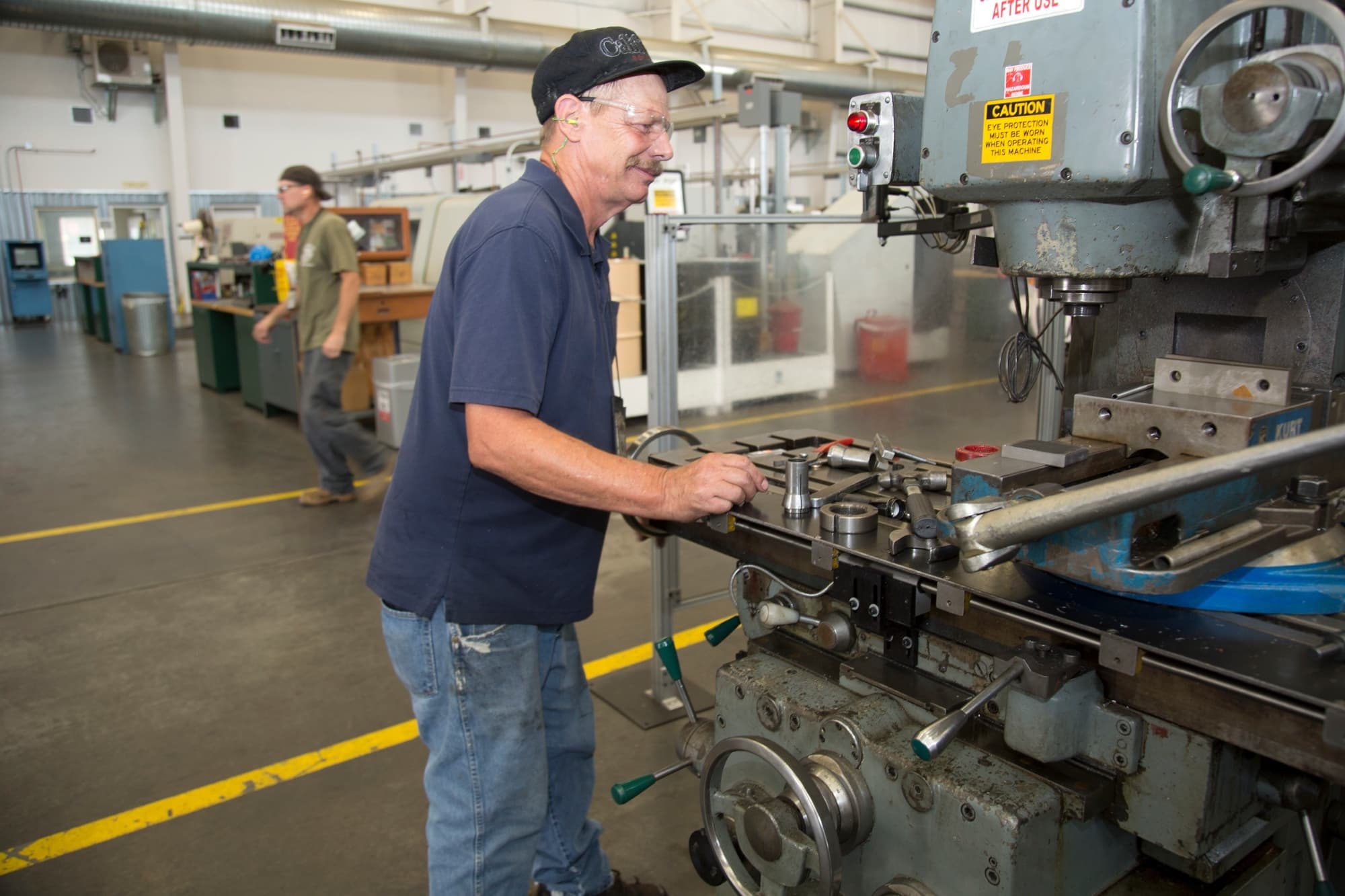
Plenty of manufacturing plants already work around the clock. Construction crews mostly don't. On Sep 24, 2026 the Bureau of Labor Statistics reported that 15.3 percent of manufacturing wage and salary workers held non-daytime schedules in 2024 and 2025, against 3.1 percent in construction, and most of that construction share (2.2 points) was irregular hours, not evening or night work. So when a plant project adds a second or third shift, the plant is used to nights and the contractor usually is not.
The usual mistake is copying the day headcount onto nights and leaving the support behind. Eight electricians at 2 a.m. with no one who can release an area, answer a drawing question or witness a test will spend much of the shift waiting.
Hanford staffed its night support roles by name
One of the few detailed public accounts of a construction night shift comes from a waste-treatment plant. It is not a factory. The problems are the same ones a factory expansion runs into. At the Hanford Waste Treatment and Immobilization Plant in Washington, the U.S. Department of Energy reported in October 2019 that just under 250 people worked nights, about a tenth of the day workforce. Construction nights ran from 6 p.m. to 4 or 4:30 a.m.
The night crews had a small support staff of superintendents, field engineers, startup engineers, a construction technician, health and safety personnel, an administrative assistant and quality assurance personnel. DOE's article says limited access to even that staff created challenges. Use that list as a check on your own night packages. For every package, write down who answers for area access, a drawing that doesn't match the field, a missing fitting or meter, an inspection point and a safety concern, and whether that person is on site or reachable by phone at 2 a.m.
"There are fewer resources available to us, so we have to come together to answer questions and work through the issues we encounter," says Bobby Campbell, electrical superintendent on the plant.
Eric J. Klein, a vice president at Long International, says in a 2022 article on commissioning and startup that because most systems run 24x7 once they are energized, "the night shift should be appropriately staffed with engineering support."
Hanna measured the loss on 26 projects
A University of Wisconsin-Madison team led by Awad Hanna measured shift work in a 2005 study of 26 projects in 15 states, all from mechanical and sheet-metal contractors, some of them on manufacturing and industrial jobs. Productivity ran from an 11 percent gain to a 17 percent loss. Where a project fell in that range tracked how much of the budgeted work (1 to 50 percent of total manhours) went to a second shift. The paper cites Penkala's 1997 list of why shifts go wrong. Most items on it are management problems. There is no single point of responsibility for progress and quality, procedures differ between shifts, and nobody above the crew makes timely decisions outside regular business hours.
Electrical numbers exist, though only second-hand inside the same paper. Haneiko and Henry reported a 24 to 37 percent drop in production rate when electrical work was double-shifted for a year. The size of the drop varied by commodity. Hanna's team cautions that overtime may have been mixed in. High Bridge Associates, whose 2017 reference document reproduces the paper, says its own experience points to roughly a 15 percent hit from a second shift.
Industry contacts gave Hanna's team a list of fixes. The first-shift foreman stays one to two hours late and the second-shift foreman comes in one to two hours early. Night work is kept independent of day work, with its own materials and tools. Scope is small and well defined and needs little engineering support. Material needs are kept minimal, because most supply stores are closed on second and third shifts. And there is enough artificial light to work by.
That last one has numbers. OSHA 29 CFR 1926.56, Table D-3, sets 5 foot-candles for general construction area lighting and 10 foot-candles for general construction plant and shops, a category that includes mechanical and electrical equipment rooms and active store rooms.
Turnover starts at 4 p.m.
"Our superintendents come in at 4 p.m. to do turnover with the day shift," says Kelly Lofton, night shift superintendent for Bechtel National. "We have to work with the day shift to make sure that we both have what we need and that we're supporting each other."
According to DOE's article, that turnover settles work scope and open questions and puts the right materials and equipment in hand before work begins, because getting them later can be hard. Put a decision cut-off on it. By the time day leaders leave, each night package is released, swapped for a prepared alternate or held.
How often you hand off is also a choice. High Bridge Associates counts 10 shift changes in 5 days on a day and night 5x8 pattern, against 2 changes in 8 days when crews alternate 4x10s.
A thinner crew can reach work the day shift can't
"Fewer people working can be a benefit," Tracey Hagood, piping superintendent for Hanford's Effluent Management Facility, told DOE in 2019. "During the day, two or three crews would have to stop working if we wanted to move a lift or large piece of equipment."
Hanna, writing in Electrical Contractor in 2004, found no efficiency loss at 191 square feet per worker and a 50 percent loss at 90 square feet, and recommended a second shift, if possible, to relieve stacked trades. At Hanford, a 2017 DOE Enterprise Assessments review found most electrical cable pulling was done on the night shift, when there was less interference from other crafts. Assessors and site electrical inspectors watched two night pulls. In one, electricians pulled seven cables by hand through a single conduit, all at once, because there was not enough room in the conduit to pull them one at a time. It went without incident.
Locks and fire watches run past the shift change
Under 29 CFR 1910.147(f)(4), specific procedures must be used at shift or personnel changes to keep lockout or tagout protection continuous, including an orderly transfer of devices between off-going and oncoming employees. Paragraph (e)(3) says each device is removed by the employee who applied it. The exception, for when that employee is not available, requires an employer procedure that starts with verifying the employee is not at the facility and making all reasonable efforts to reach him. A night lead can't clear a day electrician's lock just because the package is ready.
Christopher Coache, senior electrical engineer at NFPA, says in a 2022 NFPA blog post that if contractors may use their own lockout procedures, the program has to settle whose procedure is followed and who trains the affected employees, and someone has to review the contractor's procedure against the facility's. Construction work inside a plant may fall under Part 1926 instead of 1910, so confirm which part covers the job before writing the handoff procedure.
Hot work has the same problem. The NFPA hot work fact sheet says NFPA 51B requires the fire watch to stay on site for at least 60 minutes after the work ends. OSHA 1910.252(a)(2)(iii)(B) sets at least a half hour. Welding that stops at 3:50 a.m. needs someone watching after the crew is gone.
Fatigue belongs in the schedule
OSHA's worker fatigue page puts accident and injury rates 18 percent higher on evening shifts and 30 percent higher on night shifts than on days, and cites research tying 12-hour days to a 37 percent higher injury risk. The NIOSH work-hour training, written for nurses, says shifts of 8 hours or less are better tolerated in the evening and at night, and it recommends one or two full days of rest after five 8s or four 10s. The next page of the module cites a recommendation of at least 11 hours between shifts and says forward rotation, day to evening, is easier to adjust to than backward.
"It's a different lifestyle," Lofton says. "Family balance can be difficult because you're sleeping when everyone else is awake. You have to have the support of your family and you have to watch your vitamin D levels."
Price the premium and the support together
The U.S. Department of Labor says the Fair Labor Standards Act does not require extra pay for night work, so the premium comes from the agreement. IBEW Local 11 in Los Angeles is one example.
| Shift | Start time | Premium | Hourly rate |
|---|---|---|---|
| Day | 5:00 to 9:30 a.m. | Straight time | $65.00 |
| Swing | 9:31 a.m. to 7:59 p.m. | 17.3% | $76.25 |
| Graveyard | 8:00 p.m. to 4:59 a.m. | 31.4% | $85.41 |
Those rates expired with the 2023 to 2026 agreement on Jun 30, 2026, so pull the current bulletin from Local 11's contracts and wages page before pricing nights. The table is there to show the size of the differential, 17.3 percent for swing and 31.4 percent for graveyard. Hanna's paper lists the other added costs of a shift as administration personnel, supervision, quality control, safety and lighting, on top of the shift differential. If you are deciding between nights and longer days, run the overtime math first.
Supplemental labor adds another handoff. OSHA's Bulletin No. 15 for construction says the host employer should give the staffing agency all task assignments, written job descriptions, the job hazard analysis and a list of equipment and machinery on the site. The two have shared responsibilities, and the bulletin says neither can discharge or subcontract its legal responsibilities to another party. "The key is communication between the agency and the host," says OSHA's Protecting Temporary Workers page. The same planning applies when you are staffing a plant expansion without draining the maintenance team.
"If we can complete a job at night and the day shift comes in and asks, 'Wait, when did that get done?' then I consider that a win," Lofton says.
Sources
- Hanford's Waste Treatment Plant Night Shift Key to Success, U.S. Department of Energy Office of Environmental Management, Oct 22, 2019.
- Assessment of the Hanford Site Waste Treatment and Immobilization Plant Construction Quality, U.S. Department of Energy Office of Enterprise Assessments, Aug 2017.
- Construction Productivity Impacts due to Extended Work Weeks, Shift Work, and Fatigue (including Hanna, Chang, Sullivan and Lackney, Shift Work Impact on Construction Labor Productivity, 2005), High Bridge Associates, 2017.
- The Stacking of Trades, Awad S. Hanna, Electrical Contractor, Aug 15, 2004.
- Job Flexibilities and Work Schedules, Table 7, U.S. Bureau of Labor Statistics, Sep 24, 2026.
- Commissioning and Start-Up, Eric J. Klein, Long International, Feb 18, 2022.
- 29 CFR 1910.147, The control of hazardous energy, Occupational Safety and Health Administration, accessed Sep 29, 2026.
- A Better Understanding of NFPA 70E: Setting Up an Electrical Safety Program (Part 4, Lockout), Christopher Coache, NFPA, Jul 11, 2022.
- Hot Work Safety Fact Sheet, NFPA, Apr 2021.
- 29 CFR 1910.252, General requirements (welding, cutting and brazing), Occupational Safety and Health Administration, accessed Sep 29, 2026.
- 29 CFR 1926.56, Illumination, Occupational Safety and Health Administration, accessed Sep 29, 2026.
- Long Work Hours, Extended or Irregular Shifts, and Worker Fatigue: Hazards, Occupational Safety and Health Administration, accessed Sep 29, 2026.
- NIOSH Training for Nurses on Shift Work and Long Work Hours, Module 5, page 5, National Institute for Occupational Safety and Health, reviewed Mar 31, 2020.
- NIOSH Training for Nurses on Shift Work and Long Work Hours, Module 5, page 6, National Institute for Occupational Safety and Health, reviewed Mar 31, 2020.
- Night Work and Shift Work, U.S. Department of Labor, accessed Sep 29, 2026.
- Labor Relations Bulletin, Inside Wiremen's Agreement, rates effective Jan 26 to Jun 30, 2026, IBEW Local 11.
- Contracts & Wages, IBEW Local 11, accessed Sep 29, 2026.
- Temporary Worker Initiative Bulletin No. 15: Construction Industry Employment, Occupational Safety and Health Administration, May 2025.
- Protecting Temporary Workers, Occupational Safety and Health Administration, accessed Sep 29, 2026.
Featured image: Keith Hayes, via DVIDS (public domain).